Garlic and Medications: What the Studies Cover
Search for garlic and medication and you will find a confident list of warnings, most of them pointing at the same few studies. Those studies are worth reading closely, because the first thing they reveal is that nearly all of them were about garlic you swallow: caplets, extracts, supplements. We sell a garlic essential oil for external, aromatic use, so we read this research as a map of what is known, and where it ends.
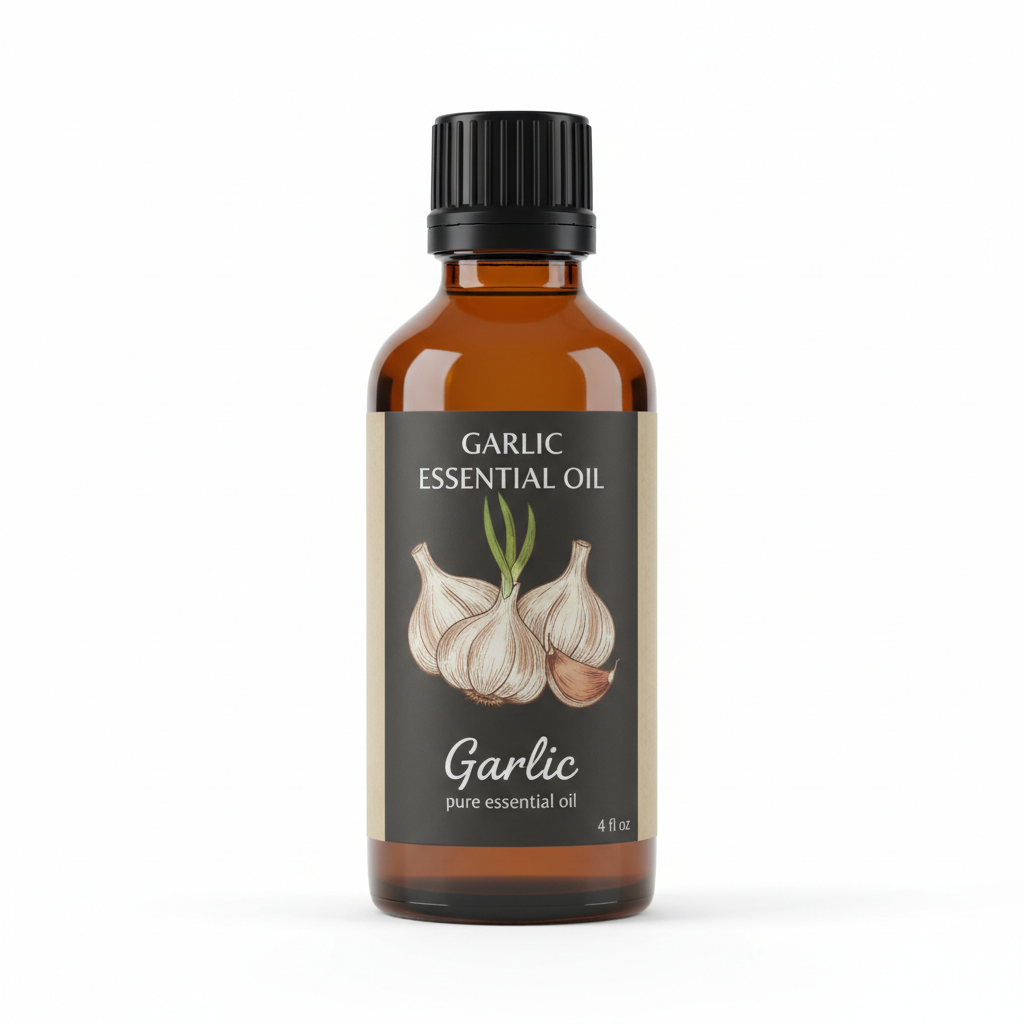
Garlic Essential Oil
Our own Garlic Essential Oil, in sizes from 0.5 oz to bulk.
From $10.99
Shop Now →Start with the question "which garlic?"
Raw cloves, aged garlic extract, garlic powder caplets and a distilled essential oil are four different materials. They contain different mixtures of sulfur compounds, and they reach the body by different routes. A result from a pill taken twice a day for weeks tells you something real about that pill. It does not automatically carry over to a diluted oil on the skin, and it does not automatically stop applying either. It is simply a case the studies did not look at, which is exactly when a pharmacist's judgment is worth more than ours or any website's.
What the health authorities say
The NIH's National Center for Complementary and Integrative Health says plainly that taking garlic supplements "may increase the risk of bleeding," and that this is "especially important if you are going to have surgery." It suggests telling your providers about garlic and any medicines that also affect bleeding, such as anticoagulants or aspirin, and talking with a provider before using garlic or other herbal products when you take medicines, because some herbs and medicines interact in harmful ways. That is a sensible, general-purpose habit, and it is the one we would pass on.
The three studies people cite
The best known is a small study of garlic and saquinavir, an HIV protease inhibitor. Ten healthy volunteers took the drug on its own, then alongside garlic caplets for about three weeks. With garlic on board, the drug's exposure over a dosing interval dropped by roughly half, and after a ten-day washout it had recovered to only 60 to 70 percent of baseline. The authors advised caution when garlic supplements are combined with saquinavir used as the sole protease inhibitor. Note the shape of the evidence: healthy volunteers, one garlic product, one drug.
Warfarin tells a calmer story. In a placebo-controlled pilot, 48 patients on warfarin finished twelve weeks of aged garlic extract (5 mL twice a day), and the researchers saw no increase in bleeding compared with placebo. In a separate crossover study, twelve healthy men took a single dose of warfarin after two weeks of garlic, and garlic did not significantly change how the drug behaved. In that same study, cranberry did, which is a good reminder that the unexpected interactions are not always where the headlines look.
Both warfarin trials were small and short, and neither used an essential oil. Reasoning from that, they are reassuring about the specific extract and doses tested, and quiet about everything else. That is why the authorities still say to ask.
Why the details matter so much
It is tempting to want a single yes or no, and it is fair to feel frustrated when the honest answer is "it depends." But the studies above were built around one product, one dose and one drug at a time. Change any one of those and the picture can change too. Reading them closely is not about being cautious for its own sake, it is about being accurate. A careful list of what you use gives the person checking it something solid to work with.
Two different kinds of interaction
It helps to separate the ideas. One is about bleeding: garlic supplements have antiplatelet properties, which could add to what an anticoagulant already does. The other is about drug levels: the saquinavir authors proposed that garlic switched on a drug-processing enzyme in the gut, so less drug reached the blood. Both ideas assume garlic compounds are absorbed in meaningful amounts. Whether a diluted oil on the skin, or an aroma in the air, delivers enough to matter is the open question, and we would rather leave it open than guess in either direction.
How to bring it up at the pharmacy counter
It is a routine question, and a pharmacist is well placed to answer it. Bring the actual bottle or a photo of the label, and say what it is, how you use it and how often. Add a list of everything else you take, including vitamins and herbal products. Mention if you have surgery coming up. The more specific you are, the more useful the answer will be, and it takes only a few minutes.
Practical steps
- If you take an anticoagulant, an antiplatelet medicine or an HIV protease inhibitor, ask the pharmacist who fills your prescription before using any garlic product, and tell them it is an undiluted essential oil used on skin or as an aroma.
- If you have surgery coming, add every herb, supplement and aroma product you use to the list you give the surgical team.
- If you take no medication, the interaction question matters less, but the skin guidance still applies. Our guides to whether garlic essential oil is safe and to garlic oil and skin irritation cover it.
- If you are weighing a supplement instead, that is a different product with its own evidence; our comparison of garlic oil and garlic extract explains how they differ, and your clinician is the person to decide.
Questions like these are never silly, and a quick conversation now is easier than a worry later.
Our oil is an external, aromatic product and is not for internal use, so the supplement research above is background, not guidance about our bottle. For anything touching a prescription, your pharmacist or prescriber has the full picture and we do not.
Garlic Essential Oil
Garlic Essential Oil from our own shop, in sizes from 0.5 oz to bulk.
From $10.99
Shop Now →Sources & Further Reading
- NCCIH. Garlic. nccih.nih.gov/health/garlic
- Piscitelli SC et al., 2002. The effect of garlic supplements on the pharmacokinetics of saquinavir. Clin Infect Dis. pubmed.ncbi.nlm.nih.gov/11740713
- Macan H et al., 2006. Aged garlic extract may be safe for patients on warfarin therapy. J Nutr. pubmed.ncbi.nlm.nih.gov/16484565
- Mohammed Abdul MI et al., 2008. Pharmacodynamic interaction of warfarin with cranberry but not with garlic in healthy subjects. Br J Pharmacol. pubmed.ncbi.nlm.nih.gov/18516070