Garlic Essential Oil FAQ: Eight Straight Answers
Garlic essential oil trips people up because it shares a name with two things it is not: the garlic in your kitchen and the infused oil beside your stove. It is a concentrated aromatic, measured in drops and treated with respect. Here are eight answers we would want ourselves, with a link to the longer story behind each one.
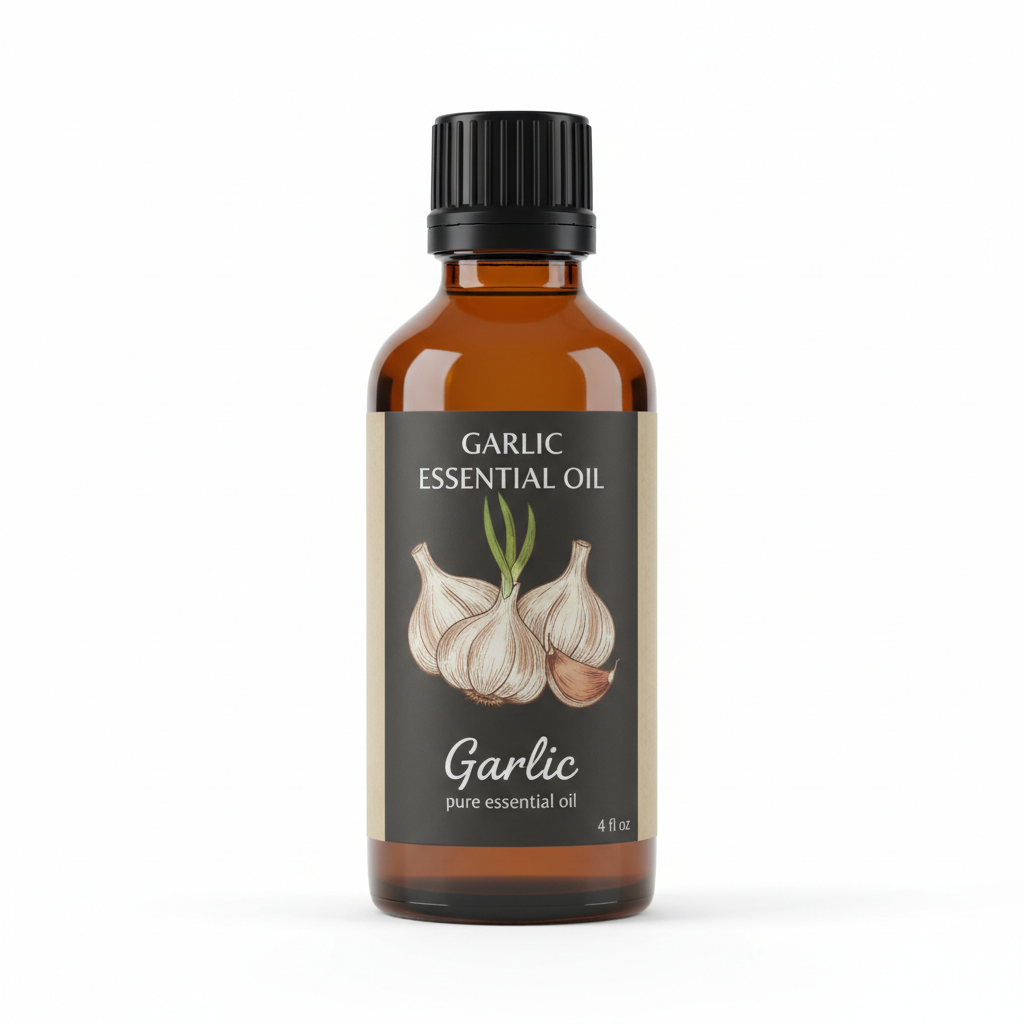
Garlic Essential Oil
Our own Garlic Essential Oil, in sizes from 0.5 oz to bulk.
From $10.99
Shop Now →What is it, and how is it different from infused oil?
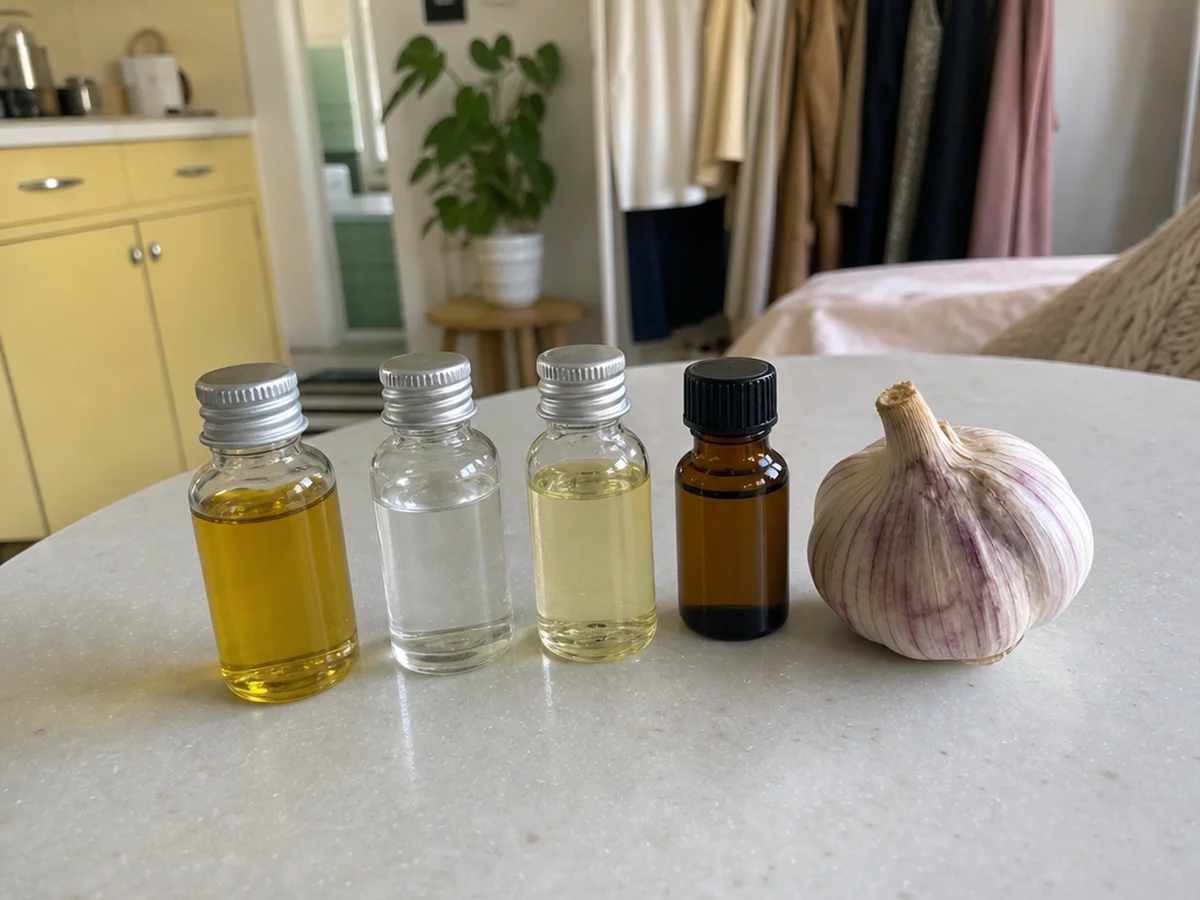
We sell one garlic oil, steam-distilled from crushed bulbs and sold undiluted. Garlic-infused oil is a food made by steeping garlic in cooking oil, and the two have almost nothing in common. In a 2017 study of chopped Spanish bulbs, the distilled oils were mostly sulfur compounds, with diallyl disulfide and diallyl trisulfide prominent, and the industrial steam-distilled batch yielded just 0.18% oil (Satyal et al., 2017). By our arithmetic from that figure, a single fluid ounce of oil represents roughly 17.7 kg of bulbs, which is why a drop goes so far.
Infused oil is a different matter entirely. The CDC advises: "Refrigerate homemade oils made with garlic or herbs. Throw the oils away after 4 days" (CDC, Botulism Prevention). Our side-by-side comparison goes deeper.
Can I eat it or cook with it?
No. Our oil is an aromatic material for garden, bait and specialty formulation use. It is not a food ingredient and it is not for ingestion, so we give no amounts for eating it, adding it to food or taking it by mouth. For garlic flavor, use real garlic or a food product labelled for the job. The Poison Center notes that some essential oils are poisonous when swallowed, so if someone has, call 1-800-222-1222 (National Capital Poison Center).
What does our Certificate of Analysis tell me?
The certificate we publish covers one batch and lists a relative density of 1.075 and a refractive index of 1.566 at 20 C, both inside the listed standard ranges, with appearance and smell marked as complying. Those two numbers confirm the oil sits in the expected physical range. They do not break down the individual sulfides. If you need a GC-MS profile for your lot, ask us in writing through the contact page before you order. Our guide to reading a label and lot report lists good questions for any seller.
How much should I dilute it for skin?
Our dilution guidance is 0.5% to 2% in a carrier oil, with a patch test first, and our own habit would be to start at 0.5%. For context, the Tisserand Institute's general ranges for essential oils run 0.2% to 1% for sensitive skin, 0.5% to 1.2% for the face and underarms, and 1% to 3% for body products, with the advice to "start low and increase the concentration only if needed" (Tisserand Institute, dilution guide). Garlic is a strong one, so we would keep it off the face and underarms. The measuring maths is in our dilution basics.
What if it touches my skin?
With care. The NIH says fresh raw garlic "can cause severe skin irritation and chemical burns" (NCCIH, Garlic). That describes raw cloves, and since the oil is the concentrated form, we treat it with at least as much respect. If oil reaches your skin, remove any affected clothing, then rinse with plenty of running water for at least 15 minutes, using mild soap for anything that clings; for eyes, rinse for 15 to 20 minutes (Poison Control, first aid). A blister or a rash that lingers belongs with a doctor. Our burn article shows what the documented cases look like.
Will it keep pests off my plants?
We do not make pest claims for it and do not recommend it for pest control. In the United States, a product sold with pest claims is a pesticide matter. The EPA's minimum risk page says active ingredients must be those listed in 40 CFR 152.25(f)(1), that states may require registration, and that EPA does not review exempted products (EPA, conditions for minimum risk pesticides). If you mix your own garden spray, read that page and ask your county extension office. Our EPA rule article walks through the conditions.
How long does it keep?
We say typically 2 to 3 years tightly capped in a cool, dark place, away from other aromatics. The Tisserand Institute explains why those conditions matter: heat, light, moisture and extra air in the bottle all speed oxidation, most oils keep well for at least 1 to 2 years, and refrigeration "will about double their useful lifespan" (Tisserand Institute, oxidation). Oxidized oils raise the chance of skin reactions, so retire an old bottle. Keep it where children and pets cannot reach it. More in our storage guide.
Why does the smell stay on my hands?
Garlic's sulfur compounds are made to linger. America's Test Kitchen had five testers rub minced garlic on their hands and try baking soda, vinegar, lemon juice, salt, toothpaste and soap. Everything lessened the odor a bit, baking soda and lemon juice did best, and their verdict was "no magic cure" (America's Test Kitchen, removing garlic odor). Our deodorizing guide puts the order of steps first.
One last practical tip: when you first open a bottle, do it briefly in a ventilated room and simply notice the smell. You will quickly learn what a single drop feels like, and that is better preparation than any amount of reading.
If a question is still unanswered, ask us in writing; we would rather give you a straight answer than a guess.
Garlic Essential Oil
Garlic Essential Oil from our own shop, in sizes from 0.5 oz to bulk.
From $10.99
Shop Now →Sources & Further Reading
- Satyal P, Craft JD, Dosoky NS, Setzer WN, 2017. The chemical compositions of the volatile oils of garlic (Allium sativum) and wild garlic (Allium vineale). Foods 6(8):63. pmc.ncbi.nlm.nih.gov/PMC5575638
- CDC. Botulism prevention. cdc.gov/botulism/prevention
- National Capital Poison Center. Essential oils. poison.org/articles/essential-oils
- National Capital Poison Center. First aid for poisonings. poison.org/first-aid-for-poisonings
- Tisserand Institute. Dilution guide. tisserandinstitute.org/safety/dilution
- Tisserand Institute. Is my bottle of essential oil oxidized? tisserandinstitute.org/learn-more/oxidized
- NCCIH. Garlic. nccih.nih.gov/health/garlic
- EPA. Conditions of minimum risk pesticides. epa.gov/minimum-risk-pesticides
- America's Test Kitchen. Removing garlic odor. americastestkitchen.com/how_tos/6004-removing-garlic-odor