Garlic Oil Benefits: Why Studies on Pills Do Not Apply
Search for garlic benefits and you will find a lot of enthusiasm and very little that applies to a small amber bottle of essential oil. Almost everything people cite, from blood pressure to colds, was studied in garlic powder tablets, aged extracts or garlic eaten as food. That is not a disappointment so much as a useful map: knowing which garlic a study used tells you what it can and cannot say about ours.
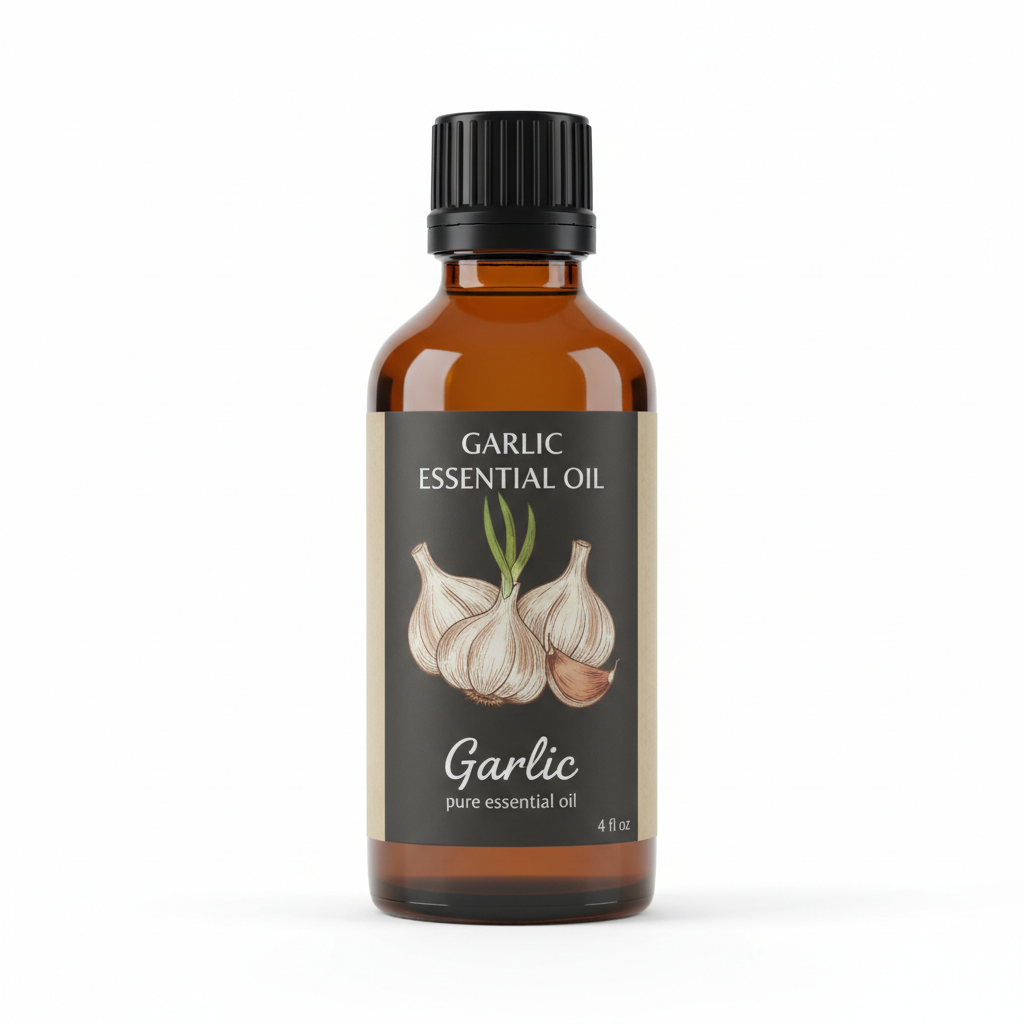
Garlic Essential Oil
Our own Garlic Essential Oil, in sizes from 0.5 oz to bulk.
From $10.99
Shop Now →Four things that all get called garlic
Whole garlic in a meal, a garlic powder capsule, an aged garlic extract and a steam-distilled essential oil are four different materials. The distilled oil is mostly sulfur compounds. In one analysis of garlic oils distilled several ways, the compounds were dominated by allyl polysulfides (Satyal et al., Foods, 2017). A different laboratory analysis found a different mix, with diallyl trisulfide leading (Gong et al., Molecules, 2021). Garlic oils differ with the garlic, the distillation and the batch, so a result for a tablet is not a result for an oil.
The Certificate of Analysis we publish for one batch of our oil lists a relative density of 1.075 and a refractive index of 1.566 at 20 C. If you need a compound-by-compound profile, ask us in writing through the contact page.
What the research literature is actually about
The most-studied use of garlic is the supplement. The National Center for Complementary and Integrative Health notes that a great deal of research has looked at cholesterol, and that garlic supplements may lower total and LDL cholesterol to a small extent in people whose cholesterol is high (NCCIH, Garlic). One pooled analysis of 20 trials of garlic preparations on blood pressure reported a modest average drop compared with placebo, about 5 mmHg systolic (Ried, J Nutr, 2016). A Cochrane review of garlic and the common cold found one qualifying trial of 146 people taking a daily supplement and called the evidence insufficient (Lissiman et al., Cochrane, 2014).
Notice what those three have in common: capsules or tablets, swallowed, under medical interest. None involved a distilled oil, and none involved a bottle used for aroma. We mention them because readers ask, not because they describe what our oil does. We make no health claim for it, and if any of these topics concern you, a physician or pharmacist is the right person to talk with, especially if you take anticoagulants or have surgery coming up, as NCCIH advises for supplements.
Test tubes are a starting point, not a finish line
Garlic's best-known compound, allicin, has been shown to act against bacteria and other microbes in the laboratory (Ankri and Mirelman, Microbes Infect, 1999). That is interesting chemistry, and it is why researchers keep returning to garlic. But a result in a dish says what a compound did at a chosen concentration, and says little about what happens in a person. It also says little about a distilled oil: the Satyal analysis found no detectable allicin in its steam-distilled sample, because the oil is built from what heat and steam rearranged. Our allicin and sulfur explainer tells that story, and the antimicrobial roundup goes through the lab work study by study.
What the scent is actually like
Open the bottle in a ventilated room and the first impression is savory and sharp, like a hot pan on a busy night. Give it a minute and a deeper, rounder note comes through underneath. We call it a base note, which means it is the part that stays long after the lighter notes have gone. On a blotter strip you can follow it for a long time, and the smell is still there when you pick the strip up later. It is bold, and it is honest about it.
So what is the bottle good for?
An honest answer is aroma. Garlic oil is pungent, savory and sulfurous, with real staying power, and that is the quality we describe and sell. In practice it is a workshop material: a trace in soap or candle experiments, a drop on a blotter strip beside onion or ginger oil, or a carefully diluted balm trial. If you want to feel how strong it is, a single drop on paper in a ventilated room will tell you more than a page of statistics.
For skin contact we recommend diluting to between 0.5% and 2% in a carrier oil, patch testing first and starting at the low end; our dilution basics post shows the drops. We keep it away from eyes, children and pets, and it is not for internal use.
If you are new to strong aroma materials, a good habit is to meet them slowly. Hold the strip at arm's length first, then bring it a little closer, and put it down when you have had enough. Garlic oil rewards that kind of patience, and it will not be rushed.
That is the kind of benefit we can stand behind: an interesting, unmistakable aroma, offered plainly, with respect for how far a little of it goes.
The healthy way to approach garlic oil, in other words, is the same way you would approach a very strong spice: curiosity, small amounts and respect for how far it goes. If you are weighing it against a supplement or a food, that is a decision for your own clinician and your kitchen, and we are happy to point out that the two bottles are very different things.
Garlic Essential Oil
Garlic Essential Oil from our own shop, in sizes from 0.5 oz to bulk.
From $10.99
Shop Now →Sources & Further Reading
- Garlic, National Center for Complementary and Integrative Health
- The Chemical Compositions of the Volatile Oils of Garlic (Allium sativum) and Wild Garlic (Allium vineale), Satyal et al., Foods, 2017
- Diallyl Trisulfide, the Antifungal Component of Garlic Essential Oil and the Bioactivity of Its Nanoemulsions Formed by Spontaneous Emulsification, Gong et al., Molecules, 2021
- Garlic Lowers Blood Pressure in Hypertensive Individuals, Regulates Serum Cholesterol, and Stimulates Immunity: An Updated Meta-analysis and Review, Ried, J Nutr, 2016
- Garlic for the common cold, Lissiman et al., Cochrane Database Syst Rev, 2014
- Antimicrobial properties of allicin from garlic, Ankri and Mirelman, Microbes Infect, 1999