Why Garlic Oil Costs What It Does: Yield and Weight
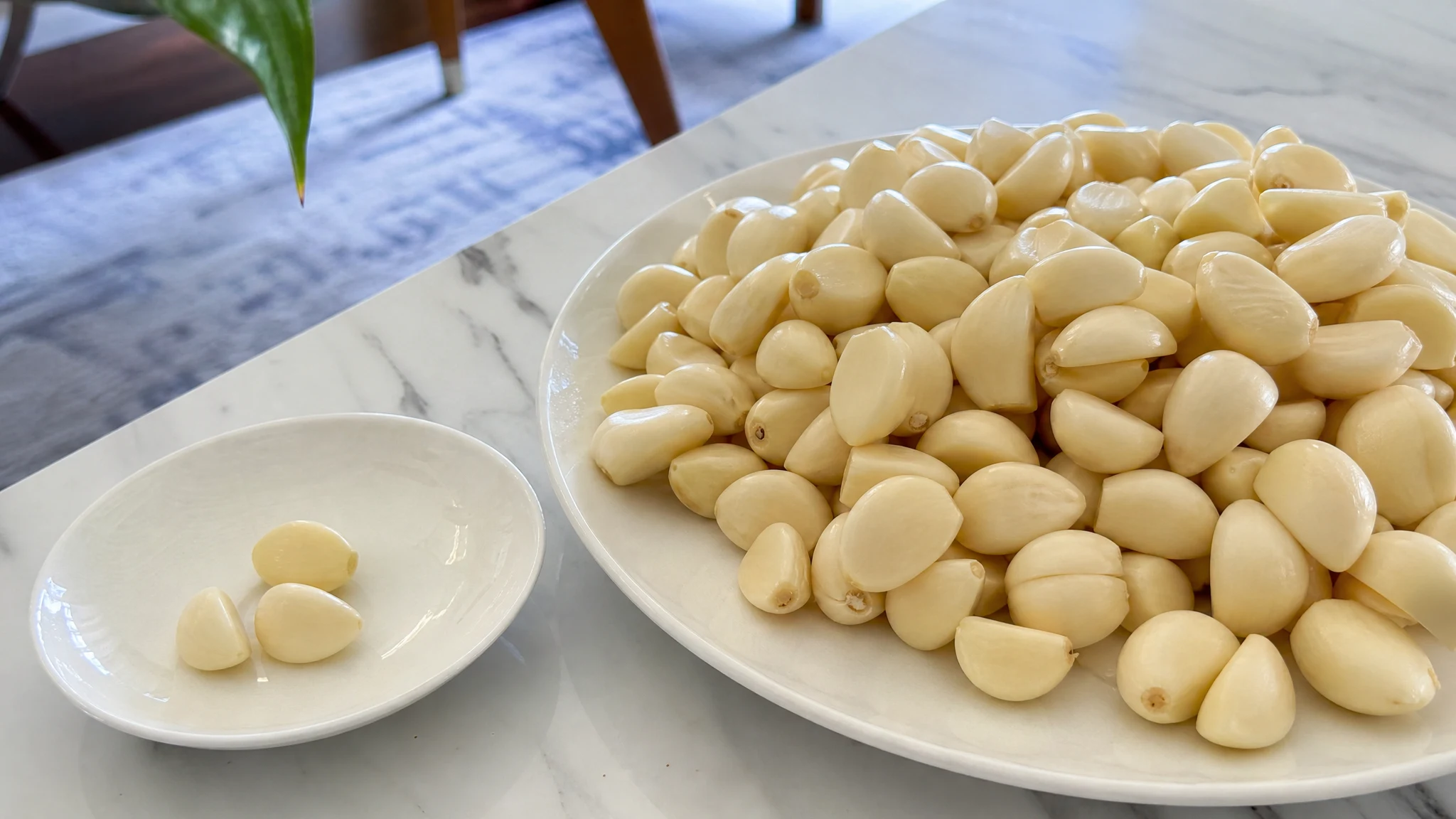
A garlic oil needs a lot of garlic. In a 2017 study, finely chopped Spanish bulbs gave between 0.18% and 0.22% oil, depending on how they were distilled. Do the division and one kilogram of oil takes roughly 450 to 550 kilograms of bulbs. That single fact explains most of why distilled garlic oil is not a grocery-aisle price, and it is where the cost conversation should begin.
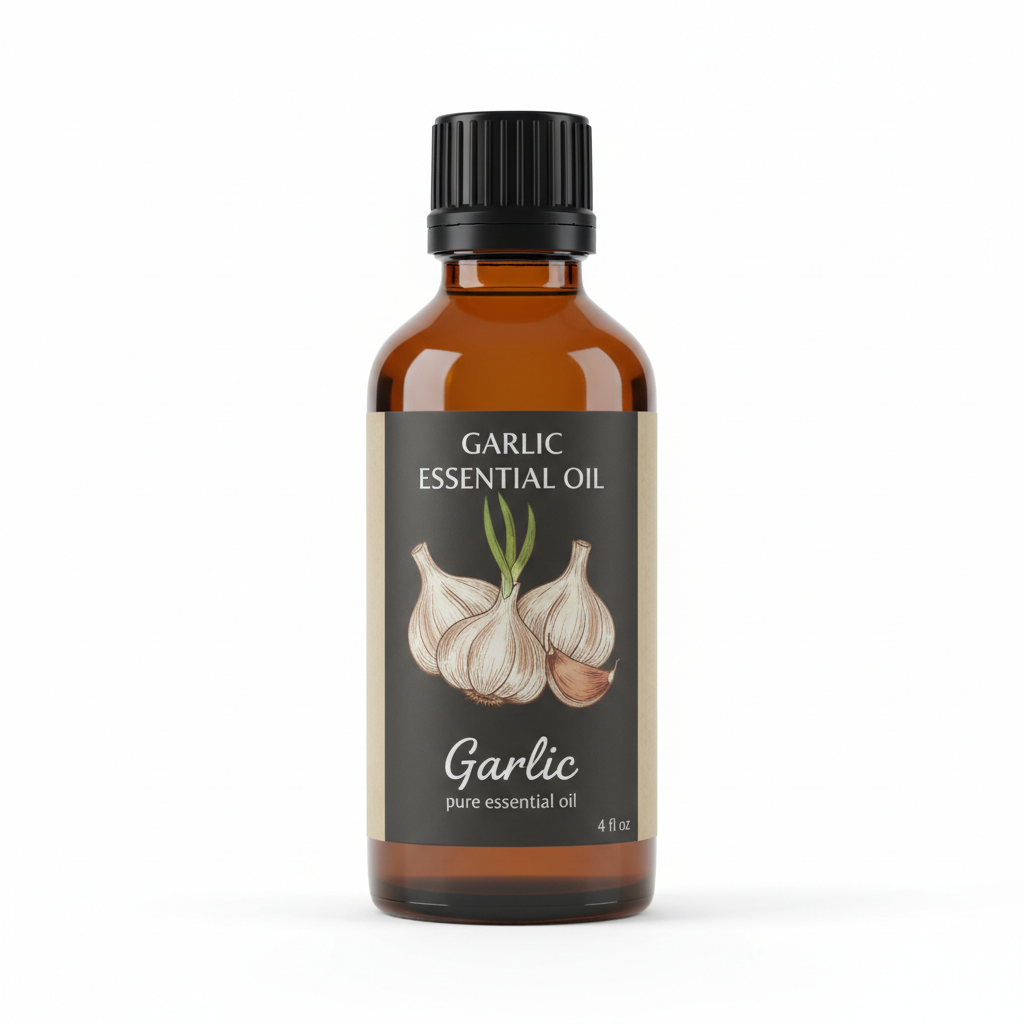
Garlic Essential Oil
Our own Garlic Essential Oil, in sizes from 0.5 oz to bulk.
From $10.99
Shop Now →Yield is the honest cost driver
That study is one lot from one place in one season, so treat it as an order of magnitude and not a description of any particular bottle. Still, it makes a useful sanity check. A bottle priced like a pantry condiment deserves a question, because the raw material alone is bought by the half-tonne per kilo of oil.
A high yield does not make a good oil either. The same paper shows the oil from identical garlic shifting with the method: steam distillation was led by diallyl disulfide, a laboratory hydrodistillation by diallyl trisulfide. Cost can be explained by yield, but quality is a separate check, and the quality guide covers it.
Compare by grams, not by ounces
Garlic oil is denser than water. The Certificate of Analysis we publish for one batch lists a relative density of 1.075 at 20 C, inside the 1.050 to 1.095 standard printed beside it, so a millilitre weighs about 1.075 g. A US fluid ounce (29.57 ml) therefore holds about 31.8 g, more than a 28.35 g weight ounce. A pound is 453.6 g, which is 421.9 ml or about 14.3 fluid ounces of this batch, so a "16 oz" listing and a "1 lb" listing are different quantities.
The printed density range moves a fluid ounce by only a little over a gram, so density is not where price gaps come from. A two-fold difference per gram is meaningful. A four percent one is noise. US cosmetic labels must state net quantity, so a listing that will not say whether it means volume or weight is skipping something the label itself carries.
A worked example with round numbers
Say, just for illustration, that you use about 5 g of oil a month in a workshop. Over a year that is 60 g. Dividing by the batch density of 1.075 gives about 56 ml, or a little under 2 US fluid ounces. In that picture a 2 oz bottle covers your year, and a 16 oz bottle covers closer to eight. The numbers are made up, but the habit is real: work out how much you go through before you compare sizes.
Three bottles that share a name
Infused garlic oil is garlic steeped in a carrier oil, so most of the liquid is the carrier. A garlic flavoring for food makers is a third thing again. Comparing any of those per millilitre with a distillate tells you nothing, so compare a distillate only with another distillate. The infused oil comparison and the flavoring comparison explain the differences.
What a price cannot tell you
Price does not reveal dilution. A review of adulteration testing notes that gas chromatography reads the volatile part of a sample, and in one clove oil example a vegetable-oil additive went undetected by the method while benzyl alcohol did not. The same review adds that peak changes can come from region and season rather than fraud. A 2026 review lists relative density and refractive index among the basic European Pharmacopoeia tests, with GC-MS the standard for volatile constituents.
Our certificate is a good example of what the first group gives you: density, refractive index, and "Complies" for appearance and smell, for one batch. If you need a sulfide profile for the lot in your hands, ask us in writing through the contact page, and expect any seller to be able to say plainly what its report covers.
Four questions to ask instead of "why so cheap?"
- Is the size volume or weight, and what density converts it?
- Is it a distillate, an infused oil or a flavoring base, and does the ingredient line say so?
- Does the certificate name a batch, and is it the batch you will receive?
- Can the seller supply a gas chromatography report for your lot?
A seller who answers all four has told you more than the price ever could.
Why a little goes so far
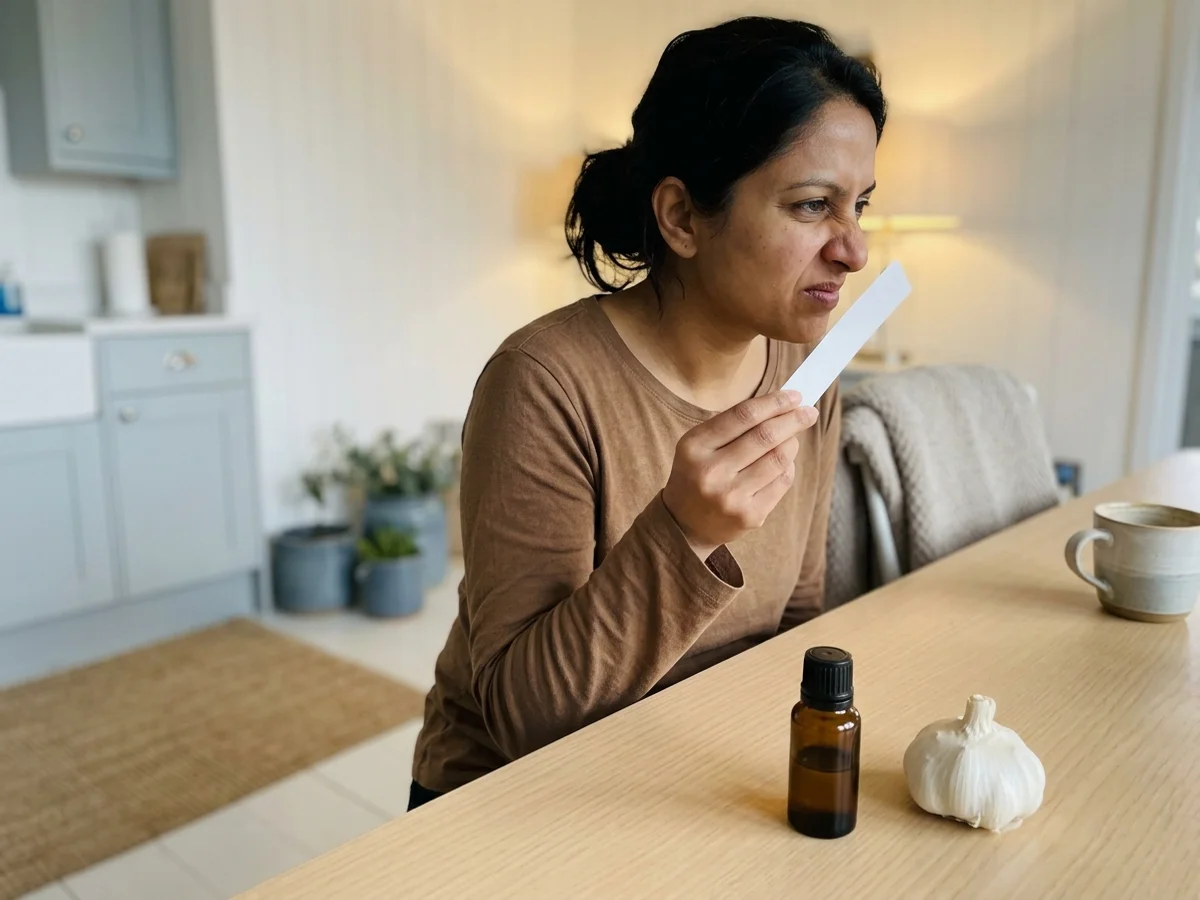
Here is the pleasant side of all that garlic per kilo of oil. The smell is concentrated enough that a single drop on a blotter strip tells you nearly everything about the aroma. Open the bottle, wave the strip once, and put it down; you will notice the scent in the room well after. That strength is a reason to measure small, and it is why a modest bottle lasts longer than newcomers expect.
If the goal is flavor
If you want garlic flavor in food, garlic itself is the answer. Our oil is not for internal use, and the National Capital Poison Center says some essential oils are poisonous when swallowed and that a swallowed oil is a reason to call 1-800-222-1222. Ask a physician or pharmacist about eating questions.
For aroma and workshop use, work out the weight you will go through in a year and pick the size that fits. The first-bottle guide helps with that, and production sizes are on the bulk page.
Buy by grams per use, and the right bottle usually becomes obvious.
Keep your numbers simple, ask your questions plainly, and a fair price will make sense on its own.
Garlic Essential Oil
Garlic Essential Oil from our own shop, in sizes from 0.5 oz to bulk.
From $10.99
Shop Now →Sources & Further Reading
- Satyal P, Craft JD, Dosoky NS, Setzer WN, 2017. The chemical compositions of the volatile oils of garlic (Allium sativum) and wild garlic (Allium vineale). Foods 6(8):63. pmc.ncbi.nlm.nih.gov/articles/PMC5575638
- Jentzsch PV, Guerrero LR, Ciobotă V, 2019. Detection of essential oils adulteration: a quick overview and current challenges. American Journal of Biomedical Science & Research 4(1). biomedgrid.com/fulltext/volume4/detection-of-essential-oils-adulteration-a-quick-overview-and-current-challenges.000746.php
- Szambora O, Paradowska K, 2026. Problems and challenges in the detection of essential oil adulteration: a review of current analytical methods. Prospects in Pharmaceutical Sciences 24(3):45-53. prospects.wum.edu.pl/index.php/pps/article/view/880
- US FDA, current as of 2022. Cosmetics Labeling Guide. fda.gov/cosmetics/cosmetics-labeling-regulations/cosmetics-labeling-guide
- National Capital Poison Center. Essential oils: poisonous when misused. poison.org/articles/essential-oils