How to Judge Garlic Oil Quality Before You Order
Sniffing the bottle will not tell you whether a garlic oil is good. Every allyl sulfide in garlic smells like garlic, and the oil is made almost entirely of them, so a strong, sulfurous smell says only that sulfides are present. What you can judge before buying is the paperwork and the seller, and that is where a short sequence of checks pays off.
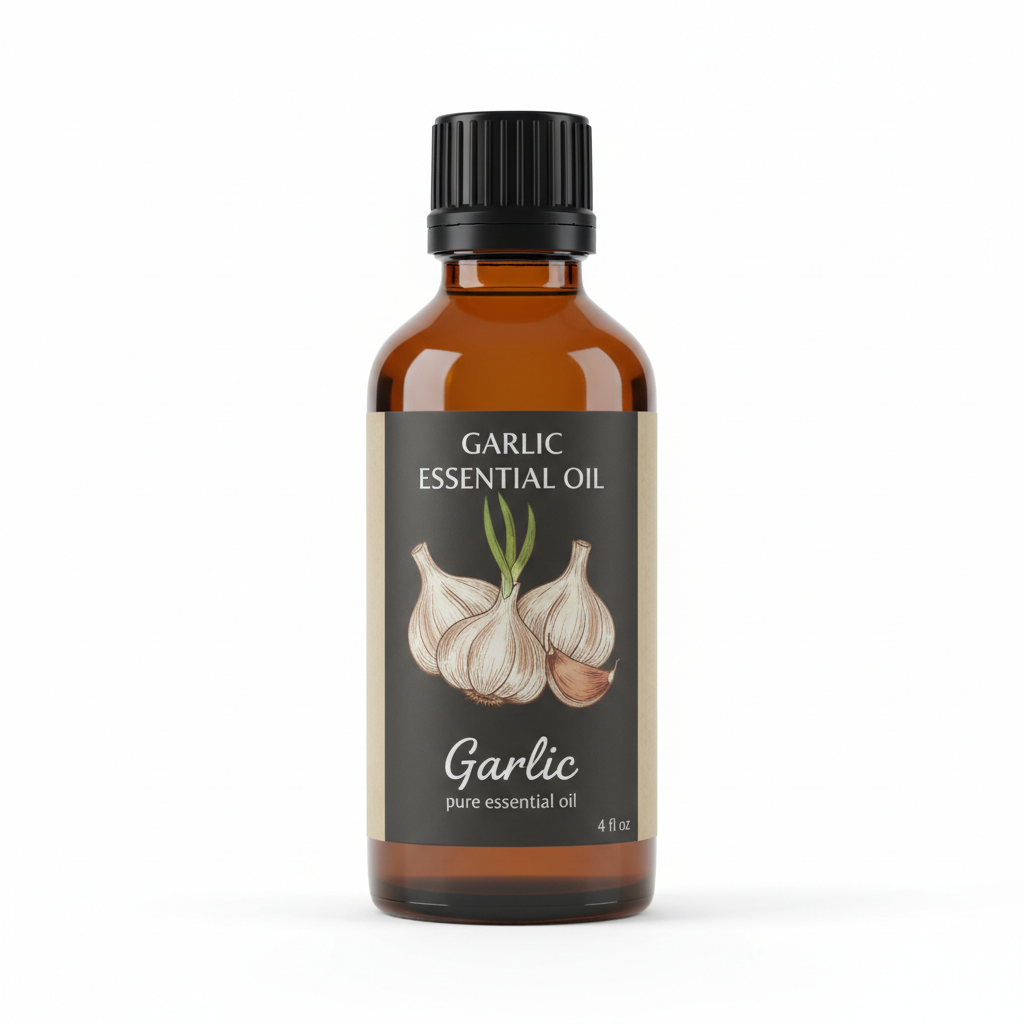
Garlic Essential Oil
Our own Garlic Essential Oil, in sizes from 0.5 oz to bulk.
From $10.99
Shop Now →Why the nose falls short
In a 2017 study of chopped Spanish bulbs, diallyl disulfide and diallyl trisulfide led the oil, with allyl methyl trisulfide also above 14% in all three distillations. Reasoning from that, a bland vegetable-oil diluent has almost no smell of its own and would merely soften the odor, so a milder smell is not proof of dilution and a loud one is not proof of purity. We would not trust a nose, ours included, to sort a good lot from a thinned one.
We love a good question, so we are happy to say this plainly: a seller who welcomes your questions is giving you information before you spend anything. Each of the checks below takes a few minutes, and none of them requires a laboratory of your own.
Check one: what is actually in the bottle?
Look for the botanical name (Allium sativum), the words steam-distilled or distillate, and an ingredient line with a single item. A US cosmetic label must carry an identity statement, net quantity, the business name and place, and ingredients in descending order. If a carrier oil appears on the ingredient line, you are looking at an infused or diluted oil, which is a different purchase, explained in the infused oil comparison. Our garlic oil is steam-distilled from crushed bulbs, sold undiluted and bottled in amber glass.
Check two: read what the certificate measured
A certificate is only as informative as its list of tests. A 2026 review notes that the European Pharmacopoeia lists relative density and refractive index as basic tests and treats GC-MS as the gold standard for volatile constituents. So ask whether a certificate names the batch, gives a standard for each result, and includes a composition test.
The Certificate of Analysis we publish names one batch and prints a relative density of 1.075 against a standard of 1.050 to 1.095, a refractive index of 1.566 against 1.550 to 1.580, and "Complies" for appearance and smell. It is a sensible screen for identity, and it does not include composition data. Because physical numbers sit in a band, a result inside the band does not by itself pin down a single oil.
Check three: ask for composition, then read it with care
If composition matters for your use, ask in writing for a gas chromatography report for the lot you will receive. For ours, write to us through the contact page. When a report arrives, remember that one garlic gives different profiles by method: the Spanish bulbs gave diallyl disulfide at 20.8% to 27.9% and diallyl trisulfide at 16.8% to 33.4% depending on distillation. A report that matches a paper to the decimal is a reason for a question, not a verdict, because a paper describes one sample, and natural variation by region and season also changes peak patterns.
There is one more subtlety. A review of adulteration detection points out that non-volatile additives such as vegetable oil stay behind in the instrument's injection port, so a trace can look normal on a diluted oil. A report is strongest alongside density and refractive index, and a knowledgeable seller will tell you so.
Check four: read the claims like a regulator
FDA decides whether a product is a cosmetic or a drug from its intended use, judged from labels, websites and advertising, and it lists claims like easing pain or helping sleep as drug claims. A listing that promises health outcomes from a bottle of garlic oil is showing you a compliance question, not quality. Our footer states that our products are not intended to diagnose, treat, cure or prevent any disease.
What you can safely do with your nose
Although smell cannot sort good from poor, it still has a job. Once a bottle arrives, put a small touch on a blotter strip and wave it a few inches from your face. You should notice something pungent, savory and strongly sulfurous, with a depth that lasts. Jot down your impression with the date, then compare it against the same strip an hour later and again the next day. A written record helps you notice if a later bottle smells noticeably different from the first.
It also helps to keep the original bottle capped and in a cool, dark place, so your reference does not change while you compare. Your notes will not prove anything on their own, but they give you something concrete to bring to a conversation with a seller if a question comes up.
Putting the answers to use
Run the checks in order of how cheaply they fail. If the listing fails the first, stop. If the certificate is thin, you are buying on trust, which is reasonable for a small scent trial and thin ground for a production drum. If composition matters, make the order conditional on the lot report. For a first purchase, the smallest size limits the cost of being wrong, and the first-bottle guide goes through the options. Choosing between sellers is covered in the buying checklist.
If you were hoping to put garlic oil in food, it is the wrong product: our oil is not for internal use, and poison control sources warn that swallowed essential oils can be poisonous (1-800-222-1222). Cook with garlic itself and ask a physician or pharmacist about anything swallowed.
Good questions, answered in writing, are the best quality test a buyer has.
Garlic Essential Oil
Garlic Essential Oil from our own shop, in sizes from 0.5 oz to bulk.
From $10.99
Shop Now →Sources & Further Reading
- Satyal P, Craft JD, Dosoky NS, Setzer WN, 2017. The chemical compositions of the volatile oils of garlic (Allium sativum) and wild garlic (Allium vineale). Foods 6(8):63. pmc.ncbi.nlm.nih.gov/articles/PMC5575638
- Szambora O, Paradowska K, 2026. Problems and challenges in the detection of essential oil adulteration: a review of current analytical methods. Prospects in Pharmaceutical Sciences 24(3):45-53. prospects.wum.edu.pl/index.php/pps/article/view/880
- Jentzsch PV, Guerrero LR, Ciobotă V, 2019. Detection of essential oils adulteration: a quick overview and current challenges. American Journal of Biomedical Science & Research 4(1). biomedgrid.com/fulltext/volume4/detection-of-essential-oils-adulteration-a-quick-overview-and-current-challenges.000746.php
- US FDA, current as of 2022. Cosmetics Labeling Guide. fda.gov/cosmetics/cosmetics-labeling-regulations/cosmetics-labeling-guide
- US FDA, current as of 2023. Aromatherapy. fda.gov/cosmetics/cosmetic-products/aromatherapy
- National Capital Poison Center. Essential oils: poisonous when misused. poison.org/articles/essential-oils