Do Deer and Rabbits Dislike Garlic? What Trials Show
Gardeners have long hoped that garlic's famous smell will keep hungry deer and rabbits out of the hostas. Researchers have actually put that idea to the test with captive deer and young trees, and the results are more interesting than a simple yes or no.
Garlic Essential Oil
Our own Garlic Essential Oil, in sizes from 0.5 oz to bulk.
From $10.99
Shop Now →Garlic against black-tailed deer
In 1995, Dale Nolte, James Farley and Sandi Holbrook compared garlic with a commercial powder repellent on western redcedar seedlings, with black-tailed deer doing the browsing. They checked for damage at 24 and 48 hours and then weekly for 10 weeks. The powder protected seedlings better than garlic or nothing for the first 8 weeks. Garlic cut damage below the untreated level for only about 48 hours, and the authors called its protection marginal, though they thought it might be worth trying on less-preferred tree species.
The summary does not spell out how the garlic was prepared, so we would not stretch that result to every garlic product.
The sulfur-smell clue
A larger comparison tells a more hopeful story about smell in general. A US Forest Service technology center tip (Trent, Nolte and Wagner, 2001) tested 20 commercial repellents on cedar seedlings in pastures at Olympia, Washington, using captive black-tailed deer. Eight of the nine most effective repellents in the first 11 weeks of the winter test gave off sulfurous odors, and the products built on decaying animal proteins such as egg looked strongest. Some of the products tested did contain garlic, from a 99.3% garlic juice to a 10% garlic oil blend, but the report gives no separate result for any of them, so there is no garlic ranking to share.
It also makes a point every gardener can use: no repellent eliminated browsing across the full 18 weeks, and efficacy was expected to decline significantly after 12 to 16 weeks. In other words, smell works for a while, and then you reapply or change tactics.
Putting the two studies together, a reasonable reading is that sulfur-type odors are a promising class, while garlic on its own looks like a modest member of it. That is our interpretation, not a finding from either paper.
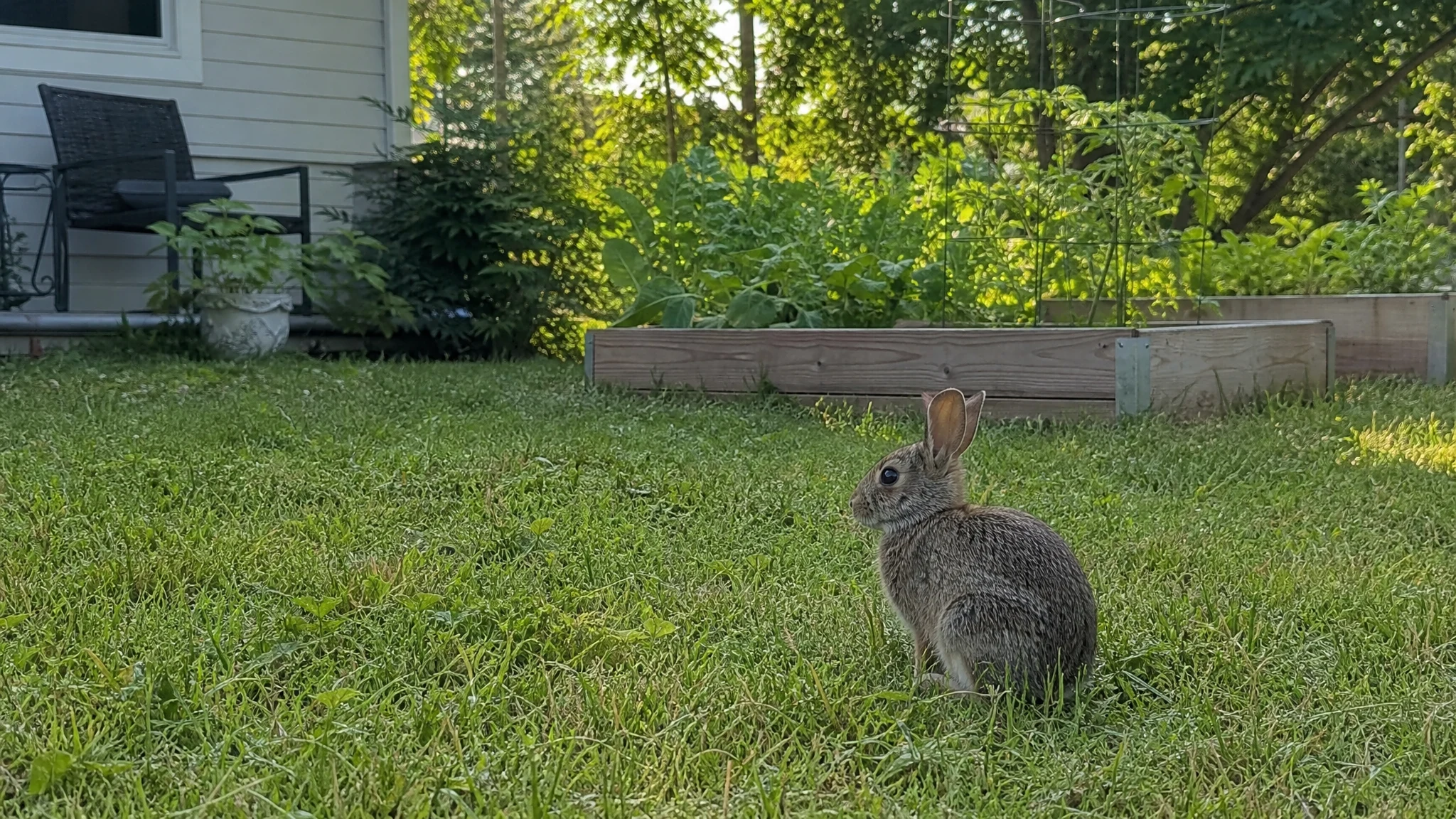
For rabbits, it is a fence
Iowa State University Extension is refreshingly practical here. The most dependable protection is chicken wire with mesh of 1 inch or smaller, or 1/4-inch hardware cloth, standing about 2 feet tall and pinned down with U-shaped landscape pins or buried 1 to 2 inches at the bottom. For winter trees and shrubs, go taller, 24 to 36 inches. Repellents get a gentler review: they are not always effective, rabbits may get used to an odor, most need reapplying after heavy rain, irrigation or new growth, and they cannot be used on edible crops.
A 4 by 8 foot bed needs 24 feet of fence, which is a one-time purchase, compared with respraying after every storm. For a vegetable patch, that math is hard to beat.
If you try anything, try it small
Gardeners are practical people, and a test on one plant teaches more than a spray across the whole yard. Pick a single bed, leave a neighboring bed alone for comparison, and write down the date and what you did. Check again after rain and after new growth, since those are the moments the extension notes say protection fades. A few photos on your phone will tell you more than memory does.
A fence is not glamorous
There is a quiet satisfaction in a fence that simply works. It does not need reapplying, it does not smell, and it does not depend on what the deer ate that morning. If you want to enjoy your garden without a weekly chore, that is a point worth weighing against any spray.
Plants that tend to be left alone
Ask around at a garden center and you will often hear that deer pass over some plants with strong scents or fuzzy, bitter leaves. That is local folklore, and it varies by region and by how hungry the deer are, so treat it as a starting point. Walk around your neighborhood and notice what is nibbled and what is untouched. That observation is free, and it tells you far more about your own deer than a general list ever will.
Where our oil stands
We sell our garlic oil as an undiluted aroma material, and we do not offer it as a repellent or recommend it for deer, rabbits or any pest. Under EPA rules, a product sold to repel pests is a pesticide, and the exemption for minimum risk products depends on six conditions, including ingredients from a specific list, a full label and no misleading statements. States may add their own registration rules. Our minimum risk explainer walks through them, and a county extension office can tell you which methods suit your species and local law.
The oil is also very strong, clings to skin and cloth, and our guidance is to keep it away from children and pets, which matters in a garden where both like to wander. Our pet article reports what veterinary sources say. If voles and moles are your garden's real visitors, that article covers the ground-level version of this question.
For deer, the best-supported plan we can describe is plants they dislike, a repellent whose maker stands behind it, and a good fence.
Garlic Essential Oil
Garlic Essential Oil from our own shop, in sizes from 0.5 oz to bulk.
From $10.99
Shop Now →Sources & Further Reading
- Nolte DL, Farley JP, Holbrook S, 1995. Effectiveness of BGR-P and Garlic in Inhibiting Browsing of Western Redcedar by Black-Tailed Deer. Tree Planters' Notes 46(1)
- Trent A, Nolte D, Wagner K, 2001. Comparison of Commercial Deer Repellents. USDA Forest Service Tech Tip 0124-2331-MTDC
- Iowa State University Extension. How to Protect Gardens from Rabbits
- US EPA. Conditions for Minimum Risk Pesticides (updated August 31, 2026)