Garlic Ear Drops: What the Children's Trials Tested
"Garlic ear drops" sounds like a single, simple remedy. Follow the trail back to the research, though, and you find a commercial oil blend with four herbs in it, tested in children with earache, with pain as the thing being measured. It is a more interesting story than the folklore, and it ends somewhere practical.
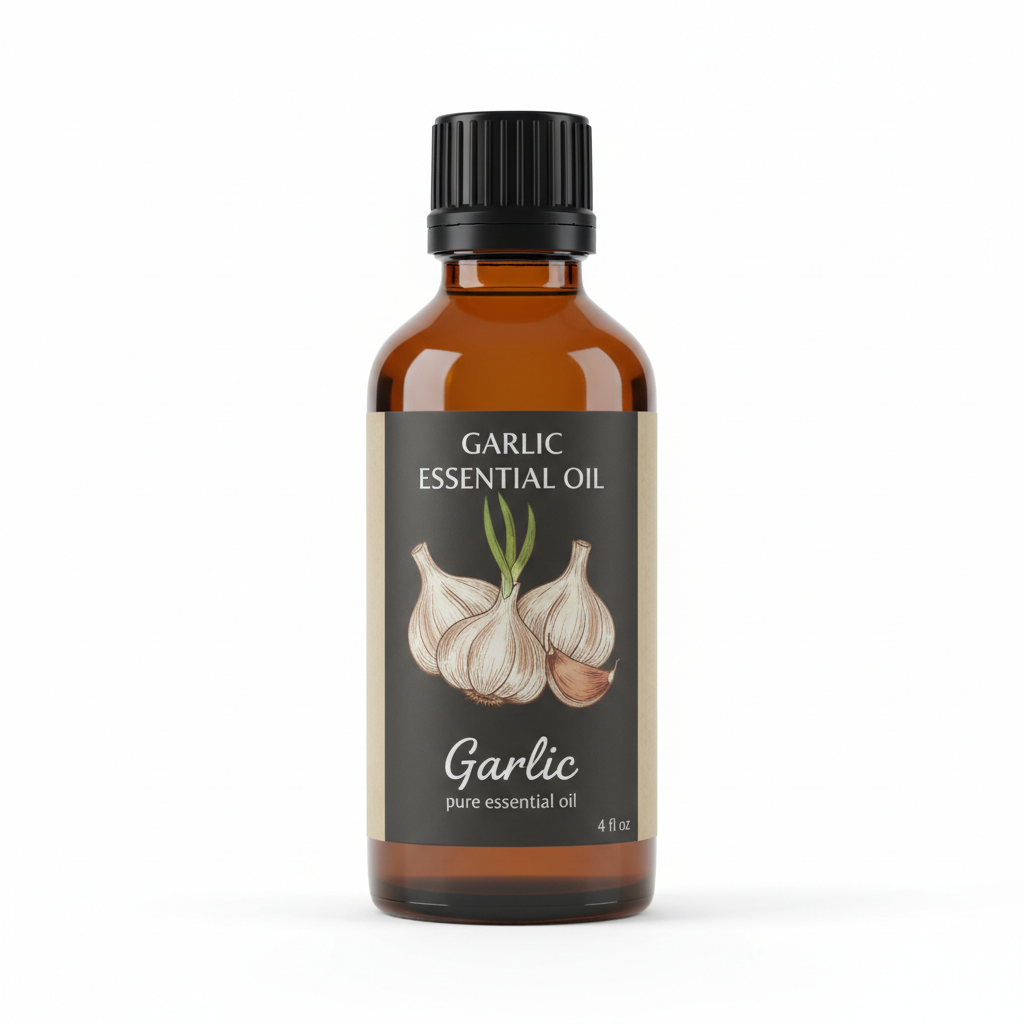
Garlic Essential Oil
Our own Garlic Essential Oil, in sizes from 0.5 oz to bulk.
From $10.99
Shop Now →Four herbs in olive oil
Two trials from one Israeli group are the ones usually cited. Both used a product that contained garlic, mullein, calendula and St John's wort in olive oil. In the first, 103 children aged 6 to 18 with ear pain from acute middle-ear infection were given either the herbal drops or anaesthetic drops. Pain scores improved over three days in the study, and the authors judged the herbal drops comparable to the anaesthetic ones (Sarrell and colleagues, 2001).
That is a herbal macerate, which is a different material from a steam-distilled essential oil, and garlic is one of four ingredients, so nothing in the results belongs to garlic alone. Nothing was measured about whether the infection itself cleared, either. The trials were about comfort.
The finding people skip
The follow-up study, with 171 children, compared herbal drops, anaesthetic drops and amoxicillin in different combinations. Every group improved. The authors then did something admirably honest: they noted that the pain was mostly, about 80%, self-limited and could be explained simply by the time elapsed (Sarrell, Cohen and Kahan, 2003). In plain English, children's ear pain tends to ease on its own over a couple of days, which makes any drop look good unless there is a comparison group that gets nothing.
A Cochrane review that pulled the ear-drop trials together concluded that the evidence was insufficient to know whether ear drops work at all. It also limited itself to infections without a perforated eardrum (Foxlee and colleagues, 2006). That limit is the key to the practical question.
How to read a children's trial
Small studies in children are valuable, but they come with built-in puzzles. Pain is reported by the child or the parent, and it naturally changes from hour to hour. The groups are small, the products often contain several ingredients, and without a comparison group that gets nothing, it is hard to say what caused any change. None of that makes the researchers careless. It simply means the careful reading is part of the story.
Why the eardrum comes first
Anyone can see a sore throat. Nobody can see a perforated eardrum without an otoscope. In the trials, clinicians looked into each child's ear first. At home you cannot do that, and fluid or pus draining from an ear is itself one of the signs the CDC lists as a reason to see a provider. So the useful lesson of the trials is not "try garlic." It is "get the ear looked at, then decide."
Garlic essential oil is a concentrated material that we sell undiluted for aroma and workshop use. We recommend diluting to 0.5% to 2% in a carrier oil for skin contact, and we do not suggest it for the ear canal, which is not a skin patch. Our garlic oil is not for internal use, and we do not offer it for this purpose.
What the guidance pages describe instead
For mild middle-ear infections, the guidance is calmer than most people expect. A provider may suggest watching for two or three days, and the NIDCD says antibiotics are recommended if symptoms do not improve within 48 to 72 hours. The CDC's list of reasons to call is plain: fever of 102.2 F (39 C) or higher, fluid or pus from the ear, worsening symptoms, symptoms beyond two to three days, or hearing loss, and a baby under three months with a fever of 100.4 F (38 C) should be seen right away.
The watching window is a clinician's tool, with a plan for what happens next. It is not a gap to fill with a home remedy. Pain relief questions, for a child especially, belong with a pediatrician or pharmacist.
What to have ready for the appointment
- When the pain started, and whether it is getting better or worse
- Any fever, with the actual number
- Any fluid or drainage from the ear
- Any change in hearing
- What has been given so far, and when
Write it down before you go. A clear list helps the clinician see what is going on and saves you from trying to remember it all on the spot.
If you are here out of curiosity about garlic
The wider question of what garlic does in a laboratory, and what it does in people, is worth understanding, and we cover it in our antimicrobial research post. If you handle our oil, garlic oil skin irritation explains why we are careful with dilution, and pregnancy and children covers the households we think about most.
It can be hard to watch a child with an aching ear, and the urge to do something right now is understandable. Soothing comfort, a calm voice and a prompt call to the doctor are all good things to do, and none of them need a bottle from the pantry.
We hope this gives you a calmer way to read the headlines, and we are always glad to talk about garlic when the question is a kitchen or workshop one.
The kindest thing these trials point to for an aching ear is a look from someone with an otoscope.
Garlic Essential Oil
Garlic Essential Oil from our own shop, in sizes from 0.5 oz to bulk.
From $10.99
Shop Now →Sources & Further Reading
- Sarrell EM, Mandelberg A, Cohen HA, 2001. Efficacy of naturopathic extracts in the management of ear pain associated with acute otitis media. Arch Pediatr Adolesc Med. PubMed 11434846
- Sarrell EM, Cohen HA, Kahan E, 2003. Naturopathic treatment for ear pain in children. Pediatrics. PubMed 12728112
- Foxlee R et al., 2006. Topical analgesia for acute otitis media. Cochrane Database Syst Rev. PubMed 16856108
- CDC. About ear infection. cdc.gov/ear-infection
- NIDCD, NIH. Ear infections in children. nidcd.nih.gov