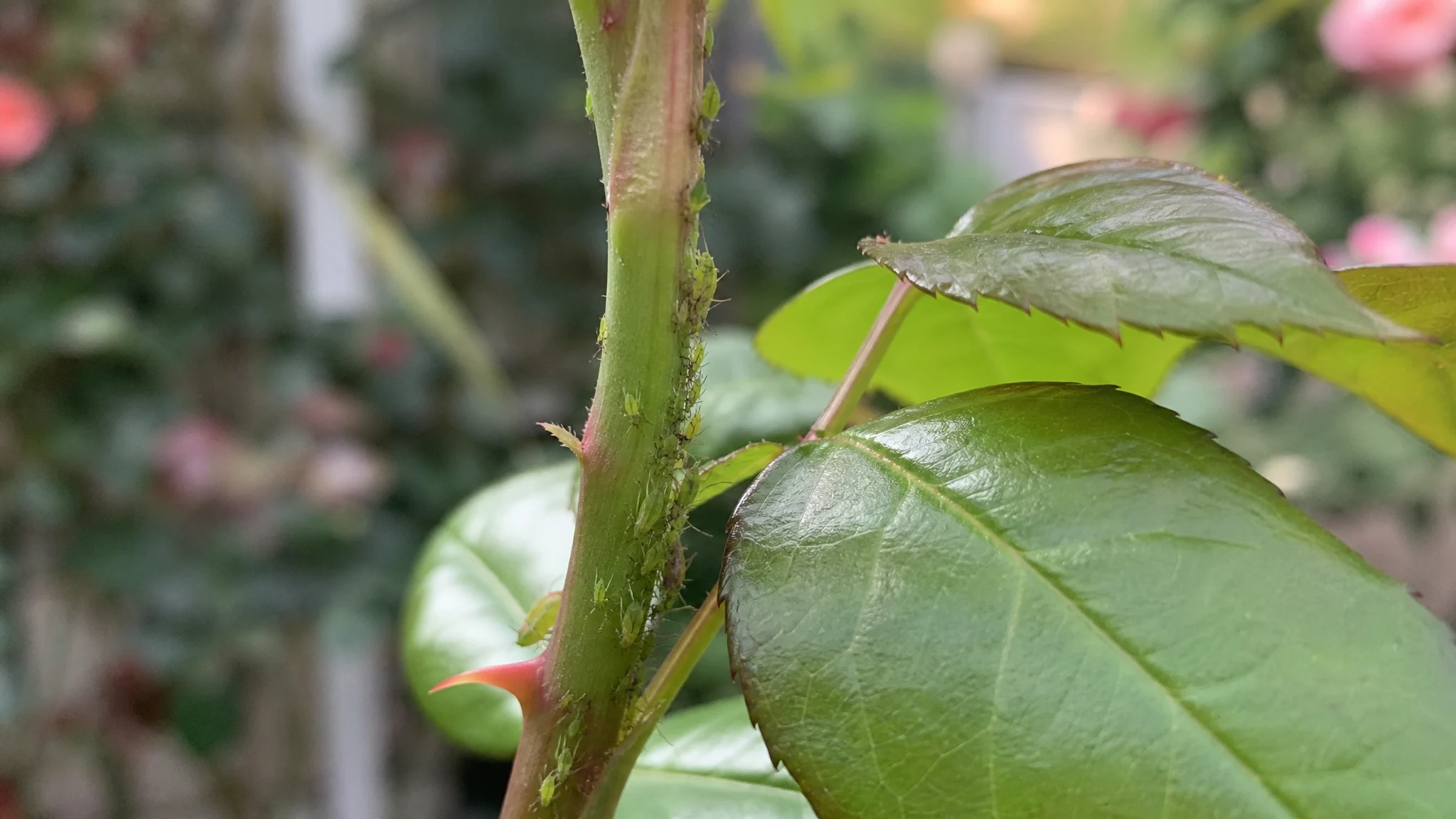
Garlic Oil for Aphids? Start With Water and Helpers
Ask an entomologist how to handle aphids and you will hear about a garden hose before you hear about any bottle. That is not a letdown; it is good news, because the best first step is free, fast and gentle on the ladybugs that do the real work. Garlic comes into the story much later.
Garlic Essential Oil
Our own Garlic Essential Oil, in sizes from 0.5 oz to bulk.
From $10.99
Shop Now →The order of work
The University of California IPM Pest Note on aphids (UC ANR Publication 7404, updated July 2013) opens with water. Knock aphids off sturdy plants with a strong stream, ideally early in the day so foliage dries quickly and fungal disease is less likely. The note says this can be enough even on large street trees.
Second, watch the ants. They feed on aphid honeydew and protect aphids from their natural enemies, so managing ants, with trunk wraps and sticky material, ant stakes or baits, and pruning branches that bridge routes to the plant, often matters more than the aphids themselves. Our ant article covers that side.
Third, welcome the helpers: lady beetles, lacewing larvae, syrphid fly larvae, soldier beetles and tiny parasitic wasps. The note says to avoid broad-spectrum insecticides that kill them. It also says most established plants tolerate light to moderate aphid numbers, and recommends checking plants at least twice a week when growth is rapid, including leaf undersides.
When a spray is needed, the note points to soaps and oils, usually as a 1 to 2% oil solution in water with thorough coverage of leaf undersides. They only kill aphids that are wet during spraying, so repeats may be needed, and they should not be used on water-stressed plants or above 90 F. Test a small area first, since some plants are sensitive. The page does not mention garlic.
A morning check
Take your coffee into the garden and look closely. Turn a few leaves over and check the new growth, where aphids like to gather. You will often notice a sticky shine on leaves below them, which is honeydew, and ants walking up and down a stem. You may also spot a ladybug larva or a tiny parasitic wasp, which are good news. Making this a twice-a-week habit, as the UC note suggests, lets you catch a small problem while a hose can still handle it.
What a garlic oil study measured
Garlic oil has appeared in at least one laboratory study with a cherry pest. Eisa, Matsera and Cagan (2023, Agronomy Research) tested oils of garlic, basil, lavender, eucalyptus and turmeric, plus DEET and a comparison compound, against the black cherry aphid at 0.3% to 1.5%, with four replications. Concentration explained the most variation in repellency (64%), and the highest repellency, 95%, came at 1.5% for garlic oil, eucalyptus oil and the comparison compound after 30 minutes in an olfactometer. In the contact test, all the oils were effective after 6 hours.
It is an intriguing result and a good reason for researchers to run plant trials. The aphids were in a laboratory apparatus, not on a leaf, with no weather, and the abstract does not say how long any effect lasts or whether a leaf would be harmed. So it points to a question, and does not yet answer the garden one.
What 1.5% looks like in a bottle
For perspective, here is the unit conversion. On the Certificate of Analysis we publish for one batch, our oil has a relative density of 1.075 at 20 C, so a milliliter weighs about 1.075 g. At roughly 20 drops per milliliter, 1.5% in a liter of water is 15 ml, about 16 g or 300 drops. In a US gallon, it is about 57 ml. That is a lot of oil, and oil does not stay mixed with water without an emulsifier. Our oil is very strong and clings to skin, hands and cloth, so a mist of it overhead would reach you as readily as the plant.
A word on patience
Aphid populations can look alarming on a bright spring morning, and the urge to do something dramatic is strong. Resist it for a day or two. The helpers you want need time to find the colony, and a plant that has been blasted with a spray is a poor place for them to land. A steady routine of looking, rinsing and waiting is quieter than a spray bottle, and it keeps the garden working in your favor. If you do need to step up, write down what you used and when, so you can see whether it helped.
Where our oil stands
We sell a single undiluted garlic essential oil, and we do not offer it for pest control or recommend it for aphids. Under EPA rules, a product sold to control pests is a pesticide, with a narrow exemption for minimum risk products that depends on six conditions, and states can add their own. Our explainer walks through them. Garlic sprays and beneficial insects are covered in our pollinator article, and there is an older traditional grower's preparation to read alongside it.
Our simple order, then: look under leaves, use the hose, check for ants, and if a spray is still needed, choose a labelled soap or horticultural oil from a garden center and follow its directions. A local extension office can match a product to your plant and region.
Garlic Essential Oil
Garlic Essential Oil from our own shop, in sizes from 0.5 oz to bulk.
From $10.99
Shop Now →Sources & Further Reading
- UC IPM. Pest Notes: Aphids, UC ANR Publication 7404 (updated 07/2013)
- Eisa MAS, Matsera O, Cagan L, 2023. The laboratory estimation of essential oils as biological methods against black cherry aphids M. cerasi. Agronomy Research 21(3)
- US EPA. Conditions for Minimum Risk Pesticides (updated August 31, 2026)