Does Garlic Repel Mosquitoes? What Studies and CDC Say
Picture a summer evening on the porch, a glass of something cold, and the first whine near your ear. It is natural to wonder whether a kitchen staple could keep mosquitoes away. Garlic has a long reputation for it, so it is worth looking at what the research did and did not test, and what the Centers for Disease Control and Prevention (CDC) suggest you rely on.
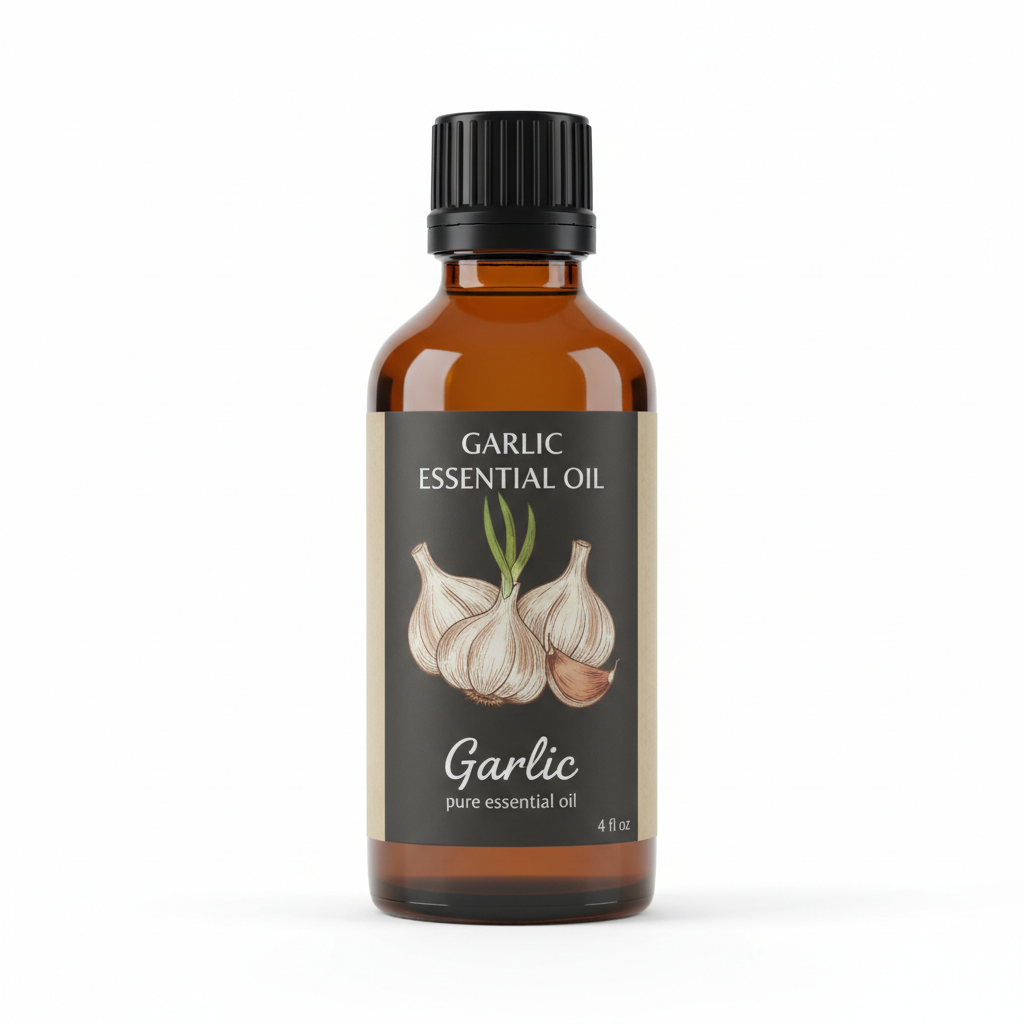
Garlic Essential Oil
Our own Garlic Essential Oil, in sizes from 0.5 oz to bulk.
From $10.99
Shop Now →Two studies, two very different questions
People usually point to a pair of papers. Neither involves garlic oil sprayed on a person outdoors.
The first, by Rajan and colleagues (2005, Medical and Veterinary Entomology), asked volunteers to eat garlic or a placebo and then exposed them to laboratory-raised Aedes aegypti mosquitoes. It was randomized, double-blinded and crossover, which makes it a tidy design. The authors reported that the data did not provide evidence of significant systemic mosquito repellence, and suggested that longer-term garlic ingestion might be needed. That is a result about eating garlic. It says nothing about oil on skin or in a yard, and we do not suggest anyone eat our oil, which is sold for external aroma use only.
The second, by Dusi and colleagues (2022, Industrial Crops & Products), tested a garlic oil against every life stage of Aedes aegypti in the laboratory. The standout numbers were for larvae and pupae in water, with LC50 values of 1.0 and 20.3 parts per million at 72 hours. The authors also reported reduced egg hatching, toxicity to adults and repellency in the laboratory, and they see promise for integrated mosquito control. It is interesting chemistry. It is also a different oil from ours, tested in containers designed to guarantee contact, so it is not a promise about what any bottle will do on your patio.
Why the garlic idea is so appealing
It starts with the smell. Garlic is so loud that it feels as though anything with a nose must want to stay away, and the idea gets handed down at picnics and over garden fences. It is a charming bit of folk wisdom, and it deserves a proper look instead of a shrug. The studies above are what that look turns up, and they are more specific, and more modest, than the folk version.
A quick bit of arithmetic
An LC50 of 1.0 ppm means about 1 milligram of oil per litre of water. The Certificate of Analysis we publish for one batch gives a relative density of 1.075, so a millilitre of that batch weighs roughly 1,075 mg, enough in theory to treat about a thousand litres. That sounds remarkable, and it shows why laboratory numbers are best read as clues. They describe oil mixed through water in a controlled test, not how long it lasts on a leaf or whether a flying adult takes any notice. It is also a good reason to keep oil out of ponds, rain barrels and bird baths, where fish and amphibians live.
What CDC suggests instead
CDC's mosquito-bite prevention page (August 2024) is refreshingly plain. It lists the active ingredients to look for in EPA-registered repellents: DEET, picaridin, IR3535, oil of lemon eucalyptus (OLE), para-menthane-diol (PMD) and 2-undecanone. It also says: "We do not know the effectiveness of non-EPA registered insect repellents, including some natural repellents."
That matters most where mosquitoes carry disease, or if you are pregnant, travelling or caring for a child. In those situations the right conversation is with a pediatrician, doctor or your local health department, not with a garlic article.
The low-cost habit CDC highlights is just as useful: once a week, empty and scrub, turn over, cover or throw out items that hold water. Mosquitoes need standing water to breed, so tipping out saucers, buckets and old tires goes after the source.
The CDC habit is easy to make part of the week. Pick a regular day, walk the yard with a bucket and a pair of gloves, and tip out saucers, empty toys, flower pot trays and anything else that has caught rain. It takes a few minutes, it costs nothing, and it goes after the place mosquitoes breed instead of the mosquitoes themselves. Take a quick look at gutters and the cover of any rain barrel while you are there.
Where our oil fits
Our garlic oil is a strong, sulfurous aroma material that we sell undiluted, for workshop and scent projects. We make no mosquito or repellent claims for it, and we do not recommend it for that purpose. Under US pesticide law a product sold with pest claims is a pesticide, and EPA's minimum-risk exemption applies only when all its conditions are met. Our minimum-risk article explains how that works. For skin, our guidance for any use is a 0.5% to 2% dilution in a carrier oil with a patch test first, and our dilution basics show why we measure this oil in drops.
If you enjoy the evidence side of garden questions, the tick article reads one of the better field trials in the same careful way.
If you are heading somewhere that mosquito-borne illness is a real concern, plan ahead with the people who know the area, such as a local health department or a travel clinic. Those conversations are more useful than any amount of porch folklore, and they are worth having before the trip instead of after the first bite.
A quiet porch, a cold drink and a tidy yard make a good evening, and none of it needs garlic.
So enjoy the porch, dump the standing water, and let a registered repellent do the heavy lifting where bites matter. Garlic is better kept for the kitchen, where fresh cloves are at their best.
Garlic Essential Oil
Garlic Essential Oil from our own shop, in sizes from 0.5 oz to bulk.
From $10.99
Shop Now →Sources & Further Reading
- CDC. Preventing mosquito bites (page dated Aug. 28, 2024). cdc.gov/mosquitoes/prevention
- Rajan TV, Hein M, Porte P, Wikel S, 2005. A double-blinded, placebo-controlled trial of garlic as a mosquito repellant: a preliminary study. Medical and Veterinary Entomology 19(1):84-89. doi.org/10.1111/j.0269-283x.2005.00544.x
- Dusi R et al., 2022. Potential of garlic oil as a biopesticide against all Aedes aegypti life stages. Industrial Crops & Products 181. ueaeprints.uea.ac.uk/id/eprint/84256
- US EPA. Conditions for minimum risk pesticides. epa.gov/minimum-risk-pesticides