How to Dilute Garlic Oil by Weight, Not Drops
With most oils, a drop here or there hardly matters. With garlic it does, because the oil is so strong that a single drop can be a big share of a small batch. The fix is to stop counting drops and start weighing. It takes a little arithmetic, and once you have it, you can dilute any garlic oil blend with confidence.
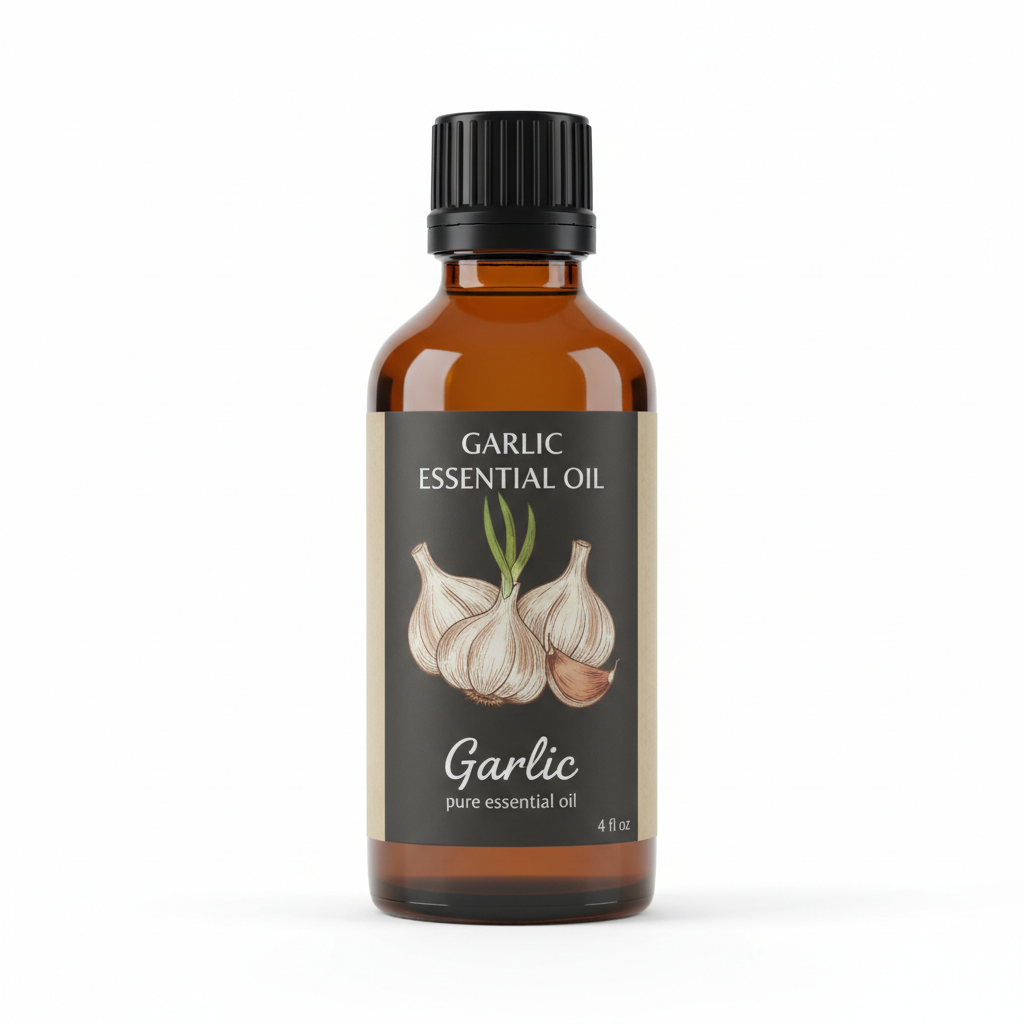
Garlic Essential Oil
Our own Garlic Essential Oil, in sizes from 0.5 oz to bulk.
From $10.99
Shop Now →Pick the ceiling first
Our dilution guidance for garlic oil on skin is 0.5% to 2% in a carrier oil, with a patch test first and a start at the low end. For comparison, the Tisserand Institute's general ranges for essential oils are 0.2% to 1% for sensitive or impaired skin, 0.5% to 1.2% for the face and underarms, and 1% to 3% for body oils and lotions, with the advice to start low and raise the concentration only if needed (Tisserand Institute, dilution guide). Those ranges cover essential oils as a class, not garlic in particular, and the NIH notes that fresh raw garlic "can cause severe skin irritation and chemical burns" (NCCIH, Garlic).
Putting those together is our own reasoning. Because our 2% ceiling sits above the face range, we would make 0.5% the working number, save 2% for a small patch-tested area of body skin, and keep garlic oil off the face and underarms.
Why weight beats drops
A drop is a convention, not a unit. The usual figure is about 20 drops to the milliliter, but droppers differ and thick oils fall differently from thin ones. Weight does not wobble. The Certificate of Analysis we publish for one batch gives a relative density of 1.075, so a milliliter weighs about 1.075 g. The oil you need is the finished weight times the percentage:
| Finished batch | At 0.5% | At 1% | At 2% |
|---|---|---|---|
| 50 g | 0.25 g, about 5 drops | 0.50 g, about 9 drops | 1.00 g, about 19 drops |
| 100 g | 0.50 g, about 9 drops | 1.00 g, about 19 drops | 2.00 g, about 37 drops |
A kitchen scale that reads to 1 g cannot weigh 0.25 g at all, and one that reads to 0.01 g handles it with an error of a few percent. The drop counts assume the 20-per-ml convention and carry dropper error on top. If you only have volume to work with, our carrier oil guide has the per-ounce drop figures.
When the amount is less than one drop
Small batches are where people overshoot. A 10 g roller bottle at 0.5% needs 0.05 g, which is about one drop and no more precise than that. The answer is a stock solution. Weigh 1 g of garlic oil into 9 g of carrier for a 10% stock, mix well, and take your working amount from that. For a 100 g batch at 0.5%, you need 5 g of stock, since 5 g at 10% carries 0.5 g of oil. For 10 g at 0.5%, you need 0.5 g of stock, which a 0.01 g scale can handle.
Stock is five times our 2% ceiling, so handle it like the strongest thing on your bench: gloves, ventilation, a label with the percentage and date, and out of reach of children and pets. Make the least you can and use it up. The Tisserand Institute notes that oxidation products tend to increase the chance of skin reactions, and that heat, light, moisture and air in the bottle all speed oxidation (Tisserand Institute, oxidation). A diluted blend that has sat for a year is better remade.
Other uses, other measures
- Diffuser: we suggest starting with a single drop in a well-ventilated room. No percentage applies. Our diffusing guide covers pets and children.
- Soap and candles: a trace goes a long way, and a soap or candle supplier is the right source for a rate. We sell only the garlic oil, not bases or wax.
- Hair and scalp: the arithmetic, and our reasons for skipping it, are in the hair mask article.
- Food: our oil is not for internal use, so no dilution table applies. Use garlic itself.
What dilution does and does not do
Dilution lowers the amount on each square centimeter of skin. It does not decide whether a reaction would be irritation or true allergy, a difference our irritation article explains. It does not remove the smell, which lingers on hands and cloth long after you finish. And stirring the oil into water does not dilute it, since oil floats on water, so a "spray" with a layer of garlic oil on top delivers it undiluted.
A practical habit that pays off: keep a small notebook by the scale. Write the date, the finished weight, the percentage and the amount of oil for every batch you make. When you want to repeat a blend you like, or lower one that smells stronger than you expected, the numbers are right there.
The order to work in
- Pick the ceiling for the body area, using 0.5% unless you have a reason and a patch-tested spot for more.
- Weigh the carrier into a clean glass container, then work out the oil from the table or from finished weight times percentage.
- Add the oil or the stock, mix, and label with percentage, date and contents.
- Patch test a small spot of the finished blend. A patch test tells you more about irritation than about allergy.
- If skin reacts, rinse with running water for at least 15 minutes, with mild soap if material clings, as Poison Control advises (Poison Control, first aid). A blister or a rash that lingers belongs with a dermatologist, and our burn article shows what the documented cases look like.
The short version: 0.5% by weight, made once, labeled and used up, beats any amount of careful drop counting. Our safety guide covers who may want to skip the oil entirely.
Garlic Essential Oil
Garlic Essential Oil from our own shop, in sizes from 0.5 oz to bulk.
From $10.99
Shop Now →Sources & Further Reading
- Tisserand Institute. Dilution guide. tisserandinstitute.org/safety/dilution
- Tisserand Institute. Is my bottle of essential oil oxidized or no longer good to use? tisserandinstitute.org/learn-more/oxidized
- NCCIH. Garlic. nccih.nih.gov/health/garlic
- National Capital Poison Center. First aid for poisonings. poison.org/first-aid-for-poisonings