Garlic Lab Studies: What Petri Dish Results Mean
Garlic has a way of looking impressive under a microscope. Dozens of papers report that garlic compounds slow the growth of bacteria and fungi in a dish, and it is easy to read that as "garlic fights infection." The more interesting story is smaller and more careful: what each paper actually tested, in what form, and what that does and does not tell you. We sell garlic essential oil as an aroma material and make no antimicrobial claim for it, so this is a tour of the science for the curious.
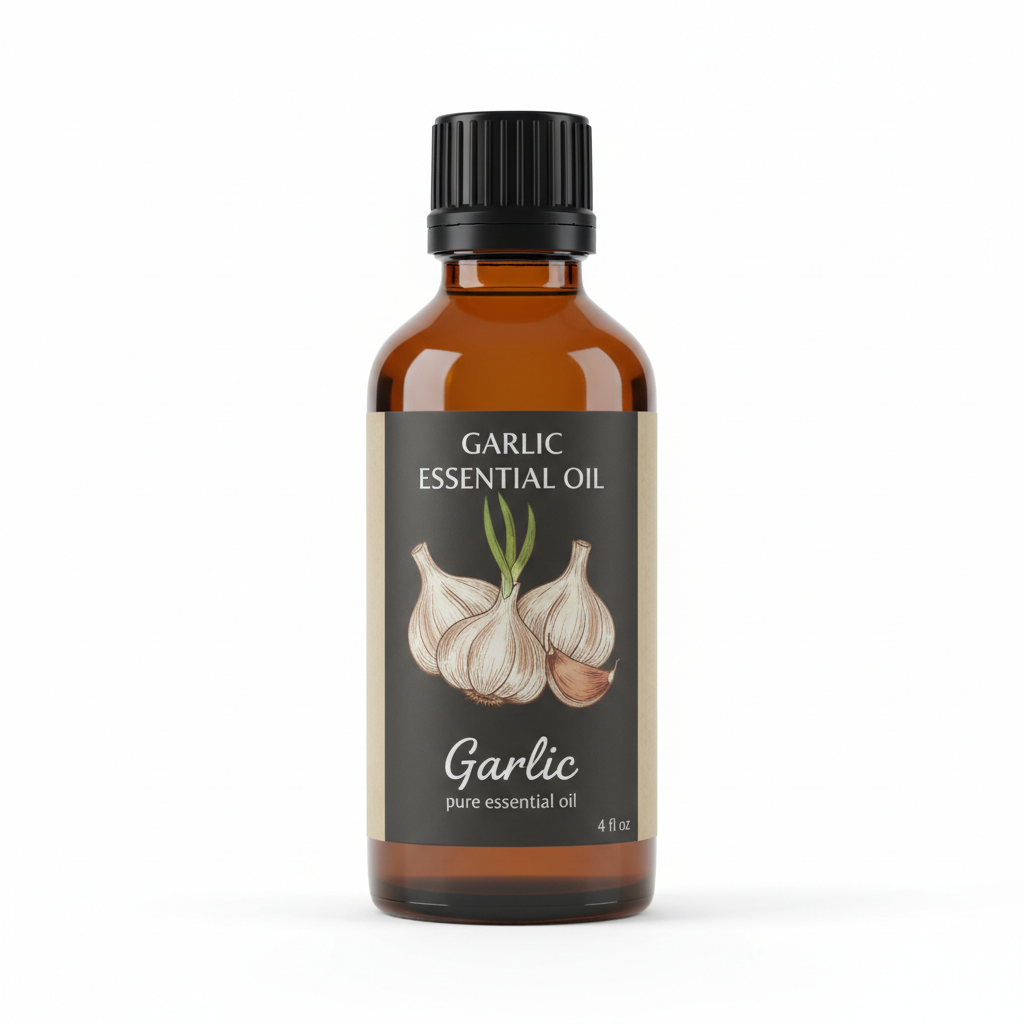
Garlic Essential Oil
Our own Garlic Essential Oil, in sizes from 0.5 oz to bulk.
From $10.99
Shop Now →"Garlic" is several different things
The famous work on allicin used the pure compound, which forms when a clove is crushed. A 1999 review reported that pure allicin showed activity against a wide range of bacteria, Candida albicans and some parasites. It explained the mechanism as a chemical reaction with thiol groups in enzymes (Ankri and Mirelman, 1999). Reasoning from that, and this is our inference rather than the review's claim, a compound that reacts with thiol groups in many enzymes is unlikely to pick only microbes, which fits what NCCIH reports about raw garlic irritating skin (NCCIH, Garlic).
A distilled garlic oil is another mixture altogether. One analysis found diallyl trisulfide (39.79%), diallyl disulfide (32.91%) and diallyl sulfide (7.02%) leading (Gong et al., 2021). A 2026 paper analysing a different garlic oil reported propyl propane thiosulfonate as the top compound at 30.3% (Florina et al., 2026). So two papers can both say "garlic oil" and be testing quite different liquids, which is a good reason to be wary of any one number.
What recent studies tested
Here is a sampling, and notice how far each one sits from a person:
- Wood-rotting fungi. Gong and colleagues tested garlic oil against two timber-decay fungi for a possible wood preservative. The pure main compound beat the whole oil on both fungi, so a result for one ingredient does not transfer to the mixture, or the reverse.
- Aquaculture. Florina and colleagues tested several essential oils as possible fish feed additives. Their abstract reports strong activity for garlic and some minimum inhibitory concentrations comparable to or lower than gentamicin, but it gives no number for garlic, so we can say no more than that.
- Emulsions. A 2026 study of sage and garlic oil emulsions found that antimicrobial activity depended on how the emulsion was made and for how long, and that Gram-negative bacteria were more resistant (Kamau et al., FEMS Microbiology Letters, 2026).
- Food preservation. In a second Kamau paper, garlic oil paired with chitosan lowered the amount of each needed against several fish spoilage and pathogenic bacteria, by 16-fold for chitosan and 8-fold for the oil (Kamau et al., Food Science and Nutrition, 2026).
The common thread is worth noticing. These are food science, wood science and aquaculture experiments, using emulsions, solvents and standardized microbes. Garlic oil does not mix with water, so every lab has to choose a way to disperse it, and the emulsion paper shows that the choice alone changes results. A figure from a dish tells you about that dish.
Four questions for any lab claim
- What was tested: a pure compound, a whole oil, a juice, an emulsion?
- Against what: a standard lab strain, or something that grows on a real surface?
- At what strength, and compared with what? A result "comparable to" another treatment only means something once you know the dose of both.
- Did anyone repeat it somewhere else?
Run any garlic headline through those four and you will find most of them shrink to a modest, specific sentence. That is not a letdown. A modest, specific sentence is how real science usually sounds.
It also helps to remember that a lab is a tidy place. Temperatures are controlled, microbes are standard strains, and nothing gets wiped, rinsed or touched by a hand. Real life is messier, and good scientists say so in their own conclusions.
The distance from lab to person
When researchers ask about people, the evidence gets thinner. A 2025 review of complementary treatments for skin infections looked at 17 studies and put garlic-derived ajoene among the agents that show promise but lack robust randomized trial validation (Ufomadu et al., 2025). That is the honest summary: interesting chemistry, early evidence.
For a spreading, painful or lingering infection, a physician is the right call, and a dermatologist or pharmacist for suspected fungal infections of skin or nails. Please do not put garlic oil, essential or infused, in an ear, on a wound or on broken skin. If you are curious about how we suggest handling the oil, our dilution basics and skin irritation guide explain our 0.5% to 2% range for skin. For a look at what has and has not been measured more broadly, see our evidence overview, and for one trial that has been done in people, our colds review.
Why we still love writing about it
We came to garlic oil for its character. Open the bottle and you meet a bold, savory, sulfurous smell that nothing else on the shelf quite matches, and that is the material we sell. The studies are wonderful reading and we enjoy sharing them, but they stay in the lab for a reason, and we would rather you enjoy them as curiosity than take them home as instructions.
Garlic's chemistry is fascinating in the lab, and the best thing we can do is describe it for what it is.
Garlic Essential Oil
Garlic Essential Oil from our own shop, in sizes from 0.5 oz to bulk.
From $10.99
Shop Now →Sources & Further Reading
- Ankri S, Mirelman D. Antimicrobial properties of allicin from garlic. Microbes Infect 1999;1(2):125-129. PMID 10594976
- Gong X et al. Diallyl trisulfide, the antifungal component of garlic essential oil and the bioactivity of its nanoemulsions formed by spontaneous emulsification. Molecules 2021. PMID 34885768
- Florina CL et al. Phytobiotic essential oils as antibiotic alternatives in aquaculture: antimicrobial and antioxidant properties of garlic, thyme, thyme conehead, rosemary, and eucalyptus. 2026. PMID 42039763
- Kamau PG et al. A comparative study on the effects of emulsification methods on the antimicrobial activity of essential oil emulsions. FEMS Microbiol Lett 2026. PMID 41848567
- Kamau PG et al. Synergistic activity of natural antimicrobials against common fish spoilage and pathogenic bacteria. Food Sci Nutr 2026. PMID 42491780
- Ufomadu P et al. A review of the efficacy of complementary and alternative medicines in managing dermatologic infectious diseases. J Clin Aesthet Dermatol 2025. PMID 41647766
- NCCIH. Garlic. nccih.nih.gov/health/garlic