Why Does Garlic Oil Smell So Strong? The Sulfur Story
Here is a small surprise: the smell most people call allicin is mostly not allicin by the time garlic reaches a still. Allicin is a fleeting molecule. It appears when a clove is crushed, then falls apart within moments, and what ends up in a bottle of distilled garlic oil is the family of sulfur compounds that come after it.
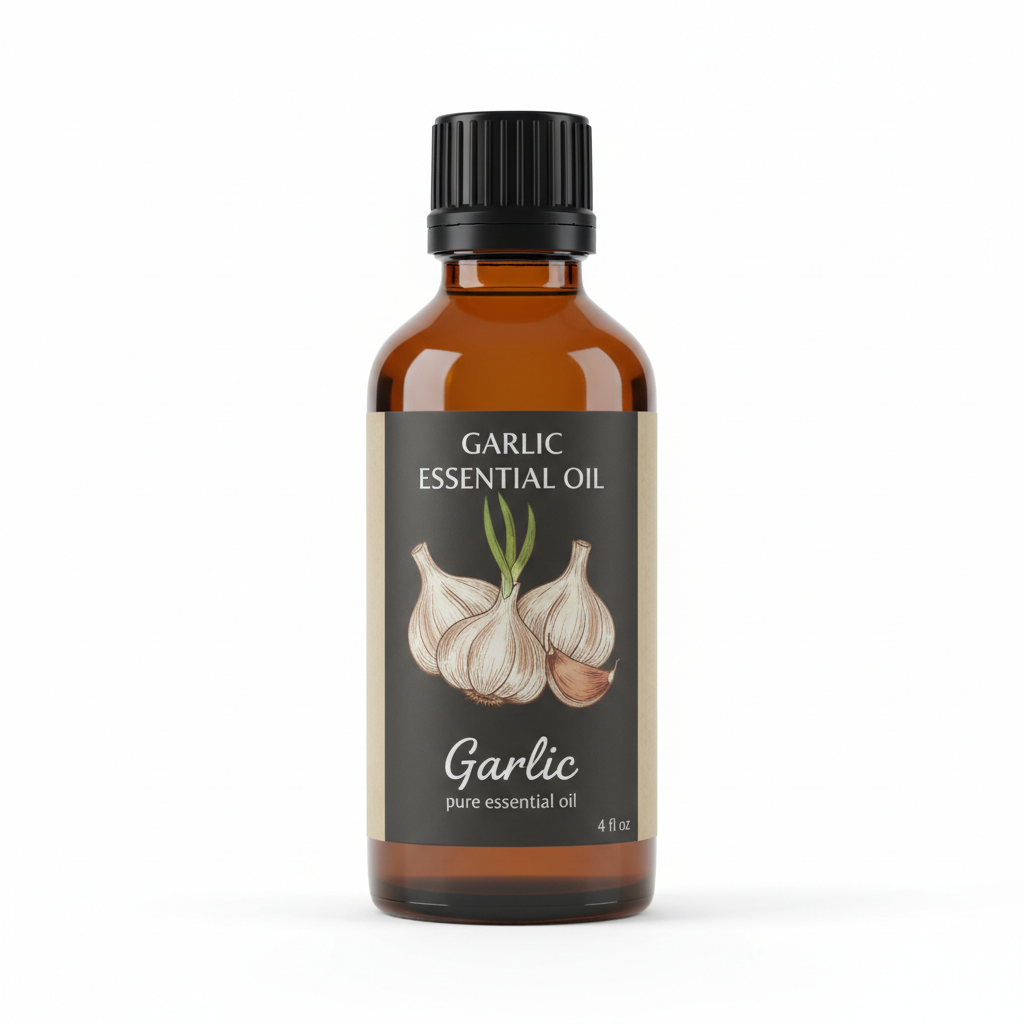
Garlic Essential Oil
Our own Garlic Essential Oil, in sizes from 0.5 oz to bulk.
From $10.99
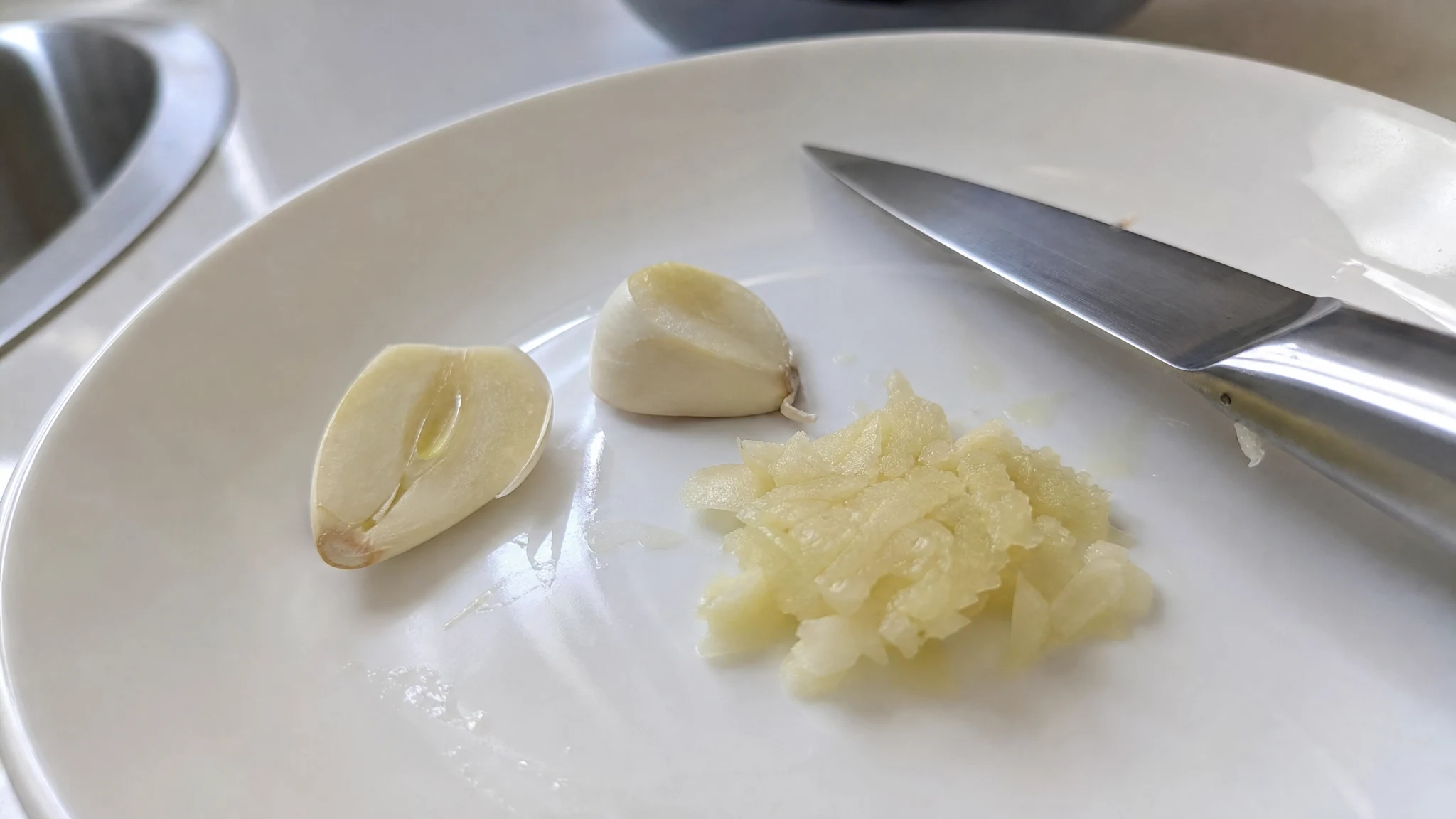
Shop Now →If you have ever chopped garlic and noticed that the smell gets bigger the longer you work, you have already watched this chemistry happen on your cutting board. The story below is just that kitchen moment explained.
Crushing starts the clock
An intact clove keeps its raw material and its enzyme in separate places. Damage the cell and the enzyme alliinase meets alliin, converts it to allyl sulfenic acid, and two of those molecules join to make allicin. A thorough review of the chemistry describes allicin as highly reactive with low thermal stability, which is why it is so hard to capture and store. The same pattern shows up in a cancer-prevention review, which notes that allicin breaks down into ajoene, vinyldithiins and sulfides, and that it and its oil-soluble relatives are largely responsible for garlic's odor. Heat denatures the enzyme, which is why a clove fried whole smells milder than one crushed raw.
What the still keeps
In a 2017 study, chopped bulbs from Las Pedroñeras in Spain were distilled three ways and analyzed. Allicin showed up only as a trace in the two hydrodistillations and was not detected in the industrial steam-distilled oil. What came over instead was a set of sulfides, led by diallyl disulfide in the steam-distilled oil and by diallyl trisulfide in the laboratory hydrodistillation. In other words, the leader changes with the method, so garlic oil is better thought of as a family of profiles than a single formula. Published figures from other countries vary widely too, which is a good reason to treat any one number with some suspicion.
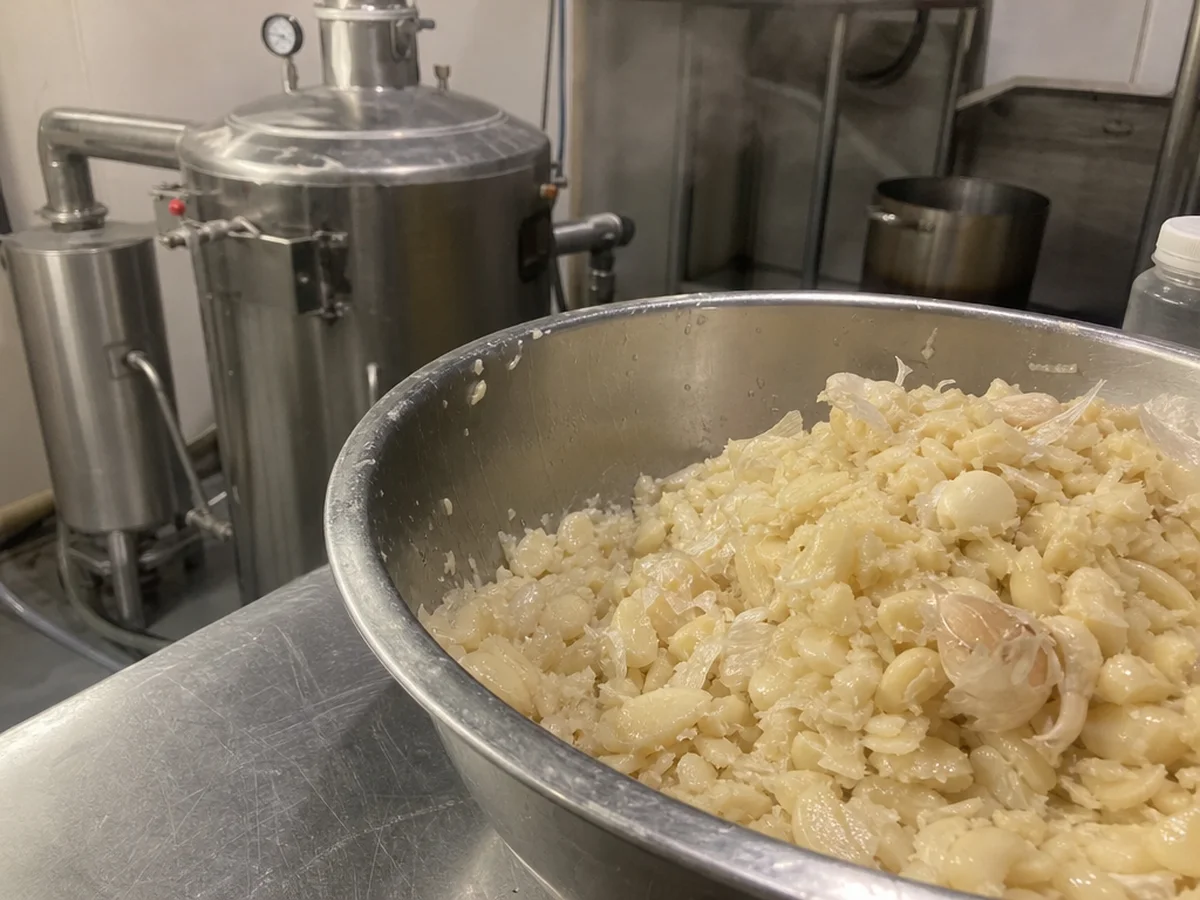
Our garlic oil is steam-distilled from crushed bulbs and sold undiluted. The Certificate of Analysis we publish for one batch lists a relative density of 1.075 and a refractive index of 1.566. If a sulfide profile matters for your work, ask us in writing through the contact page for the report for your lot.
Meeting the smell on a strip
Put a drop on a blotter strip and give it your attention. First comes the sharp, almost startling sulfurous edge. Within a few minutes it rounds into something more savory, and an hour later what is left is lower, heavier and lingering. That slow shift is what a perfumer means by a base note, and our product page lists garlic as one. It is worth doing once just to hear how the story unfolds.
Why a drop outweighs a clove
At the 0.18% yield from that steam-distilled run, one gram of oil represents roughly 555 g of bulbs, and a fluid ounce of oil at our certificate's density (about 31.8 g) stands for something like 17.7 kg of garlic. That is our arithmetic on one study's yield, so read it as scale, not a promise. It does explain why a single drop can carry the character of many cloves, and why we always describe this oil as something to measure sparingly.
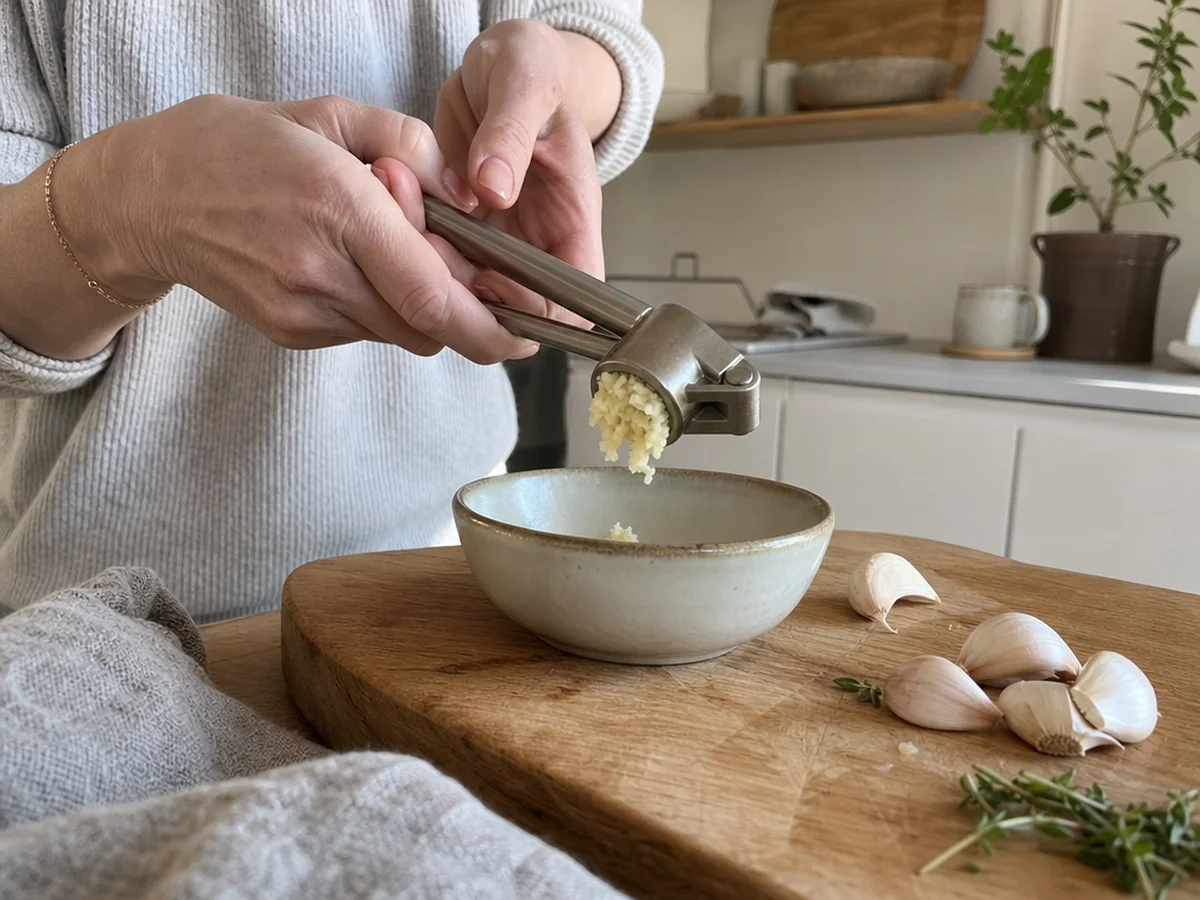
The sulfides are also already volatile and concentrated, with the water and bulk of the clove left behind. A 2023 study of raw sliced garlic found the headspace dominated by allyl mercaptan, and that frying cut the main volatiles by 75 to 99 percent while all four were still above their odor thresholds. Reasoning from that, a little of the concentrated oil leaves a bigger aroma footprint than the same weight of garlic would.
A few habits make a big smell easier to live with. Work beside an open window. Cap the bottle between sniffs. Keep a lidded jar for used strips so they do not scent the whole room. None of it is complicated, and all of it helps.
Living with the scent
The same study tested what quiets those volatiles in a closed container, and whole-milk yogurt cut the raw-garlic compounds by 99%. We mention it only as a pointer for cleanup, and the deodorizing guide goes through what to do with hands and boards. If you are weighing how garlic oil differs when it is distilled versus extracted with CO2, the steam versus CO2 comparison picks up where this one stops, and the label and lot report guide shows how to read a report if you request one.
A strong smell is a character reference, not a certificate. It tells you that sulfur compounds are in the bottle, and it is a great reason to love the oil, but it does not tell you everything about a lot. For that you want paperwork.
Handle it with ventilation and a little respect. The smell that follows you out of the room is the sulfur chemistry doing exactly what it evolved to do.
Garlic Essential Oil
Garlic Essential Oil from our own shop, in sizes from 0.5 oz to bulk.
From $10.99
Shop Now →Sources & Further Reading
- Borlinghaus J et al., 2014. Allicin: Chemistry and Biological Properties. Molecules 19(8):12591-12618. pmc.ncbi.nlm.nih.gov/articles/PMC6271412
- Nicastro HL, Ross SA, Milner JA, 2015. Garlic and onions: their cancer prevention properties. Cancer Prev Res 8(3):181-189. pmc.ncbi.nlm.nih.gov/articles/PMC4366009
- Satyal P, Craft JD, Dosoky NS, Setzer WN, 2017. The chemical compositions of the volatile oils of garlic (Allium sativum) and wild garlic (Allium vineale). Foods 6(8):63. pmc.ncbi.nlm.nih.gov/articles/PMC5575638
- Kaur M, Barringer S, 2023. Effect of yogurt and its components on the deodorization of raw and fried garlic volatiles. Molecules. pmc.ncbi.nlm.nih.gov/articles/PMC10420880