Garlic Oil on Skin: A Careful Step-by-Step Approach
Garlic has a long reputation as a kitchen remedy, so it is natural to wonder what a concentrated garlic oil might do on skin. The short, friendly answer from the research is that garlic and skin do not make an easy pair, and that the most helpful thing we can offer is a plan for handling the oil carefully. That is what this article is: how we would think it through, in order.
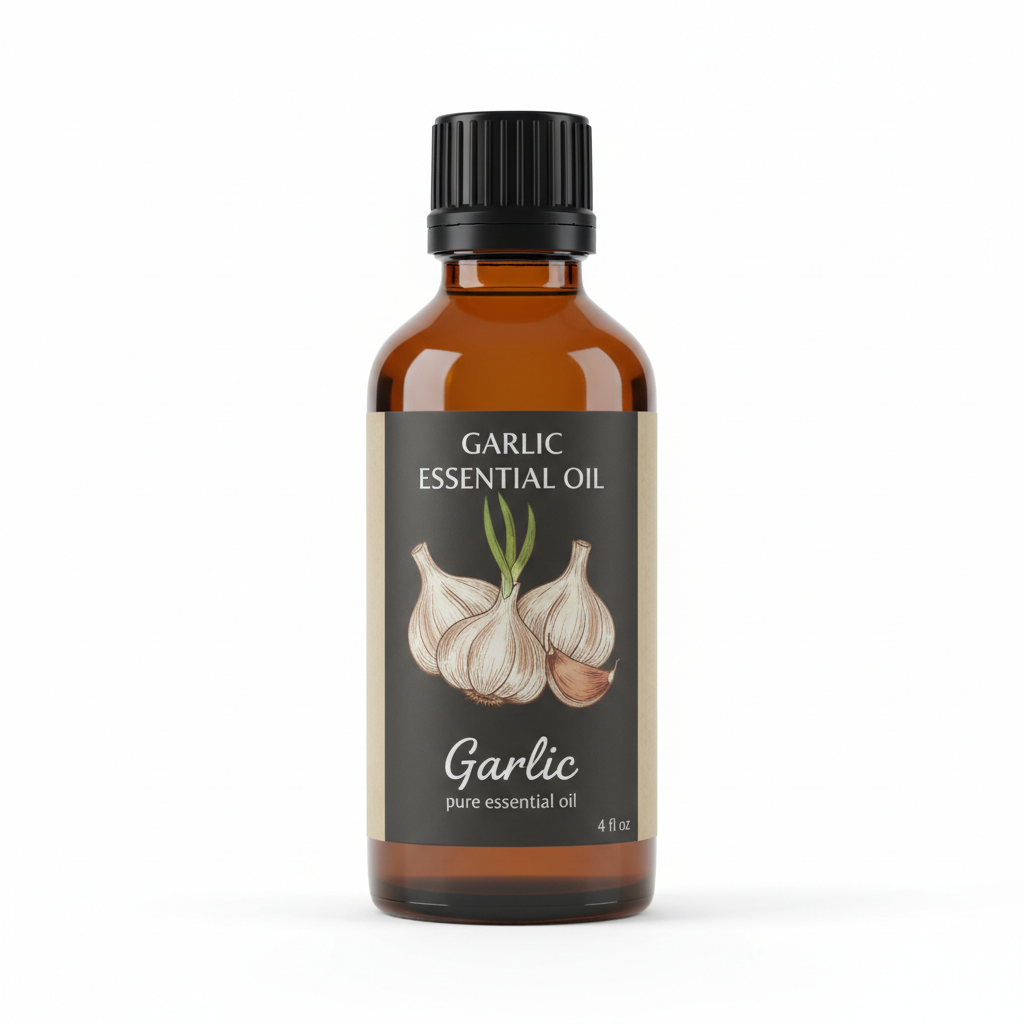
Garlic Essential Oil
Our own Garlic Essential Oil, in sizes from 0.5 oz to bulk.
From $10.99
Shop Now →Why raw garlic gets a cautious reception
The National Center for Complementary and Integrative Health says fresh raw garlic may not be safe when used topically and can cause severe skin irritation and chemical burns (NCCIH, Garlic). That is the plant, not the essential oil, but it tells you where the conversation starts.
Published case reports fill in the picture. A systematic review found 39 patients across 32 articles with burns from raw garlic, most second-degree, and pointed to volatile sulfur compounds as the likely cause (Hitl et al., 2021). A dermatology letter titled "Garlic Burn: A Home Remedy Gone Wrong" describes a garlic burn from a home remedy (Madke and Das, 2021). These are individual cases, so they cannot give a rate, but the shape repeats: crushed garlic, hours of contact, often a covering.
The oil lingers on skin and cloth far longer than people expect, and undiluted garlic oil can irritate skin readily. That is why our guidance is to dilute heavily and patch test first, in three steps: dilute, test a small spot, and wait.
A decision order we like
This is our reasoning from the sources, not medical advice. Stop at the first yes.
- Is the skin broken, blistered, infected, or showing a rash you cannot name? A physician or dermatologist is the person to see.
- Is this for an infant or young child, someone pregnant or breastfeeding, or a person with a diabetic foot problem? Ask the child's pediatrician, an obstetric clinician or the diabetes care team. NCCIH notes that little is known about topical garlic in pregnancy and breastfeeding.
- Would it be covered with a bandage, tape or wrap? Covering is the common thread in the burn reports, so we steer away from it.
- Is it raw, crushed garlic? That is the form behind the burns.
- Is it undiluted essential oil? Dilute first, always.
Anyone who gets through all five is in the territory where our dilution guidance applies: 0.5% to 2% in a carrier oil with a patch test, starting at the low end. The dilution basics post has the drop counts.
How to picture a patch test
A patch test is a small, unglamorous, sensible thing. Mix the diluted blend you actually plan to use, put a tiny dab on your inner forearm, and then leave it alone. Do not cover it with a bandage. Jot the time on a sticky note so you remember to look, and look again a couple of days later. If the spot is quiet, that is encouraging but it is not a promise. If anything stings, itches or reddens, wash it off with plenty of water and treat that as your answer.
What people point to, and what it actually studied
The best-known skin study is a double-blind trial in soldiers with athlete's foot. It used ajoene, one purified garlic compound, in a fixed-dose gel, compared with a standard antifungal (Ledezma et al., J Am Acad Dermatol, 2000). That is an interesting piece of chemistry, but it was a purified compound and not an essential oil, and a fungal infection is a job for a clinician. We cover it in the fungus article.
The same story repeats for acne and for wounds, where a home garlic preparation is simply not a good fit and a clinician is the right call. Our acne and wounds pieces explain why, and the burns article covers first aid.
Getting to know it on paper first
Before any skin, there is paper. Put one drop on a blotter strip and carry it to a room with an open window. In the first minute you will notice the sharp, sulfurous edge. Give it a while and it rounds out into something more savory, and an hour later the strip is still talking. That slow change is a good reason to be patient with this oil, and a good reason not to judge it from the first sniff.
Why we still love it as a scent
What garlic oil does extremely well is smell like garlic, with a savory depth that holds on. That is the reason to keep it around: soap and candle experiments in tiny amounts, scent studies, or a carefully diluted balm trial where the point is aroma. We make no skin claim for it, and it is not a moisturizer or a treatment. If you would like to explore it, begin with a blotter strip and a ventilated room, and let your nose decide how much is enough.
One more small-business-owner recommendation: if you are ever unsure whether a plan is a good idea, make the first batch smaller than you think you need. A tiny amount costs you almost nothing if you change your mind, and a lot of this oil is hard to undo once it is on your hands, your cloth and your room.
Handled that way, a very small amount goes a very long way.
Garlic Essential Oil
Garlic Essential Oil from our own shop, in sizes from 0.5 oz to bulk.
From $10.99
Shop Now →Sources & Further Reading
- Garlic, National Center for Complementary and Integrative Health
- Garlic burn injuries- a systematic review of reported cases, Hitl et al., Am J Emerg Med, 2021
- Garlic Burn: A Home Remedy Gone Wrong, Madke and Das, Indian Dermatol Online J, 2021
- Efficacy of ajoene in the treatment of tinea pedis: a double-blind and comparative study with terbinafine, Ledezma et al., J Am Acad Dermatol, 2000