Garlic Oil in the Kitchen or Workshop: Which Bottle?
Type "garlic oil" into a search box and you are really asking about two different bottles. One lives next to the stove and holds garlic that has been steeped in cooking oil. The other is ours: a small, intensely aromatic distillate that belongs on the workshop bench. They share a name and almost nothing else, so it is worth sorting out which job you have before you open anything.
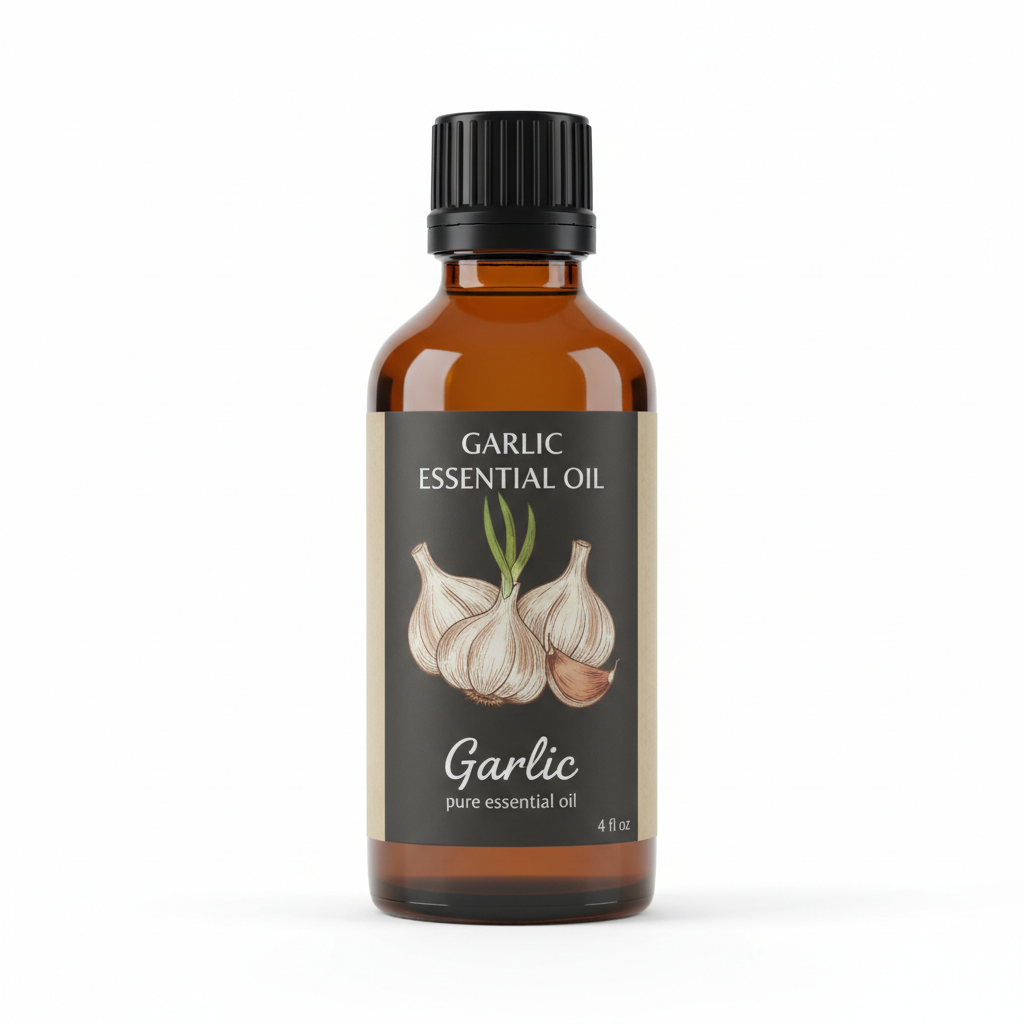
Garlic Essential Oil
Our own Garlic Essential Oil, in sizes from 0.5 oz to bulk.
From $10.99
Shop Now →The stove bottle and the bench bottle
Garlic essential oil is what carries over when crushed bulbs are distilled, and it is almost entirely sulfur compounds. A single drop can carry the character of many whole cloves, which is why we always talk about it in drops. We sell it undiluted, in amber glass, in sizes from 0.5 oz up to 400 lb, and our product guidance is clear: it is not for internal use. That means it never goes into a pan, a dressing or a marinade.
There is a sensible reason behind that line. Poison Control explains that some essential oils are poisonous when swallowed, and that breathing a swallowed oil into the lungs can cause pneumonia. Anyone who has swallowed one should call a poison center at 1-800-222-1222 (Poison Control).
Food law does recognise garlic oil as a flavoring, but as an ingredient made and documented for food: the federal rule covers garlic and its derivatives, oils included, at good manufacturing practice levels, and expects the oil to meet the Food Chemicals Codex (21 CFR 184.1317). Our bottle is sold as an aroma material, so that rule is not a green light for our oil. If you want to understand the difference between flavoring and aroma grades, our flavoring explainer goes through it.
If you want garlic flavor, here is the honest route
Fresh garlic is the answer for most dishes, and a jar of garlic oil labelled and sold as a food covers the rest. If you would rather make your own infusion, treat it as the food-safety project it is. Penn State Extension explains that garlic and herbs are low-acid, that submerging them in oil removes oxygen, and that this setting lets Clostridium botulinum spores grow at room temperature and produce toxin (How to Safely Make Infused Oils).
The CDC's everyday rule is short: refrigerate homemade oils made with garlic or herbs and throw them away after 4 days (Botulism Prevention). Penn State also describes an acidified method, built around a citric acid soak, that allows room-temperature storage, and it stresses that a weaker solution can leave you with an unsafe oil. If you go that way, follow the page exactly, and take any question it does not answer to your county extension office. Our storage article and the infused-oil comparison fill in the rest.
Where our oil earns its place
The bench is where we recommend it. Our product guidance lists a trace in workshop soap and candles, a drop in a diffuser with plenty of ventilation, heavily diluted balm prototypes judged on scent strength, and scent studies beside onion or ginger oils on a blotter strip. That last one is a lovely way to meet the oil: a paper strip, a single drop, and a few minutes to notice how the aroma changes from sharp and sulfurous to savory and lingering.
Three habits make workshop use easier.
- Work somewhere ventilated. The smell lingers on skin, cloth and in a room for far longer than most people expect, so pick the place for your first trial deliberately.
- Dilute anything that touches skin. We recommend 0.5% to 2% in a carrier oil with a patch test first, and with garlic it makes sense to begin at the low end. The dilution basics post has the drop arithmetic, and the burns article explains why we are careful.
- Keep the cap on and the bottle out of reach of children and pets, in a cool, dark place.
Carrier oils, soap base, wax and wicks are not things we sell; a craft or soap-supply shop will have them. If you are curious how the oil behaves in a diffuser, read the diffusing article first.
A first evening at the bench
If you are new to the oil, plan the evening before you open anything. Set out a few blotter strips, a pen, a jar with a lid for used strips, and a window you can open. Open the bottle briefly and cap it again before you set it down. You will notice how quickly the sharp, sulfurous top of the aroma fills the space, and how the savory depth shows up a few minutes later. Write a few words on each strip as you go, and keep the used strips in the lidded jar so the rest of the house is spared.
What about the garden?
People often wonder about garlic sprays for plants. We make no pest-control claims for our oil and do not recommend it for that. A homemade spray for pests can fall under pesticide rules, so read EPA's conditions for minimum risk products (Conditions for Minimum Risk Pesticides) and ask your county extension office. Our EPA article explains what that page says.
When you are unsure which bottle you are holding, read what the label says about itself. Ours says what it is, an undiluted distillate, and that it is not for internal use. A jar sold as food will say so in plain words.
So the short version is easy to remember: garlic cloves and food-labelled products for the table, our essential oil for the workbench, and a good strip of blotter paper for the curious.
Garlic Essential Oil
Garlic Essential Oil from our own shop, in sizes from 0.5 oz to bulk.
From $10.99
Shop Now →Sources & Further Reading
- Essential oils: Poisonous when misused, Poison Control
- 21 CFR 184.1317, Garlic and its derivatives
- How to Safely Make Infused Oils, Penn State Extension
- Botulism Prevention, CDC
- Conditions for Minimum Risk Pesticides, US EPA