Does Garlic Help Hair? One Small Trial, Read Closely
People search for garlic and hair with real hope, so it deserves a straight answer: the research is thinner than the internet suggests, and the best-known study did not use an oil at all. It used a gel, alongside a steroid cream, in people with a specific condition. Here is what that means.
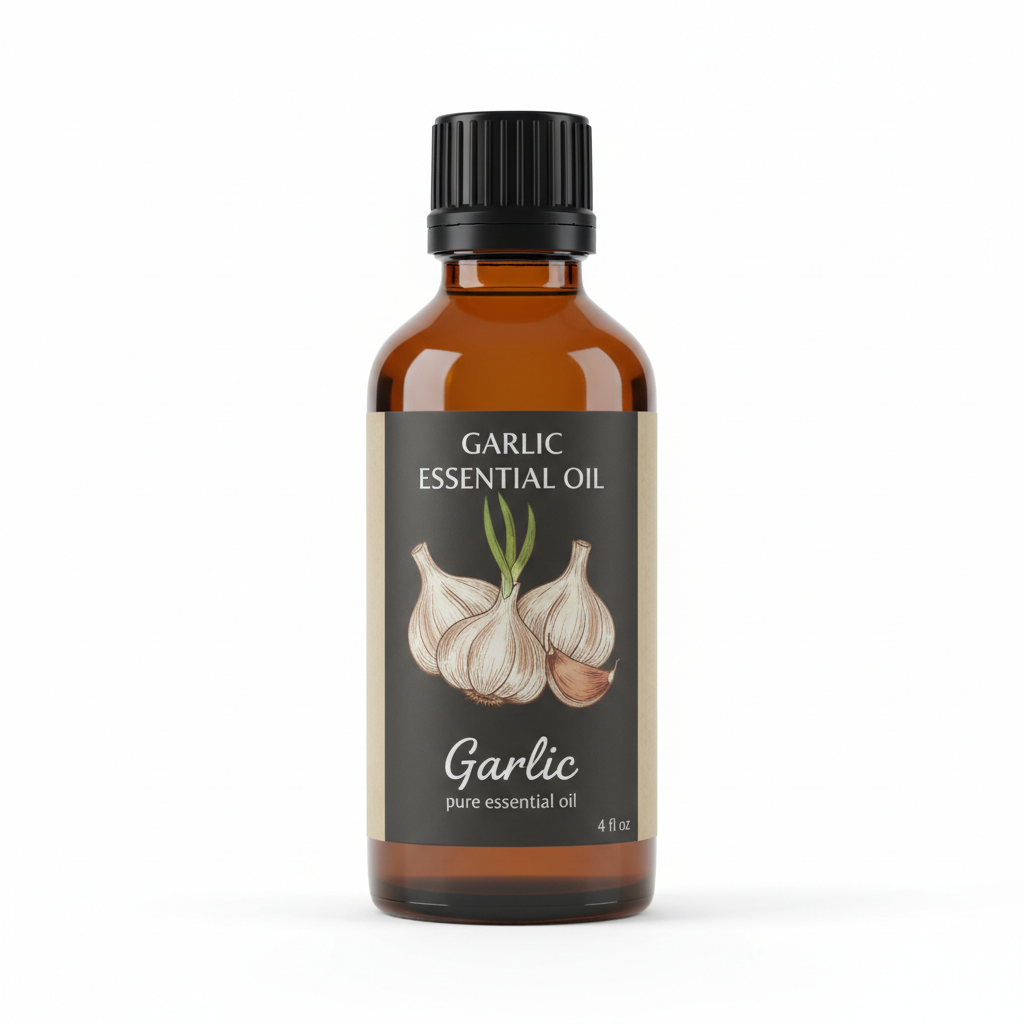
Garlic Essential Oil
Our own Garlic Essential Oil, in sizes from 0.5 oz to bulk.
From $10.99
Shop Now →The study everyone cites
In a randomized, double-blind trial, 40 people with localized alopecia areata, the condition that causes round patches of hair loss, were split into two groups of 20. Everyone used betamethasone 0.1% cream twice daily for three months. One group also applied a 5% garlic gel under a dressing for an hour twice daily, and the other used a placebo gel. At three months, 19 of the 20 garlic-gel patients were rated a good response, and the authors found that significantly better than the control group, with no complications reported (Hajheydari and colleagues, 2007).
It is a legitimate study, and it is useful to see how narrow its question is. Both groups used the steroid, so the trial asked whether garlic gel added something on top of a steroid, not whether garlic alone does anything. The authors themselves note that alopecia areata often clears up without treatment, and with 20 people per group in one centre, they present it as a sign that garlic gel may be a useful add-on and not as proof.
How headlines flatten the details
It is easy to see how "garlic gel plus a steroid cream in people with patchy hair loss" turns into "garlic grows hair." Each retelling drops a detail. First the gel goes, then the steroid, then the diagnosis, and by the time it reaches a social post only the word garlic is left. If a claim has caught your eye, find the original paper and read the first paragraph and the methods before you read anything else. The ingredients list and the people studied tell you more than the headline ever will.
What it did not test
It did not test an essential oil, so a gel at a set strength cannot be turned into a number for ours. It did not look at gradual thinning, which is what most people searching for hair help are actually experiencing. And we are not aware of a larger follow-up. The honest label is one small trial, in one condition, with a steroid alongside.
For perspective, the oil that has had a head-to-head trial is rosemary: a 6-month comparison with minoxidil 2% in 100 people with androgenetic alopecia found that both groups had increased hair counts, with no significant difference between them (Panahi and colleagues, 2015). We compare the two oils in garlic oil versus rosemary oil for hair, though we sell only the garlic oil.
A note on hope
Hair is personal, and it makes sense that people go looking for answers when something changes. We would never want anyone to feel foolish for searching. The kindest thing we can say is that good answers exist, they just come from people who can look at your scalp, and a bottle of aroma oil is not one of them.
Where we would start
If hair loss is worrying you, the first useful step is a name for it. The American Academy of Dermatology says a board-certified dermatologist can confirm whether you have alopecia areata and what may help, and that hair may regrow on its own in about a year, though without treatment it may also stay the same or worsen. Round patches, shedding after illness and slow thinning are different situations, and a clinician can tell them apart in minutes.
Raw garlic on the scalp is worth steering clear of. The NCCIH says fresh raw garlic can cause severe skin irritation and chemical burns, and our post on garlic burns goes through what the reports describe.
What a good question looks like
Instead of asking whether garlic is good for hair, try asking who was studied, what exactly they used, and what they compared it with. Those three questions can be asked of any product and any headline. They take a minute, they do not require a science degree, and they will save you from a lot of confident-sounding claims that fall apart on contact with the details.
If you simply love the scent
Our garlic essential oil is an undiluted aroma and workshop material, not for internal use, and we make no claim about hair. If you are working with it for its scent, we recommend 0.5% to 2% in a carrier with a patch test, starting at the low end and keeping it away from eyes, children and pets. A half percent in 1 oz of carrier is about three drops, using the usual 20 drops to the millilitre. Our hair mask arithmetic and dilution basics walk through the sums, and garlic oil for hair covers the wider question.
If you do pick up a bottle just for the aroma, give it a slow first meeting. One drop on a strip, a ventilated room and ten patient minutes will show you the sharp opening settle into something savory and lingering.
The most hopeful thing in this research is not a bottle, it is that hair loss now has a clinic full of better-studied options.
Garlic Essential Oil
Garlic Essential Oil from our own shop, in sizes from 0.5 oz to bulk.
From $10.99
Shop Now →Sources & Further Reading
- Hajheydari Z, Jamshidi M, Akbari J, Mohammadpour R, 2007. Combination of topical garlic gel and betamethasone valerate cream in the treatment of localized alopecia areata. Indian J Dermatol Venereol Leprol. ijdvl.com
- Panahi Y, Taghizadeh M, Marzony ET, Sahebkar A, 2015. Rosemary oil vs minoxidil 2% for the treatment of androgenetic alopecia: a randomized comparative trial. Skinmed. PubMed 25842469
- American Academy of Dermatology. Alopecia areata. aad.org
- National Center for Complementary and Integrative Health. Garlic. nccih.nih.gov