Garlic Oil Hair Mask: How Much to Use and How to Test
Garlic oil is not a shy ingredient. Our product page describes the aroma as pungent, savory and sulfurous with lasting depth, and as a base note, which in perfumery terms means it stays long after everything else has faded. Put that on your hair and it comes with you everywhere, so this is a formulation to approach with a ruler and a very light hand.
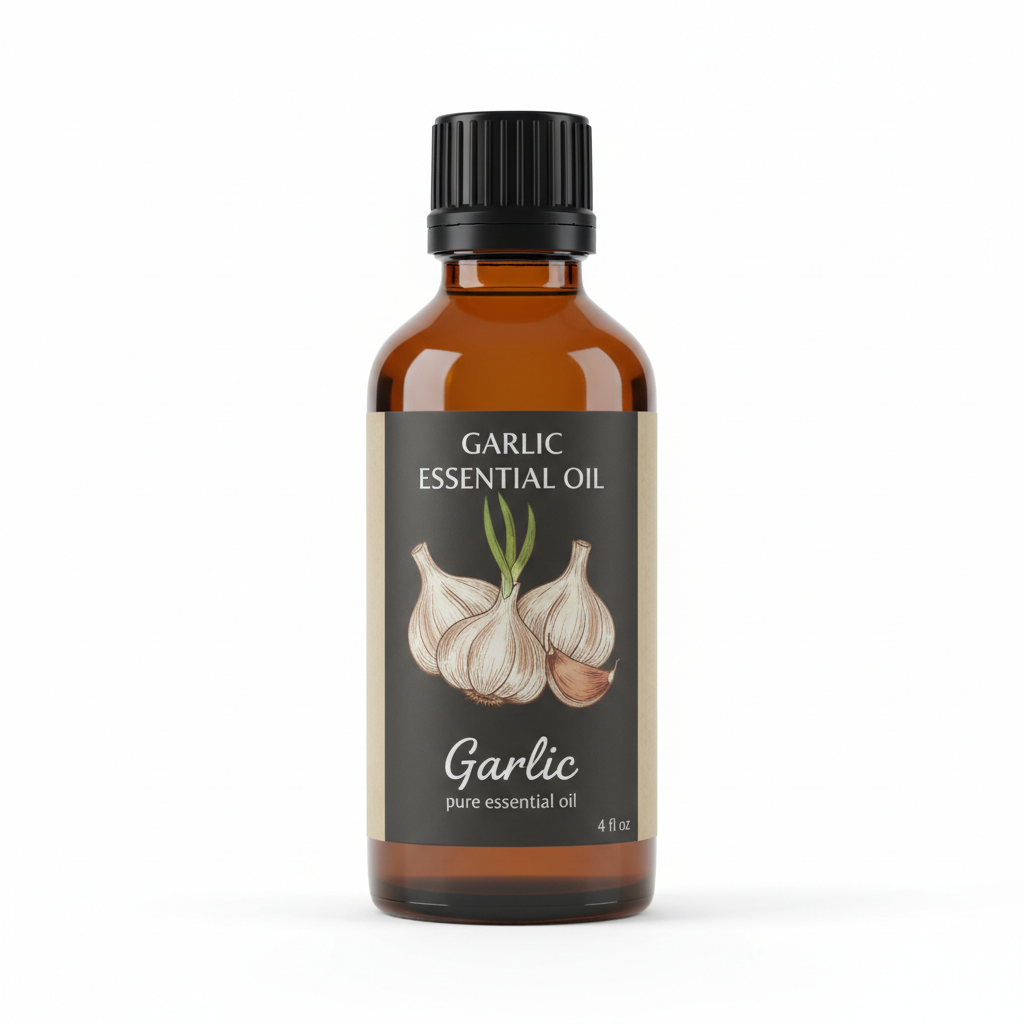
Garlic Essential Oil
Our own Garlic Essential Oil, in sizes from 0.5 oz to bulk.
From $10.99
Shop Now →To be clear about scope: we sell the garlic oil undiluted and not for internal use, and we make no claim about what it does for hair or scalp. What follows is just the arithmetic of how much it takes to scent a rinse-off hair oil, built from our dilution guidance.
Starting at the low end
Our guidance for skin is 0.5% to 2% in a carrier oil, with a patch test first, and we suggest beginning at the low end because garlic is so strong. For two tablespoons of carrier oil (about 29.6 ml, or 1 oz), 0.5% works out to roughly 0.15 ml of garlic oil. At the conventional 20 drops to the millilitre, that is about three drops. Carrier oil is something to pick up at a grocery or supply shop, since we sell only the garlic oil; our carrier oil article talks through the options.
Three drops sounds easy to measure, and that is where the trouble starts. The Tisserand Institute points out that conversions using drops are always approximate, because no two drops of essential oil are the same, and recommends working in percentages (Dilution for essential oils, Tisserand Institute). A bottle that drips small could leave you near 0.3%, and one that drips large could take you toward 0.8%.
The easy fix is a bigger batch. In 100 ml of carrier, 0.5% is 0.5 ml, about ten drops, and being one drop out matters far less. Make only what you will use, label the bottle, and since there is no preservative in a simple oil and carrier mix, start a fresh batch rather than keeping leftovers for long. Our dilution basics article has the general method.
Setting up your bench
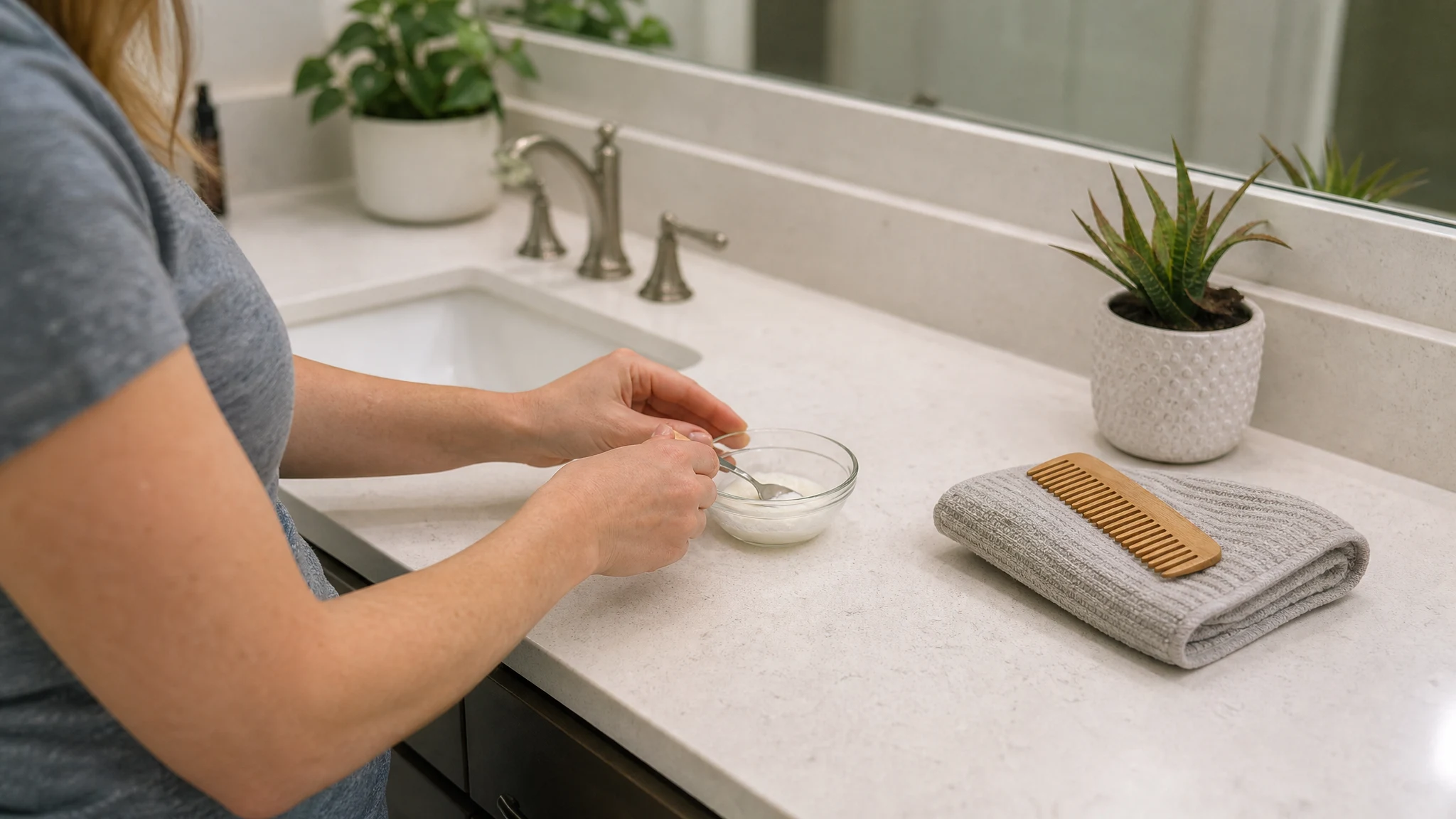
Before you measure anything, clear a small space near a window. Use a clean glass bottle or jar with a tight lid, a scale that reads to the gram if you have one, and a label and pen for the date and the percentage. Wash the measuring bowl right away, because a bowl that held garlic oil will announce it for a long time. A tidy setup makes the arithmetic above feel manageable, and it keeps a very strong ingredient from wandering around your kitchen.
Why rinse-off helps
Tisserand's ranges give a useful way to think about format. Sensitive or impaired skin sits at 0.2% to 1%, body oils and lotions at 1% to 3%, and wash-off products such as soap and shower products at 2% to 4%. Reasoning from that, a mix you rinse out with shampoo is the more forgiving format, and a leave-in oil is the most demanding. Our suggestion is to start at 0.5%, keep contact time short, and skip caps, towel wraps and overnight treatments entirely. Plain water is a poor way to remove oil, so shampoo is your friend here.
Patch test and apply with care
- Dab a little of the diluted oil on your inner forearm and wait 24 hours. Redness, itching or blistering means stop.
- If all is well, try the lengths of your hair first rather than the scalp. A scented oil does not need to touch skin at all.
- Keep it away from your eyes, which is easy to forget in the shower.
- Wash your hands, towels and pillowcases afterwards, because the oil lingers on skin and cloth.
What you will notice
Expect the garlic to be the first thing you smell when you open the diluted blend, not the carrier oil. Even at a very low percentage, the mouth of the bottle will smell of garlic. Smell it again the next day, because the aroma sometimes seems to settle or shift as it sits. Wash hands carefully after handling it, and you will notice that the scent on your fingers outlasts the soap, which is a handy reminder of how well this oil lingers.
Who should sit this one out
Garlic is a known skin irritant when applied directly. NCCIH notes that fresh raw garlic on the skin can cause severe irritation and chemical burns (Garlic: Usefulness and Safety, NCCIH), and a JAAD Case Reports paper describes blistering and lasting pigment change after raw ground garlic was kept under a bandage overnight, naming allicin and diallyl disulfide as the culprits (Herbalism in wound care: A case of garlic burn, JAAD Case Reports, 2021). Those were raw garlic cases rather than a diluted oil, but they are good reasons for caution. We would skip this idea if your scalp is broken, inflamed or easily irritated, or if you have reacted to garlic before. A flaking or itchy scalp is a question for a dermatologist, and our dandruff article says more.
The same goes for anyone who is pregnant or breastfeeding, where NCCIH says little is known about topical garlic, and for children, whom we recommend keeping away from the oil. A physician or pharmacist is the right person to ask.
If you simply want a pleasant-smelling hair oil, there are scents that are far easier to live with, and a craft or supply shop can point you toward them. Garlic oil is happiest in places where its big personality is the whole point.
Garlic Essential Oil
Garlic Essential Oil from our own shop, in sizes from 0.5 oz to bulk.
From $10.99
Shop Now →Sources & Further Reading
- Tisserand Institute. Dilution for essential oils. tisserandinstitute.org/safety/dilution
- NCCIH. Garlic: Usefulness and Safety. nccih.nih.gov/health/garlic
- Hall EL, Portera MV, Patel TS. Herbalism in wound care: A case of garlic burn. JAAD Case Reports 2021;9:100-101. pmc.ncbi.nlm.nih.gov/articles/PMC7907009