Garlic for Athlete's Foot? The Ajoene Trial Explained
Every few years the idea that garlic fights foot fungus resurfaces, and it usually traces back to one trial with a name that sounds like a spell: ajoene. It is a real, interesting piece of garlic chemistry, and it is worth understanding precisely, because the details are what separate a fascinating study from a household treatment.
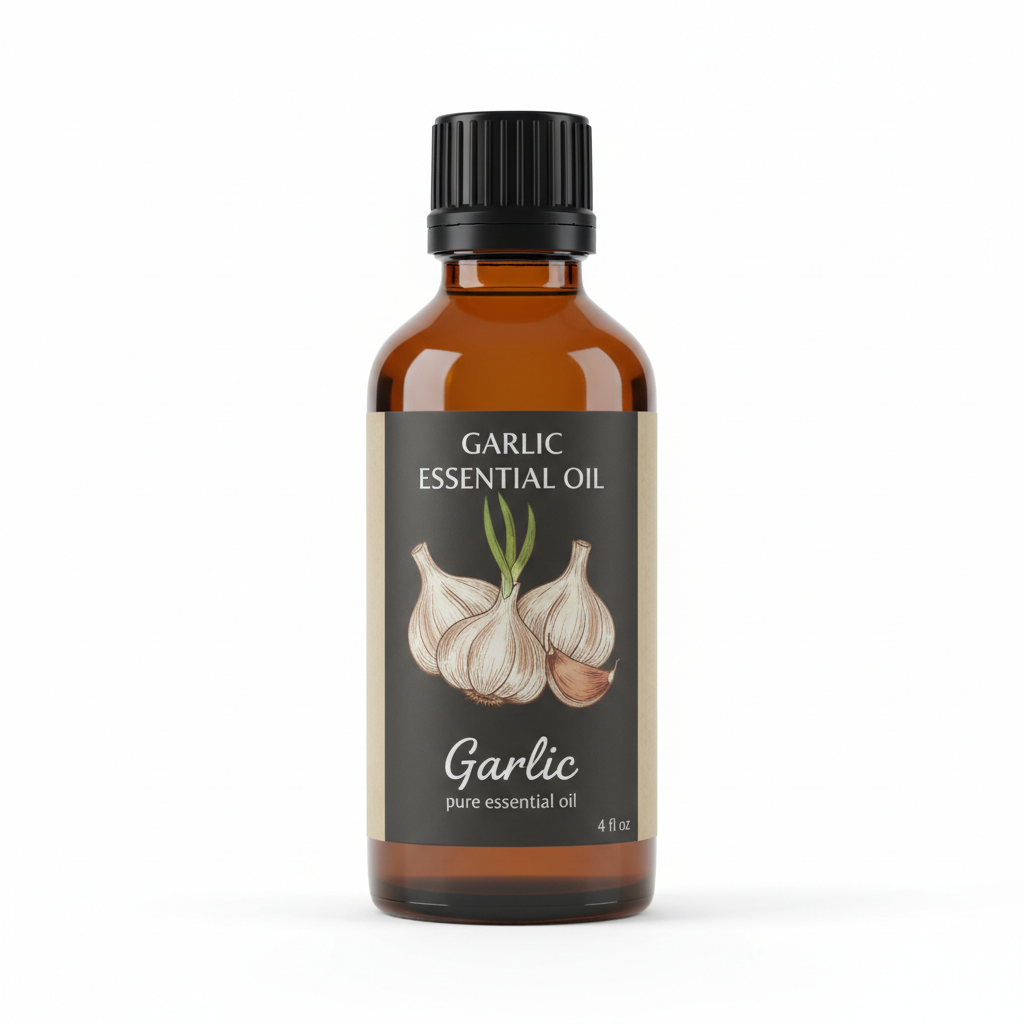
Garlic Essential Oil
Our own Garlic Essential Oil, in sizes from 0.5 oz to bulk.
From $10.99
Shop Now →What ajoene is
When garlic is crushed, a sulfur compound called allicin forms, and it quickly transforms into other compounds. Ajoene is one of them. It is a purified compound, made and measured in a laboratory, and a bottle of garlic essential oil is a different mixture again, which is why a result about one does not transfer to the other.
The trial
In 2000, researchers working with 70 soldiers in the Venezuelan armed forces who had confirmed athlete's foot assigned them to 0.6% ajoene, 1% ajoene or 1% terbinafine, a recognized antifungal, applied twice daily for one week. Sixty days after treatment ended, 72% of the 0.6% group, 100% of the 1% ajoene group and 94% of the terbinafine group were mycologically cured (Ledezma and colleagues).
It is a striking result, and the careful reading is what makes it useful. Only 47 of the 70 people were available for the final evaluation, so each group was small, and 100% in a small group does not mean a larger trial would see no failures. It tested one compound at fixed strengths, on foot skin, for a week. We are not aware of it being repeated, and it tells us nothing about a mixture of garlic compounds at any other strength, including the oils in our own bottle.
A lab compound is not a pantry ingredient
It helps to picture two very different places. In a laboratory, a purified compound is weighed out to an exact percentage and mixed into a made product, so every participant gets the same thing. In a kitchen, a clove is a living plant, and what is in it depends on the bulb, how it was cut and how long ago. A result from the first place is a clue about chemistry, and nothing more than a clue about the second. That gap is why we keep the ajoene story in the "interesting science" drawer.
Skin, nails and the pharmacy shelf
For ordinary athlete's foot, the American Academy of Dermatology says over-the-counter antifungal creams or sprays may clear a mild case, usually in about two weeks, and to see a dermatologist if it is more severe or has not cleared in that time. That is the well-trodden path, and it is the one we would point anyone toward.
Nails are another matter. They grow slowly and the infection sits underneath, which is why nail problems belong to a dermatologist or podiatrist and not to an experiment with a kitchen ingredient.
What to bring to the pharmacist or doctor
If your feet itch, peel or sting, a short list makes the visit more useful: how long it has been going on, which foot or which part of it, what you have already tried, and whether you have a health condition such as diabetes. A phone photo helps too, since skin can look different by the time you are in the chair. A pharmacist or dermatologist can then point you to something suited to your skin.
Where we draw a firm line
If you live with diabetes, foot questions deserve a professional every time. The CDC advises daily foot checks and says that if you notice a cut, blister or sore, you should not wait for your next appointment but see your doctor or foot doctor right away.
Garlic has a history on skin that is worth knowing: raw garlic held under a covering can blister, and our post on garlic burns goes through the reports. A sock is a covering. The NCCIH says fresh raw garlic may not be safe when used topically and can cause severe skin irritation and chemical burns.
Why we still love the story
We find the ajoene story delightful. A humble bulb gives chemists a whole family of compounds to study, and that is a good reason to keep a bottle of garlic oil around the workshop just to marvel at it. Open it, put a drop on a blotter strip, and notice how the aroma changes over the first few minutes: sharp and savory first, then deeper and rounder. That is what we sell it for, and it is plenty.
What we sell, and where it shines
Our garlic essential oil is an undiluted aroma and workshop material, not for internal use, and we make no antifungal claim for it. We recommend 0.5% to 2% in a carrier oil with a patch test for any skin contact, starting at the low end, and we would skip broken or peeling skin altogether. For measuring, see dilution basics and garlic oil on skin. If you are curious how another oil gets compared in this conversation, garlic oil versus tea tree oil looks at that.
If you remember one thing, let it be that a promising trial and a reliable remedy are different animals. The first tells researchers where to look next. The second needs repeated, larger studies and a product made for the job, and the pharmacy shelf already holds those.
A great story deserves to be told accurately, and that is all we are trying to do here.
The ajoene trial is a good reminder that garlic chemistry is rich and still being explored. A rich story is not a recipe, and a pharmacist can help with the part that is.
Garlic Essential Oil
Garlic Essential Oil from our own shop, in sizes from 0.5 oz to bulk.
From $10.99
Shop Now →Sources & Further Reading
- Ledezma E et al., 2000. Efficacy of ajoene in the treatment of tinea pedis: a double-blind and comparative study with terbinafine. J Am Acad Dermatol. PubMed 11050588
- American Academy of Dermatology. Ringworm and athlete's foot: diagnosis and treatment. aad.org
- CDC. Diabetes and your feet. cdc.gov
- National Center for Complementary and Integrative Health. Garlic. nccih.nih.gov