Garlic Oil Certificate of Analysis: How to Read One
A garlic oil listing with a certificate of analysis linked beside the add to cart button feels settled. The document is a good start, but it answers a few narrow questions and stays silent on others, and knowing which is which makes you a sharper buyer. We will walk through ours, since a real example teaches more than a description.
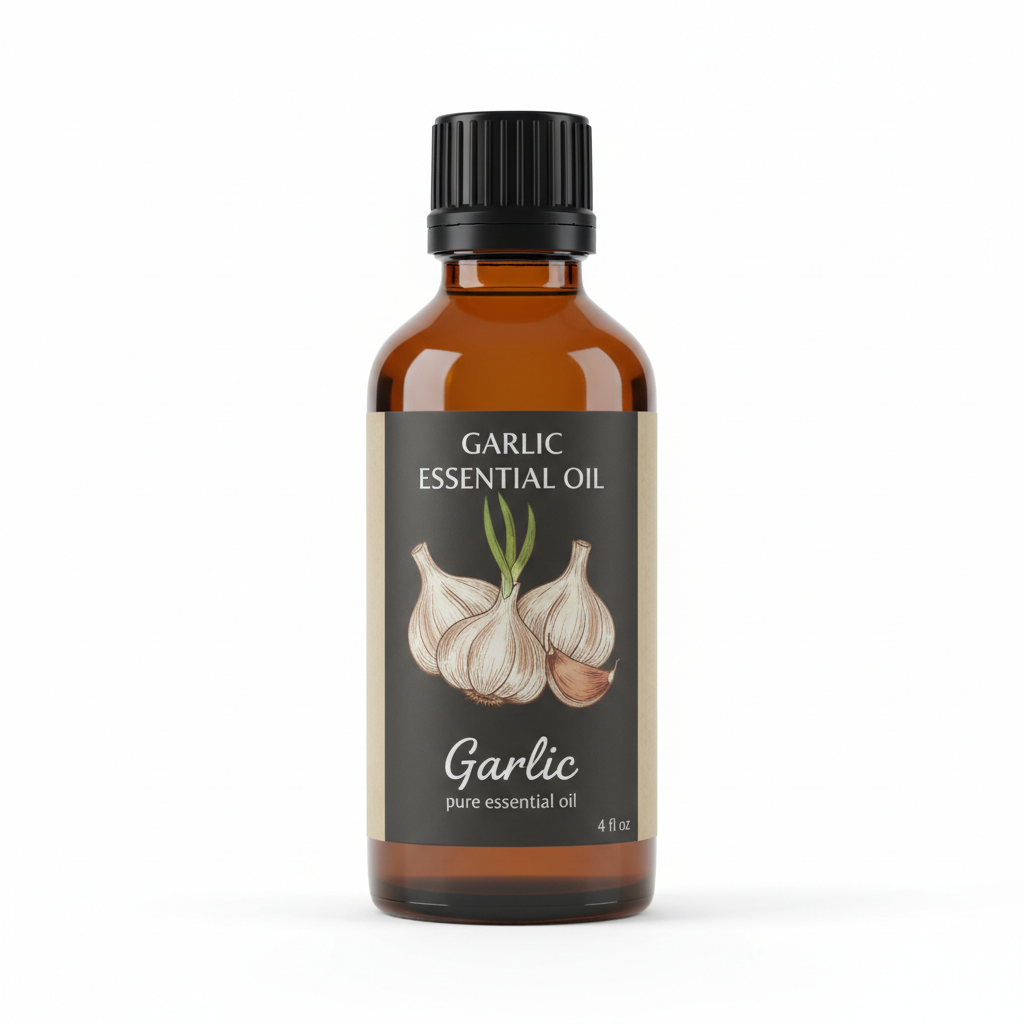
Garlic Essential Oil
Our own Garlic Essential Oil, in sizes from 0.5 oz to bulk.
From $10.99
Shop Now →First, does it belong to your bottle?
Look for the batch number on the report, then for the same code on your label or order confirmation. Ours names batch GARFBCUNUSC003A, so it describes that batch. If you need a report for the specific lot you are buying, write to us through the contact page and ask before you order. That is good practice with any seller, including us.
Next, what was measured?
Reports for essential oils generally come in two flavors. The simpler one lists physical constants, mainly relative density and refractive index. The more detailed one is gas chromatography with mass spectrometry (GC-MS), which names the volatile compounds and their proportions. A 2026 review notes that the European Pharmacopoeia recommends the physical checks and calls GC-MS the gold standard for volatile constituents (Szambora and Paradowska, 2026).

Ours is the first kind. It shows a relative density of 1.075 at 20 C (against a stated range of 1.050 to 1.095) and a refractive index of 1.566 at 20 C (range 1.550 to 1.580), plus a pass for appearance (a yellow liquid) and smell (pungent, savory, strong). Think of density and refractive index as a quick fingerprint: they tell you whether the liquid sits where genuine garlic oil is expected to sit. They do not list what is inside. If you want a sulphide profile, ask us in writing for the GC-MS report for your lot.
| Line on a report | What it tells you | What it leaves open |
|---|---|---|
| Relative density, refractive index | The oil falls inside a stated physical range | Which compounds are present |
| Smell and appearance, "complies" | Someone judged them against a description | Anything a number could check |
| GC-MS compound list | Which volatiles were found and in what proportion | Non-volatile additions |
| Best-by date | The intended shelf period | How the oil was stored afterwards |
Why even a detailed report has limits
It is tempting to say "just ask for a GC-MS" and stop there. It is a better document than a density figure, but it is one tool among several. In a study of clove oil, researchers reported that a vegetable oil added to a sample went undetected by GC/MS, because the method relies on volatile compounds and a non-volatile oil stays behind in the injection port. They also noted that shifts in peak areas can come from region and season as easily as from adulteration (Jentzsch et al., 2019). That is a clove study, so we take it as a lesson about the method, not as a finding about anyone's garlic.
Garlic has its own wrinkle, which is that the recipe changes the result. In a 2017 study of Spanish bulbs, one batch of material gave three oils with yields near 0.2% by weight, yet the top compound shifted from diallyl trisulfide (33.4%) in a laboratory hydrodistillation to diallyl disulfide (27.9%) in industrial steam distillation (Satyal et al., Foods, 2017). So when two sellers' profiles do not match, the cause may be nothing more than a different still. The sensible request is a profile for your lot plus the method that made it. Our steam distillation versus CO2 comparison goes deeper.
A two-minute routine
- Find the product name and botanical name, and make sure they match what you are ordering.
- Find the batch number, then look for the same code on your label or confirmation.
- Read the measured lines, here density and refractive index, and check each against the range printed next to it.
- Look at the best-by date and compare it with how quickly you will use the oil.
- Write down anything the report does not say, and ask about it before you order.
Then, the label on the bottle
A good label does more than carry a brand. Check for:
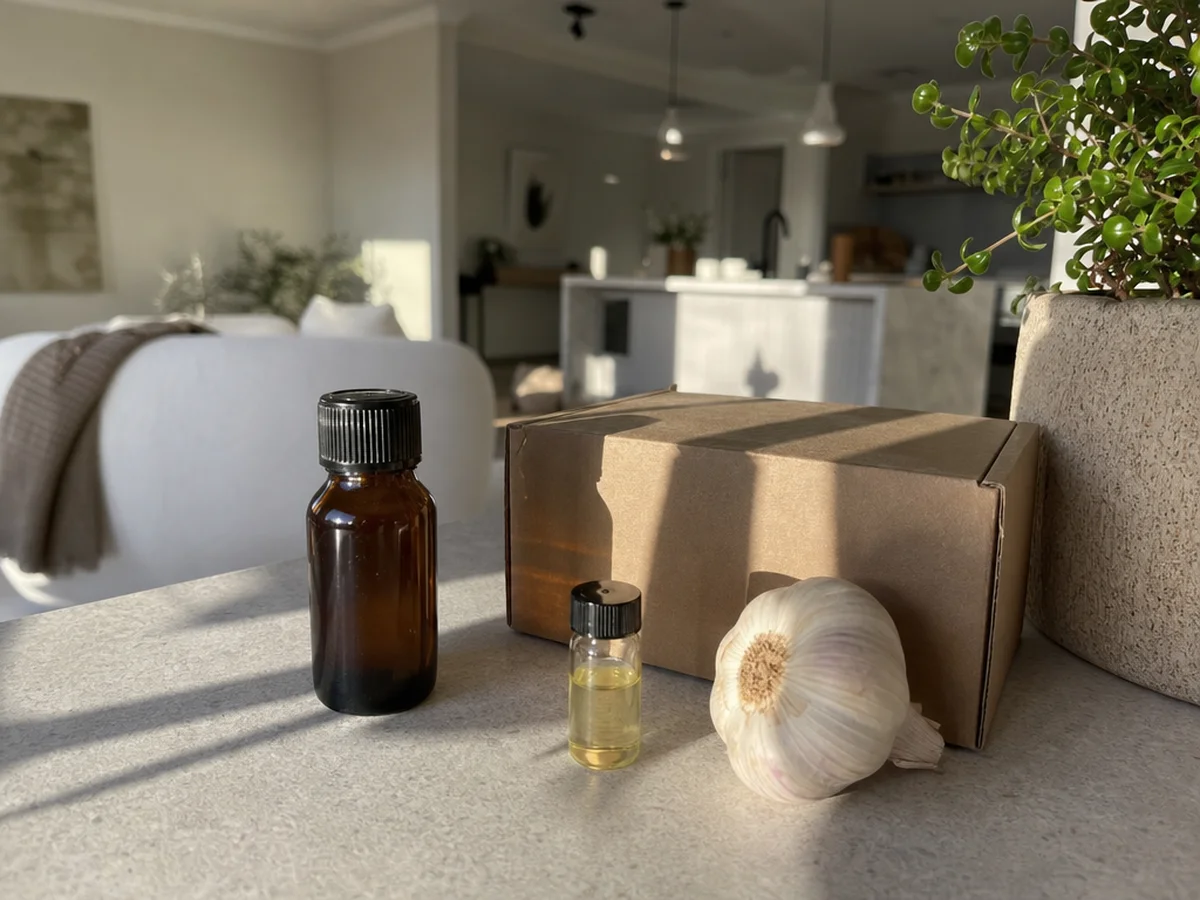
- The botanical name, Allium sativum, so you know it is garlic and not another allium.
- A plain product description. Essential oil, infused oil and flavoring are different products (see our comparison of the first two).
- A net quantity and a lot number you can match to a report.
- Storage directions. Ours say tightly capped, in a cool, dark place.
- For a cosmetic, an ingredient list. The INCI name is Allium Sativum Bulb Oil (Cosmile Europe).
For US cosmetics, the FDA expects an identity statement, net quantity, the business name and place, and ingredients in descending order (FDA Cosmetics Labeling Guide). The FDA also says a product's regulatory category depends mainly on its intended use, judged from its labeling and advertising (FDA, Aromatherapy). So a listing that wraps a certificate in health promises is worth a second look.
If you are comparing garlic oils, our quality checklist and where to buy guide pair well with this one. A seller who answers your lot questions plainly is telling you something too.
A certificate is best treated as the start of a conversation. A seller who answers your follow-up questions plainly, and says just as plainly what a document does not cover, is giving you the most useful information of all.
Garlic Essential Oil
Garlic Essential Oil from our own shop, in sizes from 0.5 oz to bulk.
From $10.99
Shop Now →Sources & Further Reading
- Szambora O, Paradowska K. Problems and challenges in the detection of essential oil adulteration: a review of current analytical methods. Prospects in Pharmaceutical Sciences, 2026. prospects.wum.edu.pl/index.php/pps/article/view/880
- Jentzsch PV et al. Detection of essential oils adulteration: a quick overview and current challenges. AJBSR 2019. biomedgrid.com
- Satyal P, Craft JD, Dosoky NS, Setzer WN. The chemical compositions of the volatile oils of garlic (Allium sativum) and wild garlic (Allium vineale). Foods 2017;6(8):63. pmc.ncbi.nlm.nih.gov/articles/PMC5575638
- Cosmile Europe. Allium Sativum Bulb Oil. cosmileeurope.eu
- FDA. Cosmetics labeling guide. fda.gov
- FDA. Aromatherapy. fda.gov/cosmetics/cosmetic-products/aromatherapy