Steam vs CO2 Garlic Oil: What the Studies Found
"CO2 extracted" has a modern, clean ring to it, and some garlic oil listings lean on it. Is it better than steam distillation? The research gives a more grounded answer: CO2 tends to deliver a bit more oil from the same garlic and a somewhat different mix of compounds, but nobody has shown that either suits your project better. Our oil is described on our product page as steam-distilled from crushed bulbs, and we do not sell a CO2 extract, so we are happy to simply lay out the findings.
Garlic Essential Oil
Our own Garlic Essential Oil, in sizes from 0.5 oz to bulk.
From $10.99
Shop Now →Two ways to pull the scent out of a bulb
Steam distillation passes steam through crushed bulbs and condenses the volatile part that travels with it. Supercritical CO2 extraction pushes carbon dioxide, held above its critical point, through ground garlic, then releases the pressure so the gas leaves and the extract stays behind. One 2025 Vietnamese study ran it at 30 MPa and 60 C for 120 minutes on garlic ground to 0.5 mm (Nguyen Van Loi et al., 2025). In practical terms, one method keeps material at distillation temperature for hours inside a still, the other needs a high-pressure vessel. Both give a sulfur-rich concentrate.
What the studies reported
The clearest comparison is a 2020 paper that made garlic oil three ways. Yields were about 0.441% with a hexane solvent, 0.124% with steam distillation and 0.465% with supercritical CO2. The CO2 oil also scored higher than the distilled oil in a laboratory antioxidant assay, which is a test-tube result and says nothing about skin or the body (Nguyen Van Khanh et al., 2020). In round numbers, that is a few grams more oil per kilogram of garlic from CO2, which matters to a producer's cost per gram and not much to a buyer holding a bottle.
On composition, the 2025 CO2 oil was 42.54% diallyl disulfide, with diallyl trisulfide at 5.75% and vinyl dithiins among its top compounds. The Spanish steam-distilled oil in an earlier study had diallyl disulfide at 27.9% and diallyl trisulfide at 16.8% (Satyal et al., Foods, 2017). That is a visibly different profile, but the garlic, the equipment and the analysis all differ between those papers, so the method cannot be singled out as the cause. Satyal's own work shows how much method alone can do: one lot of bulbs gave three profiles from three distillations.
A 2010 study found that a CO2 extract purified by molecular distillation kept four main volatiles, and that steam-distilled oil stored for 30 days had lower levels of its active components; the authors favored CO2 (Tao et al., 2010). That conclusion rests on a purified, four-compound product, which is a narrower thing than a bottle of crude CO2 extract.
Both methods strike us as clever. Steam distillation is an old, patient craft built around a boiler, a condenser and plenty of waiting. Supercritical CO2 is a newer, equipment-heavy approach that depends on pressure and temperature control. Each has its fans, and each can produce a lovely or a poor result depending on the raw material and the care taken.
What it means when you buy
For soap, candle or fragrance trials, nothing in these papers gives a reason to pay extra for the word "CO2," or to avoid it. None of them tests scent in a finished product. The questions that actually carry information are about the particular lot:
- Which method was used, and was any solvent involved? A hexane extract is a different thing from both.
- Was the extract purified afterwards? That removes compounds by design.
- Is there a GC-MS report for the lot, with the compound list and the laboratory named?
- Is it sold undiluted?
The certificate we publish is for one batch and shows a relative density of 1.075 and a refractive index of 1.566. It is a quick identity check and does not give a compound profile. A buyer who needs a report for a specific lot should ask us in writing through our contact page. How to read such a report is covered in our label and lot report article, and more checks are in the quality article.
How to compare two garlic oils yourself
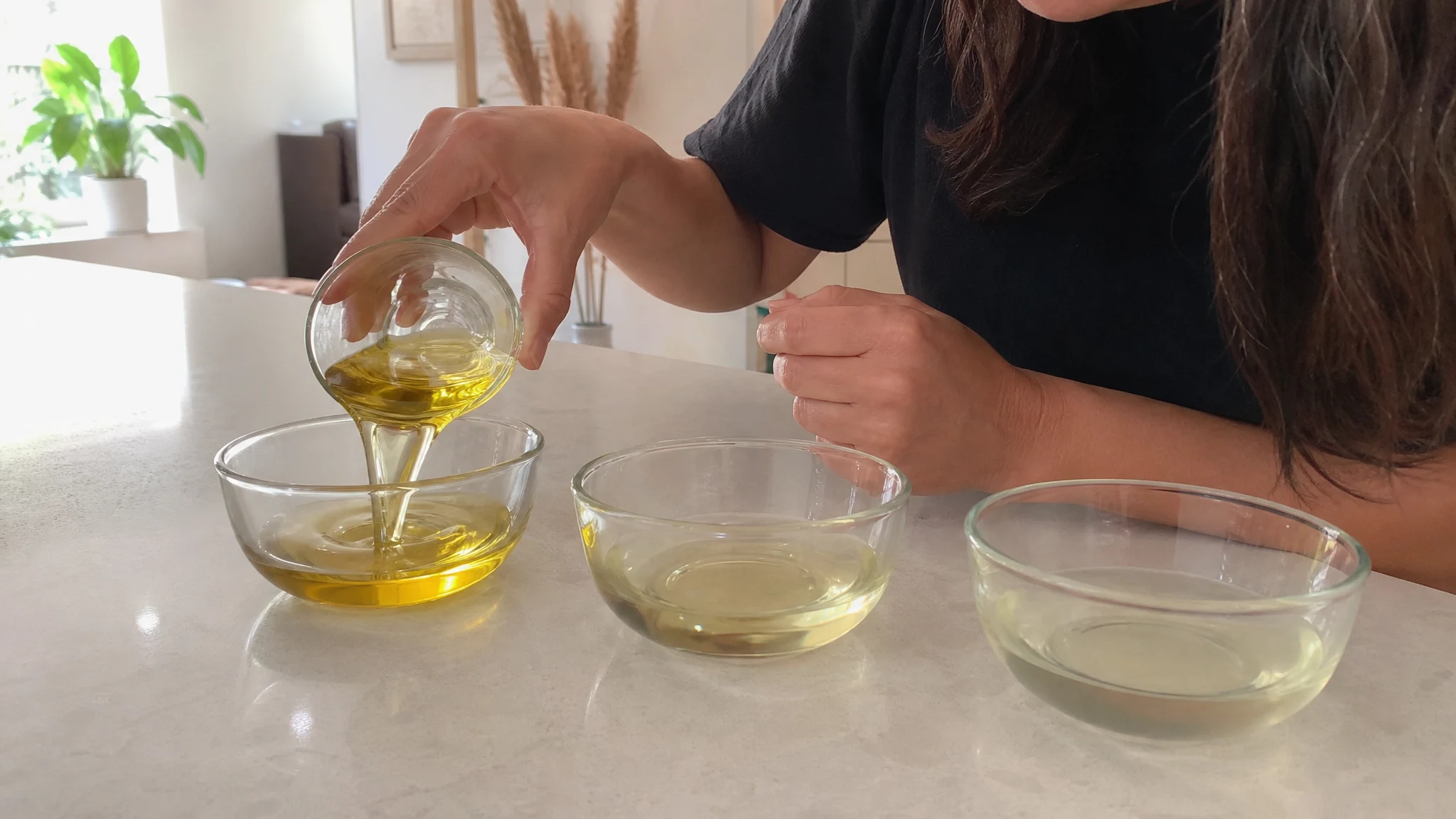
If you ever get hold of two different garlic oils, a quiet evening of blotter strips will teach you more than any listing. Put a small touch of each oil on its own labeled strip, and keep the bottles capped and well apart. Smell each strip at arm's length first, then closer. Jot down your impressions in plain words: sharp or round, sweet or flat, heavy or light, how long it lasts.
You may notice differences in sharpness and in the depth of the sulfurous backbone, and you may notice that two oils which seemed alike at first part ways an hour later. Treat your notes as personal preferences, not as measurements. They can help you decide what to ask a seller, and the lot report can help you check what you think you smelled.
One thing both methods share
However it was made, garlic oil is a strong sulfur concentrate that lingers and can irritate bare skin, so we always recommend dilution and a patch test, as described in our burns article and our dilution article. Nothing in the extraction papers makes a CO2 oil gentler on skin. And for how steam distillation of garlic works, see our steam distillation article.
CO2 gives a little more oil and a different profile in these papers; whether that profile suits your job is something only the lot report and your own nose can say.
Garlic Essential Oil
Garlic Essential Oil from our own shop, in sizes from 0.5 oz to bulk.
From $10.99
Shop Now →Sources & Further Reading
- Satyal P, Craft JD, Dosoky NS, Setzer WN, 2017. The chemical compositions of the volatile oils of garlic (Allium sativum) and wild garlic (Allium vineale). Foods 6(8):63. pmc.ncbi.nlm.nih.gov/PMC5575638
- Nguyen Van Khanh, Do Thi Nhai, Bui Thanh Tung, Nguyen Thanh Hai, 2020. The effect of different extraction procedures on antioxidant activity of garlic (Allium sativum L.) essential oil. VNU Journal of Science: Medical and Pharmaceutical Sciences 36(3). js.vnu.edu.vn/MPS/4213
- Nguyen Van Loi, Nguyen Thi Lam Doan, Nguyen Duc Tien, Bui Phuong Thao, Do Thi Hanh, 2025. Research on building a process for extracting and recovering garlic essential oil using supercritical CO2 (Vietnamese). Tap chi Nong nghiep va Moi truong, issue 18. vjol.info.vn/123422
- Tao Ning-ping, Wang Sai-sai, Chen Bi-wen, 2010. Molecular distillation purification and analysis of volatile components of garlic oil extracted by supercritical carbon dioxide extraction. Food Science 31(18):365-369. spkx.net.cn/CN/Y2010/V31/I18/365