Garlic Oil vs Oregano Oil: Two Very Different Strong Oils
Oregano oil and garlic oil show up together on a lot of "strong natural oils" lists, usually with a suggestion that one beats the other. The truth is more interesting: they are built from entirely different chemistry, and almost every number you see comparing them was measured in a flask on one bottle of oil. We sell only the garlic oil, as an aroma material, so here is a plain-English look at how these two differ.
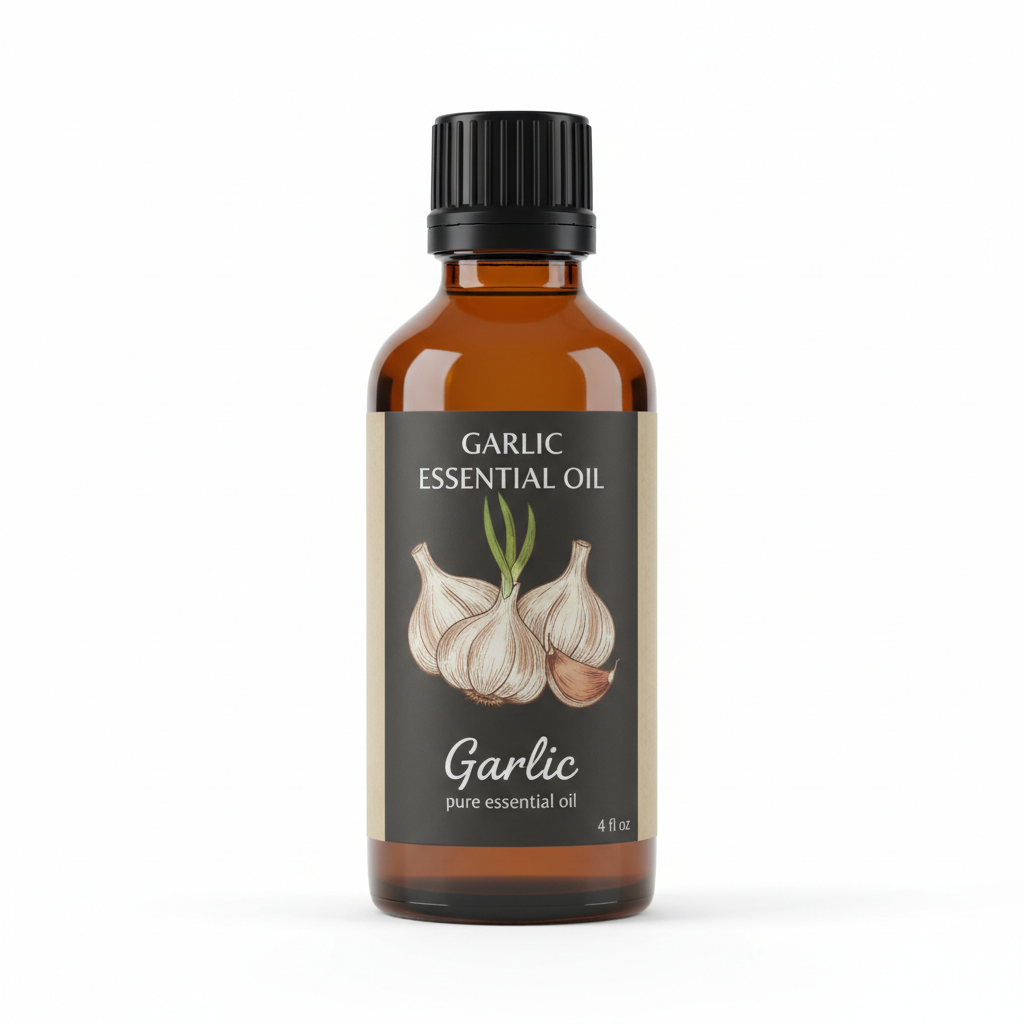
Garlic Essential Oil
Our own Garlic Essential Oil, in sizes from 0.5 oz to bulk.
From $10.99
Shop Now →A phenol oil and a sulfur oil
Oregano oil is dominated by phenols. In one laboratory study of a commercial oregano oil, carvacrol made up about 72% and thymol about 7% (Lu et al., Frontiers in Microbiology, 2018). Garlic oil is a different animal altogether: its main compounds are sulfides such as diallyl disulfide and diallyl trisulfide, and the mix moves with the method used. In one study of Spanish bulbs, steam distillation put diallyl disulfide on top at 27.9%, while a laboratory hydrodistillation of the same garlic put diallyl trisulfide first at 33.4% (Satyal et al., Foods, 2017).
That is the first useful thing to know. Phenols give oregano its warm, medicinal, herbal smell; sulfides give garlic its pungent, savory depth. If you put both on blotter strips you will not confuse them, and you will not be able to swap one for the other in a blend. Our garlic oil is described on our product page as a base note, so it lingers well beyond the first sniff.
What the oregano lab study did and did not show
The oregano study most often quoted measured how little oil it took to stop growth of bacteria in broth. Against 11 multidrug-resistant hospital isolates the minimum inhibitory concentrations ran from 0.08 to 0.64 mg/ml, and the researchers also tested a mouse burn model. The paper reports no human subjects, and the skin toxicity work was done in mice only (Lu et al., 2018).
Reasoning from the setup, a broth number tells you what happens to bacteria in a clean flask. It does not tell you what happens on a person's skin or in a kitchen, which is why we avoid reading anything from it about our own oil. The same caution applies to garlic studies in test tubes, and we cover those in our antimicrobial research article.
Smelling them side by side
If you ever have both bottles on your bench, the most honest comparison is also the simplest. Take two clean blotter strips, label each in pencil, and put a small touch of each oil on its own strip. Hold them a few inches from your nose, one at a time, and give your nose a rest in between, even a breath of fresh air from a window helps.
You will notice that the two oils announce themselves in very different ways. Oregano reads as warm, herbal and a little sharp, the way a spice jar smells when you lift the lid. Garlic is rounder, heavier and more savory, with that sulfurous edge that is unmistakable. Come back to the strips after an hour and then again later in the day. Garlic is a base note, so it tends to still be there, quietly insistent, when other strips have gone shy.
One practical tip from us: keep the strips well apart from each other and from anything you care about, and wash your hands after handling them. Garlic oil travels on fingers and cloth.
Strength is not the same as suitability
Both oils are potent, and both are used a drop at a time. NCCIH reports that fresh raw garlic may not be safe on skin and can cause severe irritation and chemical burns (NCCIH, garlic). That statement is about raw garlic, not distilled oil, but it is the reason our guidance for garlic oil on skin is a dilution of 0.5% to 2% in a carrier oil, starting at the low end, with a patch test first. Oregano has its own handling rules from whoever sells it, and they differ from ours, so read its supplier's guidance and do not borrow ours. We make no health claim for either oil, and anyone with a health concern should speak to a physician or pharmacist.
Where the two meet
For aroma work, they are neighbors. We list oregano among the oils garlic blends well with, together with black pepper, ginger, basil, rosemary and onion, which suits savory, herbal scent studies. We do not sell oregano or any of those, so those come from another supplier. Our garlic oil is for external aromatic use only and is not for internal use. If you are weighing garlic against another oil on the lab shelf, our tea tree comparison shows how to read trial results for a skin question, and the skin irritation article covers handling.
If we had to describe the pair to a friend, we would say they are both worth knowing, and neither one needs to be crowned. The more you smell them, the more their differences feel like a feature. Give yourself a quiet afternoon, a few blotter strips and a notebook, and let your nose do the comparing. You might find the sulfurous depth of garlic is exactly the shadow note a savory scent study was missing, or you might decide it is too much. Both answers are good ones.
Think of them as two strong characters with nothing to prove against each other: one phenolic and warm, one sulfurous and deep.
Garlic Essential Oil
Garlic Essential Oil from our own shop, in sizes from 0.5 oz to bulk.
From $10.99
Shop Now →Sources & Further Reading
- Lu M, Dai T, Murray CK, Wu MX, 2018. Bactericidal property of oregano oil against multidrug-resistant clinical isolates. Frontiers in Microbiology 9:2329. pmc.ncbi.nlm.nih.gov/PMC6182053
- Satyal P, Craft JD, Dosoky NS, Setzer WN, 2017. The chemical compositions of the volatile oils of garlic (Allium sativum) and wild garlic (Allium vineale). Foods 6(8):63. pmc.ncbi.nlm.nih.gov/PMC5575638
- National Center for Complementary and Integrative Health. Garlic: Usefulness and Safety. nccih.nih.gov/health/garlic