Tea Tree vs Garlic for Foot Fungus: What Trials Tested
A nail that looks off sends many people searching for something natural to try, and tea tree and garlic are the two names that come up most. They are not equals in the research. Tea tree oil has been tested as an oil in controlled trials on foot fungus, while garlic's best-known result involves ajoene, a purified compound made from garlic, in a gel. No trial we found used garlic essential oil. We sell only the garlic oil as an aroma material, so this is a read of what was tested and how to take it.
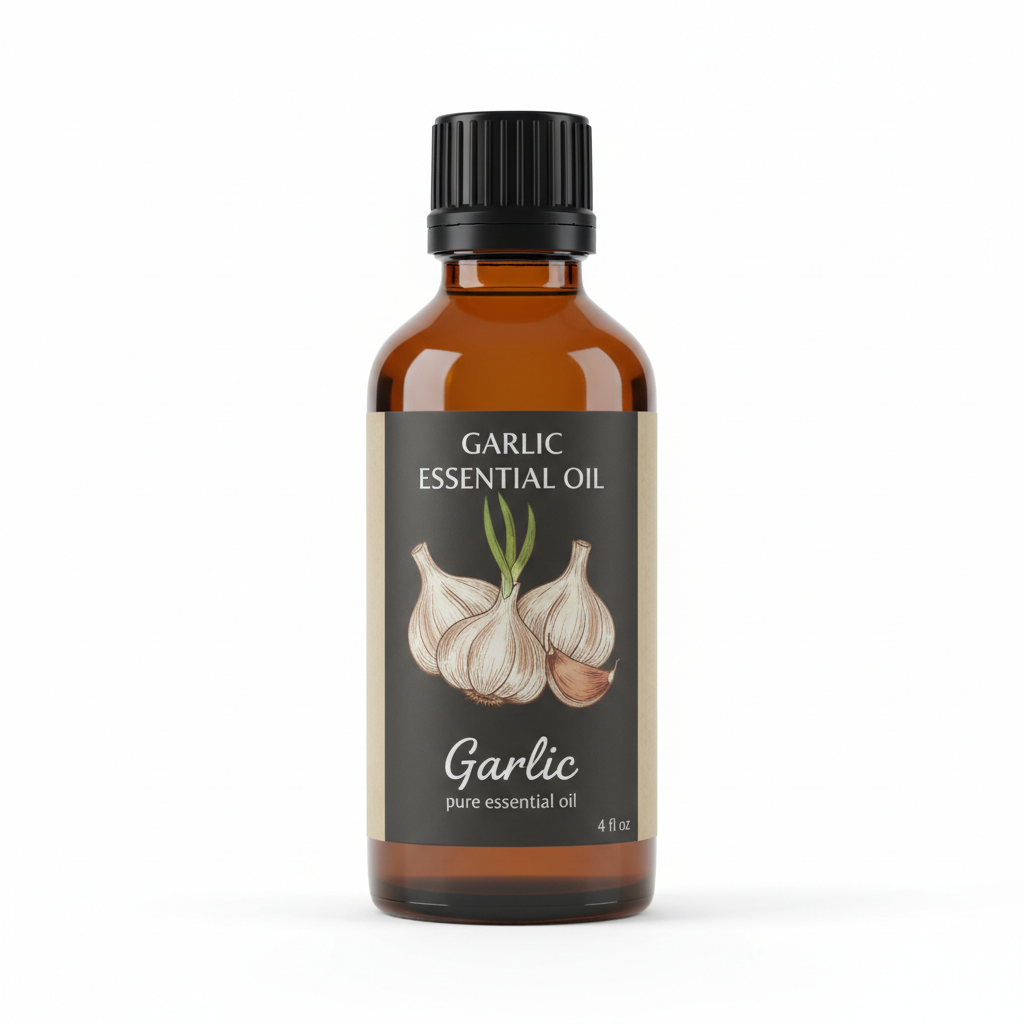
Garlic Essential Oil
Our own Garlic Essential Oil, in sizes from 0.5 oz to bulk.
From $10.99
Shop Now →What the tea tree trial found
The most useful tea tree study treated athlete's foot between the toes. It enrolled 158 people with a probable dermatophyte infection and randomly assigned them to a 25% tea tree oil solution, a 50% solution, or a placebo, applied twice daily for four weeks. A marked clinical response was reported in 72% of the 25% group, 68% of the 50% group and 39% of the placebo group, and the 50% solution cleared cultures in 64% against 31% for placebo. Four people on tea tree oil, 3.8%, developed moderate to severe dermatitis that eased after stopping (Satchell et al., 2002).
Look at the placebo figures. A 39% response with no active ingredient is a reminder that raw response rates mislead, and that the comparison, not the headline number, tells you what happened. That trial was about skin between the toes, not nails.
What the garlic trial involved
The garlic result is a week-long study of 70 Venezuelan soldiers with athlete's foot, of whom 47 were evaluated. Participants applied 0.6% ajoene, 1% ajoene or 1% terbinafine twice daily, and cultures were checked 60 days later: cure in 72%, 100% and 94% respectively (Ledezma et al., 2000). It had no placebo group, and ajoene is a purified compound and not garlic essential oil. So it is a result about ajoene on skin, and we do not read it as a result about a bottle of garlic oil or about nails.
These two trials are a nice reminder of how much a well-built study tells you about its own question and how little about the next one. The tea tree trial had a placebo group, a clear condition and a defined time frame. The garlic trial used a purified compound, had no placebo and followed participants for a different purpose. Putting them side by side is useful mostly for learning how to read the next headline you meet.
What the health agencies say
NCCIH says a small amount of research points to tea tree oil possibly helping with athlete's foot, though it may not work as well as standard treatments, and that for toenail fungus the quantity and quality of studies are too limited for conclusions. It also says tea tree oil should not be swallowed, and that irritation is more likely when a product is old or has been exposed to heat, light or air (NCCIH, tea tree oil).
Garlic has its own handling story. NCCIH notes that fresh raw garlic may not be safe on skin and can cause severe irritation and chemical burns (NCCIH, garlic). Feet spend the day in socks and shoes, and covered skin is where irritation tends to be worse. That is our reasoning, and we would not use our garlic oil on feet or nails.
A sensible order of steps
- Get the problem identified. Nail changes have more than one cause, and a podiatrist or dermatologist can confirm whether a fungus is involved.
- Ask about established treatments first, particularly with diabetes, poor circulation or a nail injury.
- If you are still curious about tea tree, buy a finished product from a pharmacy and follow its label. We do not sell it and cannot give a mixing strength.
Looking after your feet in the meantime
While you wait for an appointment, a few ordinary habits are kind to feet and cost almost nothing. Dry between the toes after washing, since damp skin is where trouble likes to settle. Change socks when they get damp, choose shoes that let air move, and rotate pairs so each one dries fully between wears. Wear sandals or shower shoes in damp communal spaces. Keep your towel to yourself.
These are common-sense routines, not treatments, and they are worth keeping up whatever the cause turns out to be. A podiatrist can tell you what suits your situation.
Where our oil sits
Our garlic oil is undiluted, is for external aromatic use only, and is not for internal use. For skin, our guidance is 0.5% to 2% in a carrier with a patch test, away from eyes, children and pets. We make no foot, nail or fungus claim for it. More on garlic in this territory is in our garlic and fungus article, our skin article, the irritation article and our antimicrobial research article.
If you do see your clinician, bring a list of everything you have been using on the area, including anything from the kitchen or a bottle of oil. It saves time, and it helps them see the whole picture of what your skin has been through.
When the question is a nail or a foot, the right first stop is someone who can examine it.
Garlic Essential Oil
Garlic Essential Oil from our own shop, in sizes from 0.5 oz to bulk.
From $10.99
Shop Now →Sources & Further Reading
- Satchell AC, Saurajen A, Bell C, Barnetson RS, 2002. Treatment of interdigital tinea pedis with 25% and 50% tea tree oil solution: a randomized, placebo-controlled, blinded study. Australasian Journal of Dermatology 43(3):175-178. europepmc.org/MED/12121393
- Ledezma E, Marcano K, Jorquera A, De Sousa L, Padilla M, Pulgar M, Apitz-Castro R, 2000. Efficacy of ajoene in the treatment of tinea pedis: a double-blind and comparative study with terbinafine. Journal of the American Academy of Dermatology 43(5):829-832. europepmc.org/MED/11050588
- National Center for Complementary and Integrative Health. Tea Tree Oil: Usefulness and Safety. nccih.nih.gov/health/tea-tree-oil
- National Center for Complementary and Integrative Health. Garlic: Usefulness and Safety. nccih.nih.gov/health/garlic