Garlic for a Toothache? Why a Dentist Is the Better Call
A toothache has a way of arriving at the worst possible time, and reaching for the kitchen cupboard is a very human response. Garlic is the classic folk answer. The dental and medical sources point somewhere else, though, and the reason is worth knowing, because garlic held against soft tissue is one of the better-documented ways to end up with a chemical burn.
Garlic Essential Oil
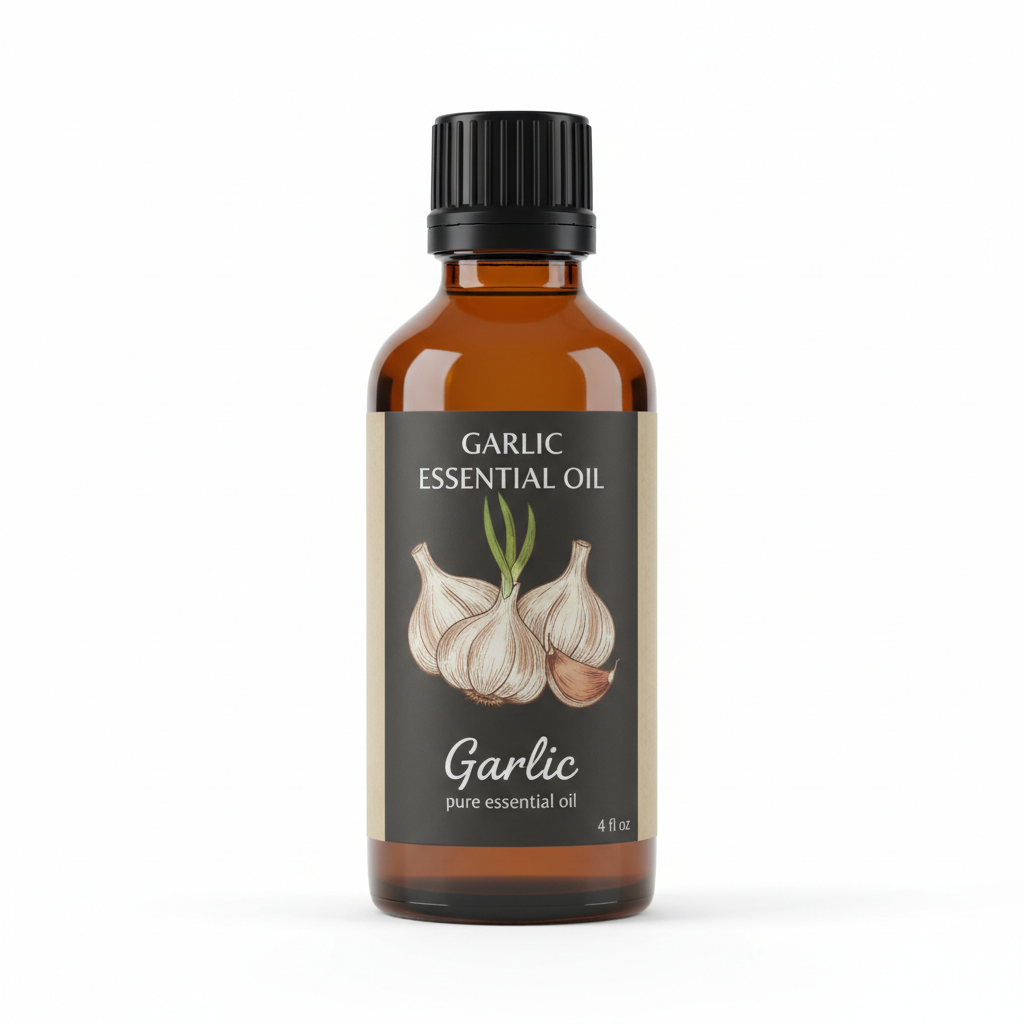
Our own Garlic Essential Oil, in sizes from 0.5 oz to bulk.
From $10.99
Shop Now →First, how urgent is it?
MedlinePlus, from the US National Library of Medicine, describes the signs of a tooth abscess: a severe, continuous toothache, discomfort when biting down, sensitivity to temperature, a bitter taste, bad breath, fever, swelling of the gum over the affected tooth, enlarged neck glands and, most seriously, swelling of the jaw. Its advice is to contact your dentist if you have a throbbing toothache that does not go away, or a pimple-like bump on the gum. It also states that its information should not be used during a medical emergency, so trouble breathing or swallowing, or swelling that is spreading, is a call for emergency care.
What a dentist can do is considerable. MedlinePlus lists antibiotics, a root canal to try to save the tooth, and in severe cases extraction or surgical drainage. For the wait before an appointment it names warm saltwater rinses and over-the-counter pain relievers, and it adds one warning that is relevant here: do not place aspirin directly on the tooth or gums, because it irritates the tissue. Garlic is not on the list.
If the pain is keeping you up, it is tempting to try anything within reach, and we understand that. A toothache is demanding. It sits in the middle of your face and will not be ignored. That is exactly why a call to a dental office is worth making early in the day: many offices keep time open for urgent problems, and they would rather hear from you sooner than later.
When you call, it helps to have a few simple things ready. Note where the pain is, how long it has lasted, whether heat, cold or biting make it worse, and any swelling you can see or feel. Mention the medicines you take. The more clearly you can describe it, the better the person on the phone can judge how soon you need to be seen.
What the case reports describe
We know of no clinical trial of garlic or garlic oil placed on a tooth or gum to ease tooth pain. What exists are reports of harm. A 2024 scoping review by Campos and colleagues (Journal of Integrative and Complementary Medicine) screened 706 records and included 28 studies from 1976 to 2022, covering adverse effects of natural products in the mouth and on the face. Garlic was the second most frequently linked product, after propolis, with nine cases. The reported effects included chemical burn, burning sensation, vesicles and blisters, crusts and ulcerations. The abstract does not say how many of those cases involved a toothache remedy, so we will not suggest they all did.
The mechanism is clear from a 2025 case report in Cureus by Bunstine and Lloyd. A 46-year-old man applied crushed raw garlic to his wrist for about five hours hoping to ease pain, and removed it to a strong burning sensation and large blisters, a second-degree chemical burn. The authors note that crushing garlic releases allicin, which can cause harm when used as an unregulated home remedy. That was skin, not gums. Reasoning from it, the lining of the mouth is thinner and wetter than a wrist, so there is little reason to expect it to be more forgiving.
What garlic smells like to a tender mouth
There is one more thing worth knowing about the plant itself, and it is a sensory one. Raw garlic is sharp for a reason. Cut a clove and you will notice the bite right away, in the nose and then on the tongue, and a clove held against any soft tissue only intensifies that. The oil we sell is far more concentrated than a clove, with a pungent, savory, sulfurous aroma that lingers on skin, cloth and in a room. That intensity is wonderful on a workshop bench and exactly the wrong thing near a sore, tender mouth.
A note on our oil
We sell garlic essential oil for aroma and workshop use. It is undiluted, it is not for internal use, and we do not offer it for tooth or gum pain. For skin, our guidance is a dilution of 0.5% to 2% in a carrier oil, beginning at the low end, with a patch test first. That is a skin figure only. We have no figure for the mouth, because the mouth is inside, and we do not give one.
If you are curious about handling garlic oil safely in the workshop, our articles on garlic burns on skin, skin irritation and whether garlic essential oil is safe go into it, and garlic oil versus garlic extract explains why a preparation in one study cannot stand in for another.
If you are caring for someone else, a child or an older relative in pain, the same advice holds, and the call to a dental office matters even more. Sit with them, keep them comfortable, and keep the kitchen cupboard closed while you wait for the appointment.
The kind thing to do for a sore tooth is to book the dentist, rinse with warm salt water in the meantime, and ask a pharmacist about pain relief that suits your age and any medicines you take. Keep garlic for the dinner plate.
Garlic Essential Oil
Garlic Essential Oil from our own shop, in sizes from 0.5 oz to bulk.
From $10.99
Shop Now →Sources & Further Reading
- MedlinePlus, US National Library of Medicine. Tooth abscess. medlineplus.gov/ency/article/001060.htm
- Campos DES, Muniz IAF, Brandao HN, Shinkai RSA, Trindade TGD, Cosme-Trindade DC, 2024. Adverse Effects of Natural Products in the Oral Mucosa and Face: A Scoping Review. Journal of Integrative and Complementary Medicine 30(8):720-734. pubmed.ncbi.nlm.nih.gov/38442321
- Bunstine R, Lloyd CM, 2025. Blistering Bulbs: The Hidden Dangers of Garlic as a Home Remedy. Cureus 17(12):e100429. pubmed.ncbi.nlm.nih.gov/41625932