How Garlic Essential Oil Is Made: Bulb to Bottle
The smell of garlic does not exist in a whole clove. It appears the instant a knife cuts it, and then keeps changing for as long as there is heat or time to change it. Garlic essential oil is the end of that chain of events, caught in a still. Following the bulb from cutting board to bottle explains why the oil smells the way it does and why a single drop is so strong.
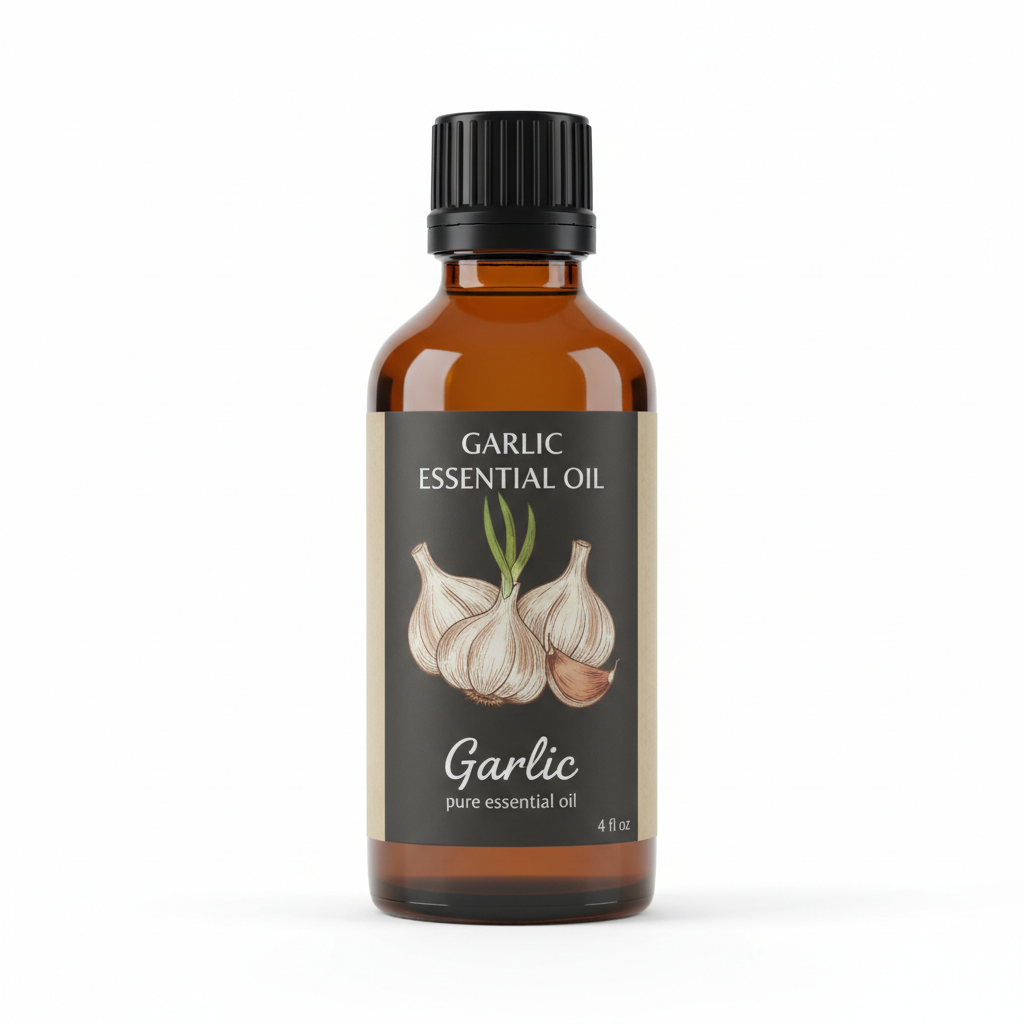
Garlic Essential Oil
Our own Garlic Essential Oil, in sizes from 0.5 oz to bulk.
From $10.99
Shop Now →The chemistry starts with the cut
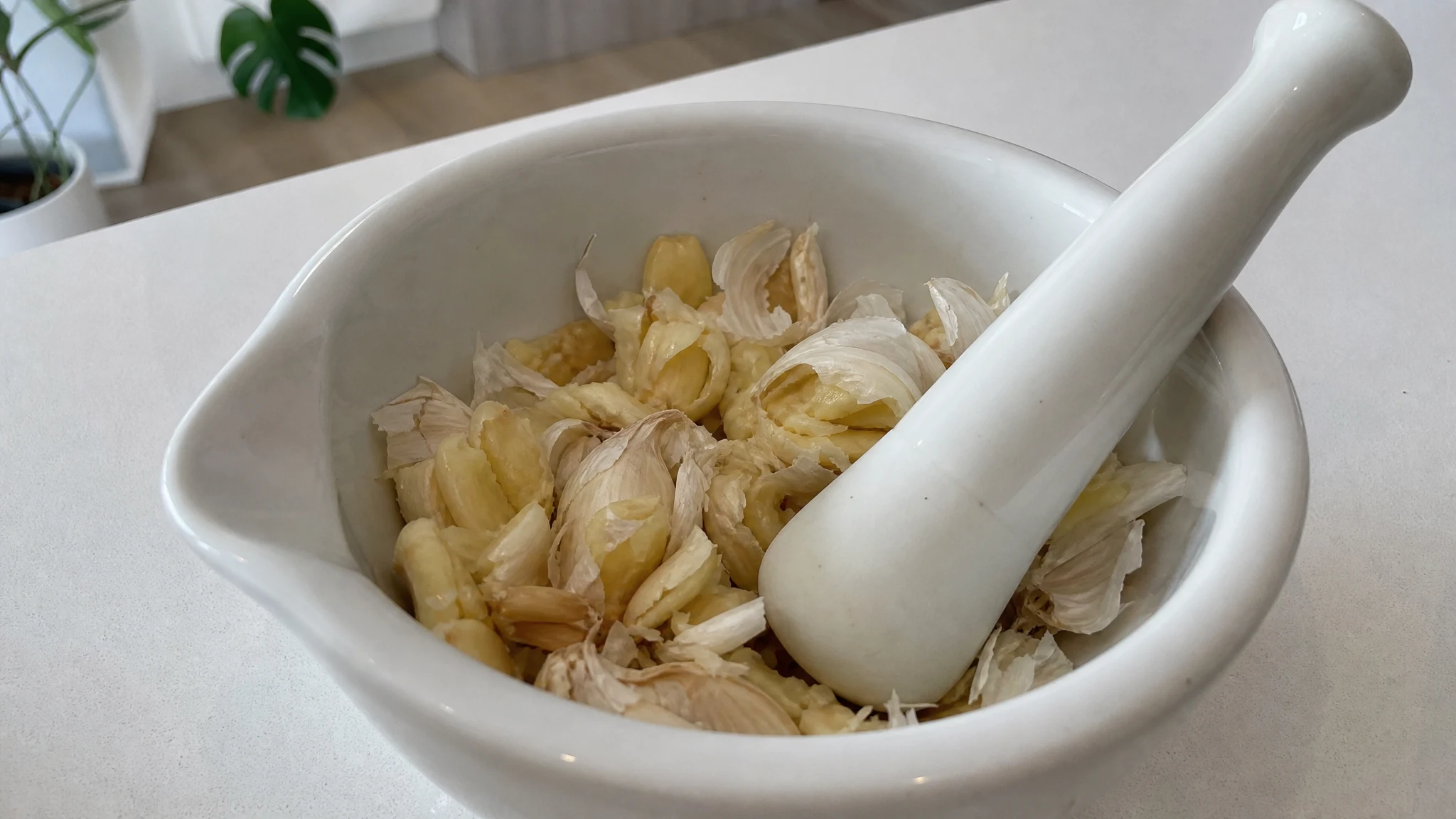
An intact clove holds a precursor called alliin and, kept apart from it, an enzyme called alliinase. Cutting or crushing lets them meet, and the result is allicin, which a review of the garlic literature calls "the major garlic thiosulfinate." Allicin does not stay put: it "is unstable and breaks down further to ajoene, vinyldithiins, and sulfides," including diallyl sulfide, disulfide and trisulfide. Heat denatures the enzyme, so the order matters, with the enzyme getting its work done before the heat arrives (Nicastro, Ross and Milner, Cancer Prevention Research, 2015).
That is why the oil in the bottle is not "bottled allicin," a common assumption. It is a blend of the sulfides that crushing and heating produce.
What the still does
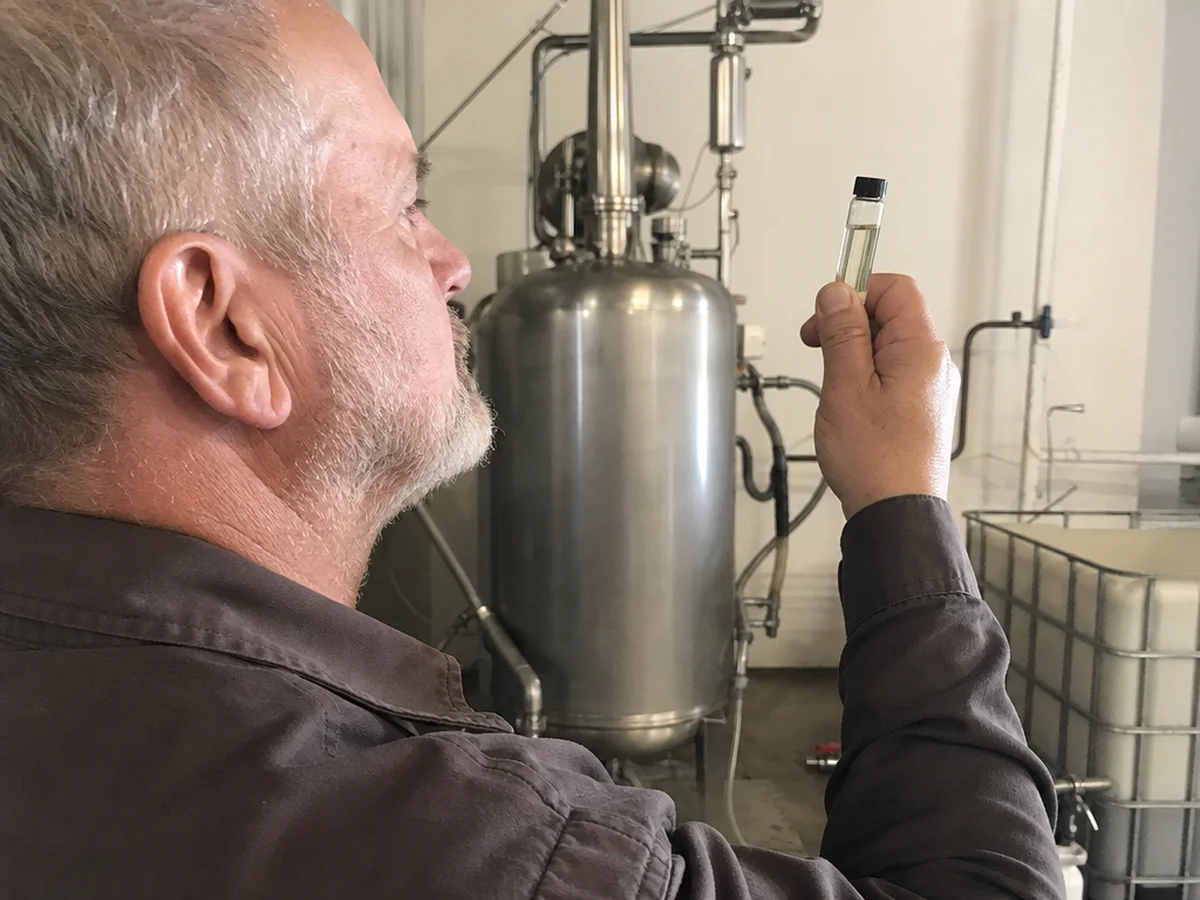
The clearest published comparison distilled the same chopped bulbs three ways. The garlic came from Las Pedroñeras in Spain, harvested in December 2015, and the study ran a laboratory hydrodistillation (boiling the material in water) and industrial hydrodistillation and steam distillation (passing steam through it) (Satyal et al., Foods, 2017).
| Method | Time | Yield | Leading compounds |
|---|---|---|---|
| Laboratory hydrodistillation | 3 h | 0.2% | Diallyl trisulfide 33.4%, diallyl disulfide 20.8% |
| Industrial hydrodistillation | 4 h | 0.22% | Diallyl trisulfide 31.2%, diallyl disulfide 25.9% |
| Industrial steam distillation | 5 h | 0.18% | Diallyl disulfide 27.9%, allyl methyl trisulfide 17.7%, diallyl trisulfide 16.8% |
Two things are worth taking from this. First, the method shifts the balance: steam-distilled oil had roughly half the diallyl trisulfide of the hydrodistilled oils, and allicin itself showed up only as a trace in the hydrodistilled samples and not at all in the steam-distilled one. Second, this is one origin, one harvest and three runs, so a different garlic or a different still would move every number. Treat the percentages as an illustration of how the process behaves, not as a standard a bottle should meet.
Anyone who has chopped a head of garlic knows how long the smell hangs around. It gets onto the board, the knife, your fingers and sometimes into the rest of the kitchen. Now imagine the same chemistry concentrated and caught in a small glass bottle. That, more or less, is why garlic oil is such a vivid material to work with, and why the people who handle it learn to respect a drop.
Why one drop goes so far
Yields of 0.18% to 0.22% mean about 1.8 to 2.2 g of oil from every kilogram of bulbs, our arithmetic from the percentages. The Certificate of Analysis we publish for one batch gives a relative density of 1.075, so a milliliter weighs about 1.075 g and takes roughly 490 to 600 g of garlic at those yields. One US fluid ounce, about 31.8 g, corresponds to around 17.7 kg of bulbs at the steam-distillation figure. That concentration is why we describe a single drop as carrying the character of many cloves, and why it is always measured sparingly. Our dilution article turns that into practical numbers.
We describe our oil in the shop as steam-distilled from crushed bulbs, sold undiluted with no additives or fillers, in amber glass. The certificate gives density and refractive index; those readings confirm the oil sits in its expected physical range, though they cannot tell you which sulfides are present or which method made a bottle. If a sulfide profile or provenance matters to you, ask us in writing through the contact page, and see reading a label and lot report for good questions to put to any seller. For larger quantities, our bulk page and guide to buying garlic oil in bulk explain what to check.
When you open a bottle of garlic oil, a few things are worth noticing. The color leans toward yellow to amber, and the liquid is thin and mobile rather than syrupy. The smell is pungent and savory with a deep sulfurous backbone, and it is quite different from the sweet, mellow smell of roasted garlic. A single sniff from a safe distance tells you everything you need to know, and then it is best to cap the bottle again.
Other routes to garlic oil
Steam is not the only way. A 2020 Vietnamese study compared hexane extraction, steam distillation and supercritical carbon dioxide on garlic. Yields came out around 0.441%, 0.124% and 0.465%, and the abstract reports that the carbon dioxide oil had higher antioxidant activity in a laboratory assay (Nguyen et al., VNU Journal of Science: Medical and Pharmaceutical Sciences, 2020). That is a lab measurement on an oil, not a statement about skin or aroma, and the steam yield of 0.124% against Spain's 0.18% shows how much results vary between studies. Our steam versus CO2 comparison goes further.
A note on home stills
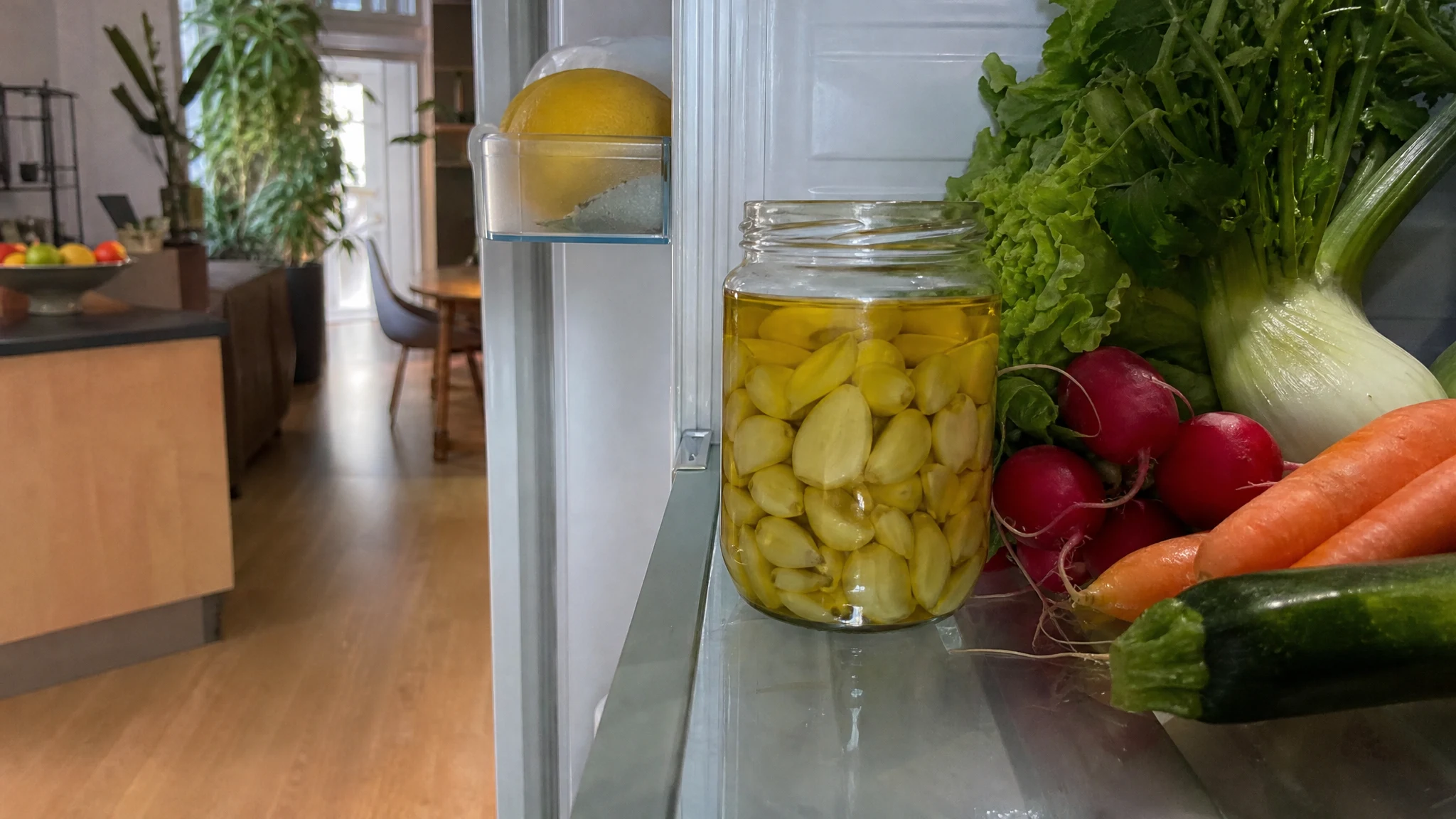
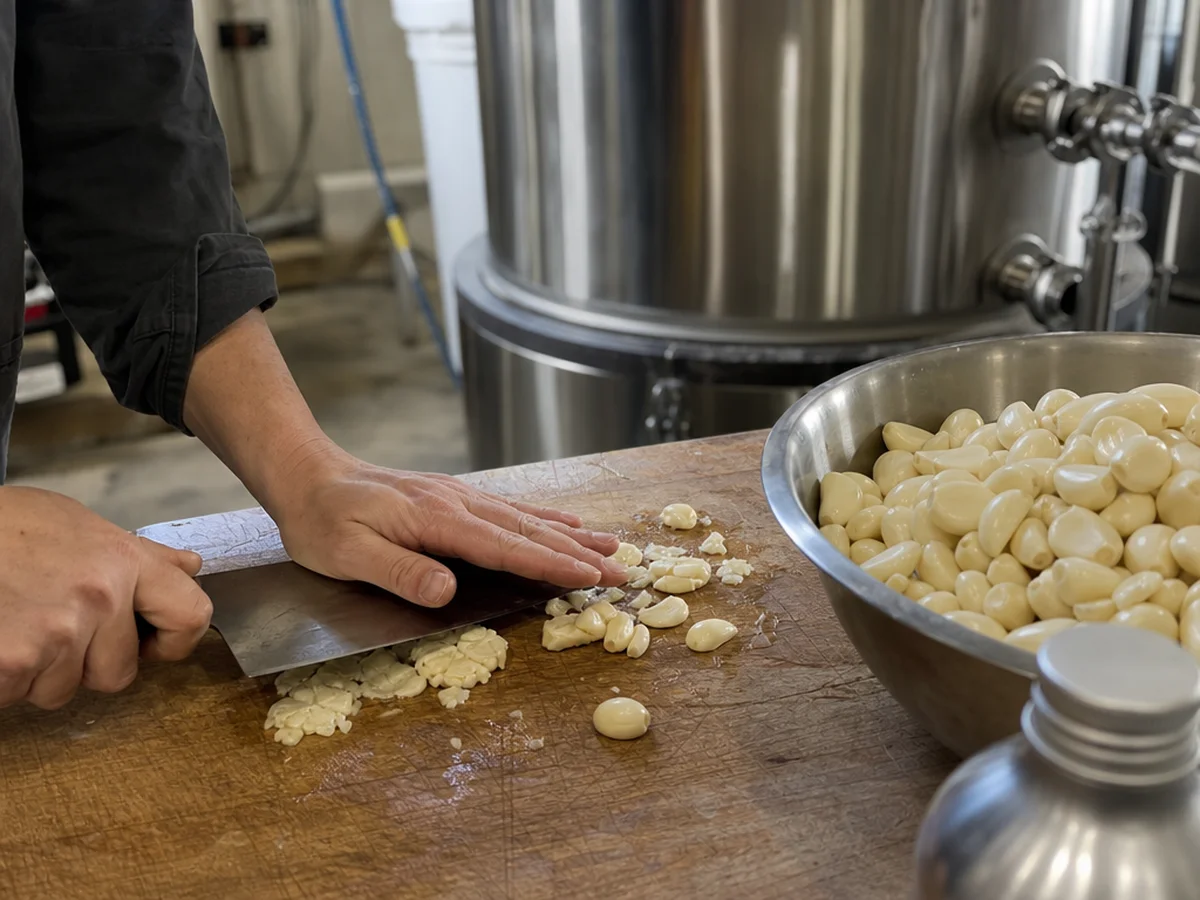
Home distillation is a tempting idea, but the numbers are discouraging. At 0.18%, a gram of oil takes about 555 g of bulbs, so a kitchen-scale run yields a few drops from a great deal of garlic, and a still running for hours would fill the room with the same sulfides that cling to skin and cloth. If what you want is garlic flavor at home, cook with garlic itself and follow the CDC's refrigeration rule for any garlic in oil; our infused oil comparison explains why that is a separate subject.
For more on why the sulfides smell as they do, see the allicin and sulfur article, and for terms like relative density, the glossary.
Garlic Essential Oil
Garlic Essential Oil from our own shop, in sizes from 0.5 oz to bulk.
From $10.99
Shop Now →Sources & Further Reading
- Nicastro HL, Ross SA, Milner JA, 2015. Garlic and onions: their cancer prevention properties. Cancer Prev Res 8(3):181-189. pmc.ncbi.nlm.nih.gov/PMC4366009
- Satyal P, Craft JD, Dosoky NS, Setzer WN, 2017. The chemical compositions of the volatile oils of garlic (Allium sativum) and wild garlic (Allium vineale). Foods 6(8):63. pmc.ncbi.nlm.nih.gov/PMC5575638
- Nguyen Van Khanh, Do Thi Nhai, Bui Thanh Tung, Nguyen Thanh Hai, 2020. Effect of extraction procedures on physicochemical properties of garlic essential oil. VNU J Sci Med Pharm Sci 36(3). js.vnu.edu.vn/MPS/article/4213
- CDC. Botulism prevention. cdc.gov/botulism/prevention