Garlic Oil Glossary: Terms You'll See on Labels
Garlic oil comes with a vocabulary, and some of it gets used loosely. Here are the terms you are most likely to meet, grouped by where you will run into them, with a line on why each one matters when you are choosing or handling an oil.
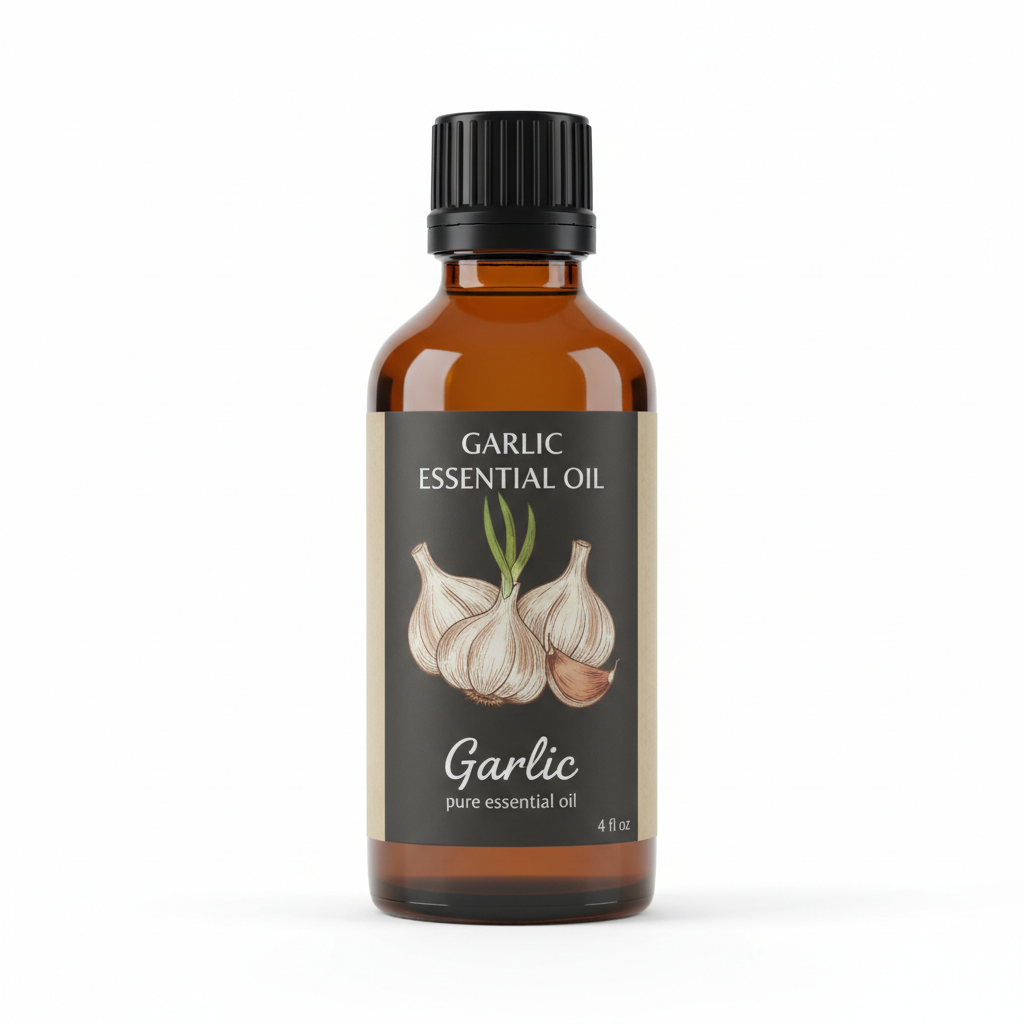
Garlic Essential Oil
Our own Garlic Essential Oil, in sizes from 0.5 oz to bulk.
From $10.99
Shop Now →Where the smell comes from
Alliin and alliinase. Alliin is a sulfur-containing compound stored in intact garlic, and alliinase is the enzyme that acts on it once the clove is damaged (Borlinghaus et al., 2014). The takeaway is that garlic's smell is not stored ready-made. It is created when you crush a clove. Our smell chemistry article tells the whole story.
Allicin. The reactive compound that forms when alliinase meets alliin, described in the same review as having low thermal stability. A steam-distilled oil is not an allicin product: one 2017 study did not detect allicin in an industrial steam-distilled garlic oil (Satyal et al., 2017). A label that sells an oil on its allicin content deserves a question.
Diallyl disulfide and diallyl trisulfide. Sulfur compounds with two and three sulfur atoms linked to allyl groups, and typical leaders in a garlic oil's makeup. In that same study, the industrial steam-distilled oil had 27.9% disulfide and 16.8% trisulfide. Those figures describe one sample, and they shift with the garlic and the method.
How an oil is made and named
Essential oil. The aromatic fraction of a plant, recovered by distillation or a similar process. Our product page describes our oil as steam-distilled from crushed bulbs and sold undiluted.
Steam distillation and hydrodistillation. In steam distillation, steam passes through the plant material. In hydrodistillation, the material is boiled in water. The garlic study found the two give somewhat different profiles from the same bulbs, which is one reason two seller reports may not match.
CO2 extract. An oil made with pressurized carbon dioxide instead of steam. One Vietnamese study reported yields of 0.465% for CO2 against 0.124% for steam distillation from garlic (Nguyen et al., 2020). That is a different product, and our steam versus CO2 comparison looks at it.
Infused oil. Garlic steeped in a cooking oil. It is a food, not a distillate. We compare the two in our essential oil versus infused oil article.
INCI name. The standard cosmetic ingredient name, which for garlic oil is Allium Sativum Bulb Oil (Cosmile Europe).
Words on a certificate
COA (certificate of analysis) and batch. A report of tests on a named batch. The certificate we publish is for batch GARFBCUNUSC003A, and it records appearance, smell, relative density and refractive index. Our certificate reading guide goes through it, and you can ask us in writing for a report for your own lot.
Relative density. How heavy the oil is compared with the same volume of water at a stated temperature. Our certificate gives 1.075 at 20 C, so a milliliter weighs about 1.075 g. A half ounce bottle (14.79 ml) therefore holds about 15.9 g.
Refractive index. How much light bends passing through the oil. Ours is 1.566 at 20 C. Together with density, it is a quick check that an oil sits where it should. The European Pharmacopoeia recommends both for essential oils (Szambora and Paradowska, 2026).
GC-MS. Gas chromatography with mass spectrometry. It separates the volatile compounds in a sample and identifies each one, producing a compound list. The same review calls it the gold standard for volatiles, and it is the test to request when you want a full profile.
Words from the perfumer's bench
Base note. A perfumer's word for a scent that arrives slowly and stays the longest. Our product page lists garlic as a base note, which fits an aroma that is still there long after you have put the bottle away.
Blotter strip. A strip of absorbent paper used to smell an oil without putting it on skin. One drop, a ventilated room and a little patience will teach you more about an oil than a description will.
Undiluted. Sold as it comes from the still, with nothing added to thin it. Our oil is sold undiluted, which is exactly why a drop goes so far and why we talk about dilution so much.
Decanting. Pouring a working amount into a smaller airtight bottle so you are not opening the main bottle again and again. Label the small bottle clearly.
Best by date. The date a maker gives for a batch. It is worth reading on any certificate and worth keeping next to the lot number in your notes.
Handling words
Carrier oil and dilution. A carrier is a fixed oil, such as a vegetable oil, used to dilute an essential oil. Dilution is the essential oil's share of the finished blend. Our guidance for skin is 0.5% to 2% with a patch test first, starting at the low end. The Tisserand Institute lists about 0.5% to 1.2% for the face and 1% to 3% for body products, and its figures are general rather than garlic specific (Tisserand Institute, dilution). At 20 drops per milliliter, a rough convention, 0.5% in 30 ml is about three drops. Our carrier oil guide has more.
Patch test. Trying a small amount of the diluted blend on a small patch of skin before wider use. NCCIH notes that fresh raw garlic can cause severe skin irritation and chemical burns, which is a good reason to take this step seriously (NCCIH, Garlic). A physician or dermatologist can give you a protocol that fits your skin.
A glossary is only useful if you come back to it. Pick two or three terms that confused you, write your own one-line definitions in your own words, and keep them next to your lot numbers. Language that you have put into your own sentences is language you will remember the next time a label throws something unfamiliar at you.
If a term on a listing is not here, ask the seller to define it. A good seller will be glad you did.
Garlic Essential Oil
Garlic Essential Oil from our own shop, in sizes from 0.5 oz to bulk.
From $10.99
Shop Now →Sources & Further Reading
- Borlinghaus J, Albrecht F, Gruhlke MC, Nwachukwu ID, Slusarenko AJ. Allicin: chemistry and biological properties. Molecules 2014. pmc.ncbi.nlm.nih.gov/articles/PMC6271412
- Satyal P, Craft JD, Dosoky NS, Setzer WN. The chemical compositions of the volatile oils of garlic (Allium sativum) and wild garlic (Allium vineale). Foods 2017;6(8):63. pmc.ncbi.nlm.nih.gov/articles/PMC5575638
- Nguyen Van Khanh et al. The effect of different extraction procedures on antioxidant activity of garlic (Allium sativum L.) essential oil. VNU Journal of Science: Medical and Pharmaceutical Sciences 2020;36(3). js.vnu.edu.vn/MPS/article/view/4213
- Cosmile Europe. Allium Sativum Bulb Oil. cosmileeurope.eu
- Szambora O, Paradowska K. Problems and challenges in the detection of essential oil adulteration: a review of current analytical methods. Prospects in Pharmaceutical Sciences, 2026. prospects.wum.edu.pl
- Tisserand Institute. Dilution guide. tisserandinstitute.org/safety/dilution
- NCCIH. Garlic. nccih.nih.gov/health/garlic